

The Sleep Economy: How Your 8 Hours Became Tech's Final Frontier
Sleep is no longer rest; it's a performance metric. An analysis of the multi-billion dollar 'Sleep Economy' and how tech is optimizing our unconscious hours.
The Sleep Economy: How Your 8 Hours Became Tech's Final Frontier
The Lede
While consumer gift guides are highlighting sleep gadgets like the Oura Ring and Manta Mask, the executive-level takeaway is far more significant. We are witnessing the maturation of the 'Sleep Economy'—a multi-billion dollar market where rest is no longer a passive state but an active, quantifiable performance metric. This isn't about selling novelty gadgets; it's about selling a competitive edge, with sleep as the new, untapped platform for human optimization. For leaders, this signals a fundamental shift in both consumer behavior and the corporate wellness landscape.
Why It Matters
The transition from analog sleep aids (melatonin sprays, basic sound machines) to sophisticated digital ecosystems represents a massive value unlock. The global sleep aids market is projected to surpass $100 billion by 2030. The implications extend far beyond direct-to-consumer sales:
- Corporate Impact: Companies are moving beyond gym memberships to integrated wellness platforms. A workforce equipped with sleep trackers provides anonymized data on burnout and productivity, creating a new battleground for enterprise health solutions.
- Insurance & Healthcare: Payers and providers see a future where data from devices like the Oura Ring can be used to underwrite risk or prescribe preventative 'sleep hygiene' protocols, shifting costs from reactive treatment to proactive care.
- Data as a Moat: The real product isn't the ring or the mask; it's the longitudinal data on user health. Companies that capture this data own the customer relationship and can expand into adjacent wellness verticals, from nutrition to mental health.
The Analysis
The sleep market has evolved through three distinct phases. Initially, it was dominated by Phase 1: Analog Interventions—pharmaceuticals, supplements like melatonin, and low-tech hardware like earplugs. The goal was simply to induce sleep.
We then entered Phase 2: Passive Tracking, led by early Fitbits and smartphone apps. This phase introduced the 'quantified self' to the bedroom, allowing users to see their sleep patterns for the first time. However, the data was often imprecise and lacked actionable insights.
We are now firmly in Phase 3: Active Optimization & Ecosystems. This is where today's market leaders operate. An Oura Ring isn't just a tracker; it's a data-driven coach that provides a daily 'Readiness Score.' It competes not with other rings, but with Apple Watch, Whoop, and Google's health ambitions. These players are building ecosystems that integrate hardware, software, and subscription-based analytics. They've successfully reframed sleep not as a luxury, but as a core pillar of performance, akin to diet and exercise.
PRISM Insight
The next frontier is the 'closed-loop' system, or Phase 4: Automated Intervention. This is where the true disruption lies and where investment should be focused. Imagine a wearable detecting a user is entering a poor-quality deep sleep stage. It then communicates with a smart mattress (like Eight Sleep) to adjust the temperature, triggers a smart speaker to modify the ambient soundscape, and signals smart blinds to block out nascent morning light. This integrated, AI-driven environment that automatically optimizes sleep in real-time without user input is the ultimate endgame. The key battle will not be over the best single device, but over the platform that can seamlessly orchestrate this ecosystem of interventions.
PRISM's Take
Viewing products like the Oura Ring as mere 'sleep gifts' misses the forest for the trees. They are beachheads in a strategic push to colonize the 8 hours of our lives that have, until now, remained largely unmonetized and unoptimized. The 'attention economy' fought for our waking hours; the 'restoration economy' is now fighting for our unconscious ones. The companies that win will not be those who sell the most gadgets, but those who successfully sell a quantifiable improvement in human potential. For individuals, this is about peak performance. For enterprise, it's the next frontier of productivity. And for investors, it's one of the most compelling, and personal, tech trends of the decade.
Related Articles
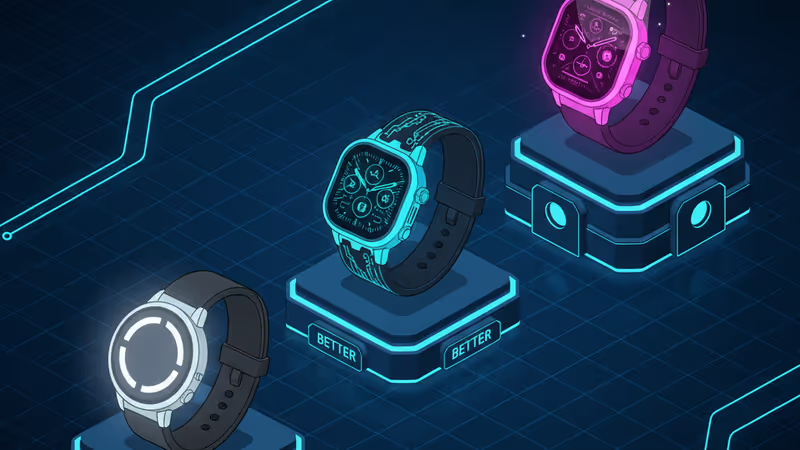
Our expert analysis reveals Apple's new 'Good, Better, Best' Watch strategy. Learn why the SE is now the most important model and what it means for you.
Apple's three-watch lineup isn't about choice—it's a strategic masterclass in market domination. Discover the real playbook behind the SE, Series, and Ultra.

Free public Wi-Fi isn't a utility; it's a transaction. PRISM analyzes the hidden security risks and why treating every connection as hostile is the new standard.

LG and Samsung are set for a 2026 TV showdown with new MicroLED and RGB LED tech. This isn't just an upgrade; it's a race for perfect color that will redefine the market.