
The Apple Watch Matrix: Why Apple's New 'Good, Better, Best' Strategy Changes Everything
Our expert analysis reveals Apple's new 'Good, Better, Best' Watch strategy. Learn why the SE is now the most important model and what it means for you.
The Lede: The Standard Apple Watch Is Being Squeezed Out
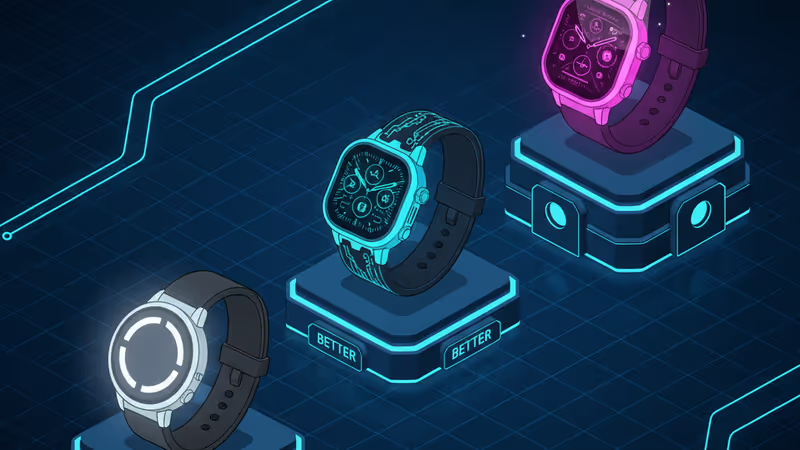
This year's Apple Watch lineup isn't a story about incremental upgrades; it's a public declaration of a new, aggressive market strategy. By making the entry-level Watch SE 3 shockingly powerful, Apple is deliberately hollowing out the value proposition of its standard 'Series' model. The company has perfected its 'Good, Better, Best' playbook, previously mastered with the iPhone, and is now deploying it to cement its dominance in wearables. The key takeaway for executives, consumers, and investors isn't what's new in the high-end Ultra, but how the SE has been elevated to become the new center of gravity for the entire product category.
Why It Matters: From Product to Platform
For years, the Apple Watch lineup felt like a simple progression of features. This year marks a definitive shift. The lineup is no longer a linear path but a calculated three-pronged assault to capture every possible consumer demographic. The second-order effect is that the standard Apple Watch Series 11 is now caught in a strategic vise. It's no longer the clear choice for the average user (a role the SE 3 now claims) and lacks the aspirational power of the Ultra. This forces the Series model into a new, narrower role as a specialized health device, a move that simultaneously elevates Apple's healthcare ambitions while making the purchase decision much clearer for the mass market.
The Analysis: Deconstructing Apple's Wearable Gambit
The 'iPhone Playbook' Comes to the Wrist
What we're witnessing is a direct parallel to the iPhone's market segmentation. The Apple Watch has finally matured to this stage:
- The SE 3 (The 'iPhone SE'): Once a heavily compromised entry point, it now possesses features that were premium just two years ago, like an always-on display and the powerful S10 chip. It is the new volume driver, designed to onboard new users and offer a compelling upgrade for those on older models without forcing them up the price ladder.
- The Series 11 (The 'Standard iPhone'): This is now a niche product. Its primary differentiators—ECG, afib history, and new hypertension notifications—are critical for users with specific health concerns but are arguably overkill for the general population. Its position is becoming less tenable as the SE's feature set expands.
- The Ultra 3 (The 'iPhone Pro'): The halo product. It's defined by hardware superiority (durability, battery, screen brightness) and exclusive features (Action Button, satellite connectivity) that command a premium price, catering to athletes, outdoor enthusiasts, and the tech-savvy crowd seeking the absolute best.
Health as a Competitive Moat—And a Potential Liability
Apple's strategy increasingly leans on FDA-cleared health features to justify the Series and Ultra models. Getting clearance for hypertension notifications, for instance, is not a simple software update; it's a regulatory barrier that competitors like Google and Samsung will find difficult and time-consuming to replicate. This transforms the watch from a wellness gadget into a serious health monitoring tool, creating immense ecosystem stickiness.
However, this strategy is not without risk. The ongoing patent dispute with Masimo over the blood oxygen sensor is a critical reminder of this. While the feature was restored via a software workaround, the legal battle underscores a key vulnerability: as Apple pushes deeper into regulated medical technology, it exposes itself to greater legal and regulatory scrutiny that could disrupt its product roadmap.
PRISM Insight: Your Actionable Guide
For Consumers: The Upgrade Calculus Has Changed
The annual upgrade is officially dead for most Apple Watch users. Our guidance is clear:
- If you own a Series 7, 8, 9, 10 or Ultra 1/2: Stand pat. This year's upgrades are marginal and do not warrant a new purchase unless you have a specific need for the Ultra 3's satellite connectivity.
- If you own a Series 6 or older: Your upgrade path is the Apple Watch SE 3. It offers the most significant performance and feature leap for the price, delivering a near-Series experience for $150 less.
- Who should buy the Series 11? Only individuals who require FDA-cleared afib history or hypertension monitoring but do not want the bulk and expense of the Ultra. This is now a specialized health device, not the default choice.
For Investors: Look Beyond Unit Sales
The maturation of the Apple Watch lineup signals a new phase of monetization. The strategy is no longer just about selling hardware; it's about deepening the user's dependence on the Apple Health ecosystem. With a robust, segmented hardware base, Apple is perfectly positioned to layer on future health-related subscription services. The watch is the data-collection endpoint for what could become a significant recurring revenue stream, making it one of the most strategically important products in Apple's portfolio.
PRISM's Take
Apple has successfully completed the transformation of the Apple Watch from a singular, aspirational gadget into a dominant, multi-tiered platform. The era of the revolutionary annual hardware leap is over, replaced by a sophisticated strategy of market segmentation. The real story of this generation is not a minor battery bump on the high end, but the empowerment of the entry-level SE. By making its most affordable watch so compelling, Apple is not just defending its market share; it's aggressively expanding its user base and laying the groundwork for its next major frontier: personal health and digital wellness. The standard Series watch may be the first casualty of this new strategy, but for Apple, it's a calculated sacrifice to win the larger war.
Related Articles

Apple is quietly transforming AirPods from an audio accessory into a powerful health and AI platform. Discover the strategy that redefines wearables.
Apple's new Watch lineup isn't an iterative update; it's a strategic pivot. Discover why the entry-level SE is now the most important smartwatch Apple sells.
Apple's new AirPods are more than just earbuds. Discover our expert analysis on how they're becoming a platform for health, AI, and ambient computing.
Apple's new Watch lineup isn't an upgrade, it's a strategic sacrifice. Discover why the 'entry-level' SE is now the default choice, and what it means for the future of wearables.