
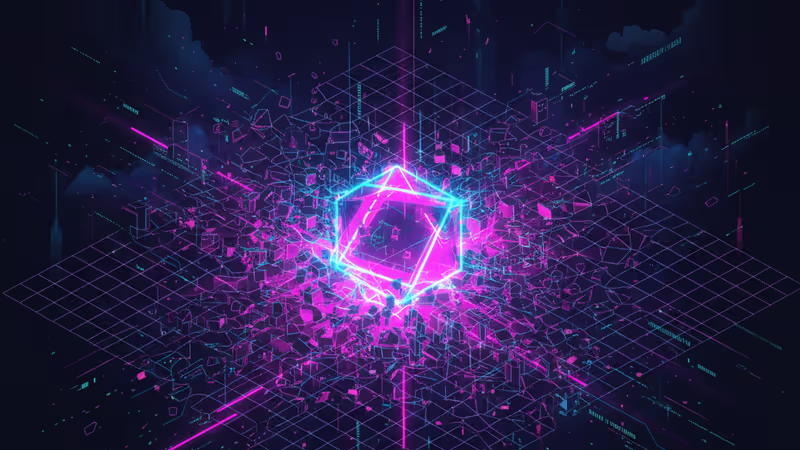
The Simulation Is Dead: Why Gödel's Theorem Torpedoes the Tech Elite's Favorite Theory
A new proof using Gödel's incompleteness theorem argues our universe can't be a simulation. PRISM analyzes the deep implications for AGI, AI, and investment.
The Lede: Beyond the Dorm Room Debate
For leaders betting billions on the future of artificial intelligence, the Simulation Hypothesis has been more than a philosophical curiosity; it's a foundational, albeit tacit, belief that reality is ultimately computable. A new mathematical argument, leveraging a century-old theorem, doesn't just question this—it attempts to kill it. This isn't about whether we're living in an advanced video game. This is a direct challenge to the core assumption that consciousness and the universe itself can be replicated by an algorithm, with profound implications for the AGI race.
Why It Matters: Cracks in the Computational Foundation
The notion that our universe is a simulation, popularized by figures like Elon Musk and thinkers like Nick Bostrom, has implicitly guided a specific vision of technological progress. If the universe is code, then consciousness is just a sufficiently complex subroutine. The goal, then, is to write that code. This new paper rips that roadmap to shreds.
- The AGI Wall: If reality possesses a "non-algorithmic" quality, as the physicists argue, then simply scaling up current AI architectures (like LLMs) will never lead to true, human-like understanding. We may be building incredibly sophisticated mimics, but they could hit a hard, theoretical ceiling, unable to cross the chasm into genuine consciousness.
- Rethinking Computing: This elevates the importance of non-traditional computing paradigms. If our universe isn't a classical computer, maybe the keys to understanding it lie in quantum or neuromorphic systems, which operate on principles fundamentally different from binary logic.
- A New Philosophical North Star: It forces the tech world to confront a more complex and potentially less controllable reality. It shifts the ultimate question from "Can we build God?" to "What are the fundamental, non-replicable properties of intelligence?"
The Analysis: From Bostrom's Trilemma to Gödel's Ghost
For two decades, the intellectual framework for the simulation debate has been Nick Bostrom's 2003 paper. It presented a trilemma: either civilizations go extinct before reaching a 'posthuman' stage, they lose interest in running simulations, or we are almost certainly living in one. This created a statistical argument that was compellingly simple.
Enter Kurt Gödel. His 1931 incompleteness theorems are one of the pillars of modern logic. In essence, they state that in any sufficiently complex formal system (like mathematics), there will always be true statements that cannot be proven within that system. It's a mathematical proof of inherent logical limits.
The new research, led by Dr. Mir Faizal, brilliantly applies this concept to the universe itself. They argue that a simulated reality would be a finite, formal system of rules (code). Gödel's theorem would therefore apply. However, our own ability to comprehend concepts like infinity and to reason about the system itself (i.e., to perform science and philosophy) represents a form of "non-algorithmic understanding." This type of understanding, they claim, is precisely the kind of 'unprovable truth' Gödel predicted—something a purely algorithmic system could not generate about itself. In short, our consciousness can step outside the system in a way a simulated being could not.
PRISM Insight: The 'Non-Algorithmic' Investment Thesis
The strategic takeaway is to diversify your AI investment portfolio beyond pure computational scale. The "bigger is better" LLM race might be a race towards a local maximum, not the final peak.
Investors should be tracking and placing bets on firms exploring the fringes, as they may hold the keys to the next paradigm:
- Neuromorphic Computing: Companies like Intel (Loihi) and BrainChip are building hardware that structurally mimics the human brain, focusing on energy efficiency and event-based processing, not just raw teraflops. This aligns with a model where intelligence is an emergent property of structure, not just computation.
- Quantum AI: While nascent, the exploration of how quantum phenomena could power AI is crucial. Quantum mechanics is inherently non-deterministic and could be the physical substrate for the "non-algorithmic" processes the paper describes.
- Interdisciplinary AI Labs: Look for research groups and startups that aren't just computer scientists. Teams that integrate cognitive neuroscientists, theoretical physicists, and philosophers are more likely to break from purely computational dogma and stumble upon the next breakthrough.
PRISM's Take: The Universe Is Messier—and More Interesting—Than Code
While this mathematical argument is not a lab-verified experiment, its intellectual power is immense. It serves as a vital counter-narrative to the simplistic, mechanistic worldview that has dominated Silicon Valley. The universe isn't clean, elegant code. It's a sprawling, self-referential, and quite possibly non-computable entity.
This is not a setback; it's an upgrade. It suggests that human consciousness isn't just a complex algorithm waiting to be replicated and surpassed. It may be a fundamentally different class of phenomenon. The future of technology, therefore, lies not in simply recreating ourselves in silicon, but in building tools that augment and collaborate with the unique, non-algorithmic power of the human mind. The most valuable reality is the one we're in, and its secrets are far from being fully compiled.
Related Articles
OpenAI's FrontierScience benchmark signals a strategic pivot from chatbots to automating scientific discovery. A deep dive into why this changes the game for R&D and tech investors.
OpenAI's GPT-5.2 isn't just another upgrade. Its mastery of math and science signals a fundamental shift from creative AI to a new era of automated discovery.
OpenAI's GPT-5.2 isn't just another upgrade. Its mastery of math and science signals a fundamental shift from creative AI to a new era of automated discovery.
Riot Games' new BIOS update requirement for Valorant marks a major escalation in the anti-cheat war, blurring the line between gaming and system-level security.