
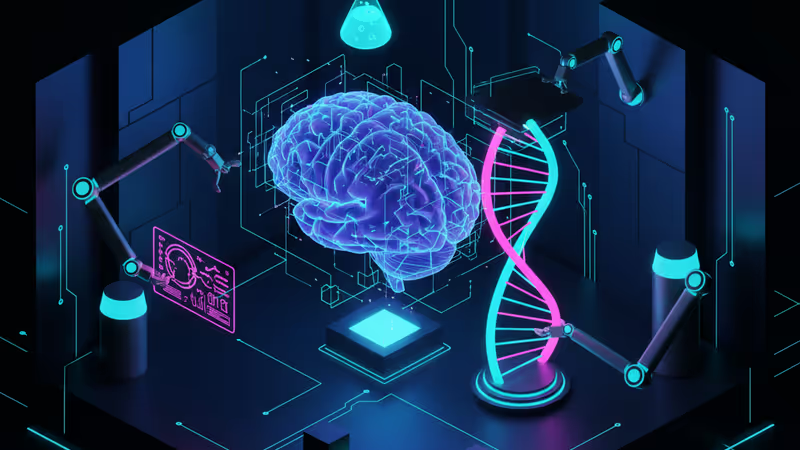
OpenAI's GPT-5.2 Just Turned AI into a Scientist. This Changes Everything.
OpenAI's GPT-5.2 isn't just another upgrade. Its mastery of math and science signals a fundamental shift from creative AI to a new era of automated discovery.
The Lede: AI Graduates from Creative Intern to Principal Investigator
OpenAI’s new GPT-5.2 model isn't just another incremental update—it's a categorical leap. By conquering complex math and science benchmarks and reportedly solving an open theoretical problem, it signals AI's transition from a tool of linguistic and creative assistance to one of fundamental scientific discovery. For executives and investors, the key takeaway is this: the AI that helped your team write marketing copy is now poised to revolutionize your R&D lab, a shift that will redefine competitive advantage for the next decade.
Why It Matters: The Economic Moat Shifts from Data to Discovery
For the past few years, the AI race has been largely defined by creative and communicative prowess. GPT-5.2’s scientific reasoning capabilities fundamentally alter the landscape. The most valuable AI is no longer just the one that can chat most eloquently, but the one that can think most rigorously.
- The New Competitive Arena: This move pressures rivals like Google's DeepMind and Anthropic to demonstrate tangible, scientific problem-solving abilities, not just linguistic fluency. The battleground is shifting from chatbots to computational discovery platforms.
- Second-Order Effects: The implications are vast. We're looking at the potential for accelerated drug discovery, the design of novel materials, optimization of complex financial models, and even breakthroughs in pure mathematics, all driven by AI co-pilots. This democratizes high-level R&D, but also introduces new systemic risks in fields like cryptography and materials science.
The Analysis: Beyond Stochastic Parrots
From Language Games to Foundational Logic
Previous generations of Large Language Models (LLMs), including the formidable GPT-4, were often rightly criticized for their brittleness in logic and mathematics. They were sophisticated pattern matchers—'stochastic parrots'—that could generate plausible-sounding text but would often fail at multi-step reasoning. Their errors in basic algebra were a common 'gotcha' for skeptics. The reported ability of GPT-5.2 to generate reliable mathematical proofs and achieve state-of-the-art results on benchmarks like GPQA Diamond (which tests graduate-level physics, biology, and chemistry questions) indicates a crossing of a critical threshold from pattern recognition to genuine problem-solving.
The Arms Race for a 'Reasoning Engine'
Benchmarks are the new battleground. While consumer-facing applications capture headlines, dominance on academic and scientific benchmarks like FrontierMath is where the long-term strategic value is being built. Solving an *open theoretical problem*—something no human has previously solved—is the ultimate proof point. This isn't just about passing an exam; it's about creating net-new knowledge. This capability turns an LLM into a reasoning engine, a far more valuable asset than a text generator. We anticipate Google will respond aggressively, leveraging its deep roots in scientific research via DeepMind (the creators of AlphaFold) to showcase its own models' reasoning capabilities, setting the stage for a clash of titans over who can build the most powerful 'AI scientist'.
PRISM Insight: The Trillion-Dollar R&D Market is Now in Play
Investment & Market Impact
The total addressable market for AI just expanded dramatically. It's no longer just about software, advertising, or workflow automation. GPT-5.2’s capabilities put the multi-trillion-dollar global R&D sector directly in play. Any industry that relies on scientific innovation—pharmaceuticals, semiconductors, aerospace, energy—must now consider its 'AI reasoning' strategy. We expect a surge in investment in two areas:
- Vertical AI Solutions: Startups that fine-tune models like GPT-5.2 on proprietary scientific data (e.g., genomic, molecular, or materials data) to create specialized 'AI researchers' for specific industries.
- Infrastructure and Validation: Companies that build the platforms to manage, verify, and deploy these high-stakes reasoning models, as ensuring the reliability of an AI-generated proof is infinitely more critical than fixing a marketing email.
Business & Enterprise Implications
For business leaders, the question evolves from "How can AI make my existing processes more efficient?" to "How can AI create entirely new products, materials, or solutions?" This is a strategic pivot from using AI for optimization to using it for origination. The most forward-thinking enterprises will begin building small, elite teams of scientists and engineers tasked with collaborating with these new AI reasoning platforms to tackle their most intractable R&D challenges. The ROI is no longer measured in saved man-hours, but in patents, discoveries, and market-defining breakthroughs.
PRISM's Take
GPT-5.2 marks the end of AI's apprenticeship. While the world was mesmerized by AI's ability to write poems and create images, the real revolution was brewing in its capacity for logical, scientific reasoning. This development is not merely an incremental improvement; it is a phase change. The focus of the entire industry will now pivot from AIs that can *communicate* to AIs that can *discover*. The companies and nations that master this new class of 'AI scientist' will not just lead the tech industry; they will lead the 21st century.
Related Articles

BNY is arming 20,000 employees with OpenAI. This isn't just about efficiency—it's a new blueprint for enterprise AI that will create a new class of winners and losers.

Chai Discovery's $130M raise at a $1.3B valuation isn't about a single drug. It's a strategic move by OpenAI's ecosystem to build the dominant AI platform for biotech.
OpenAI's quiet GPT-5.2 update is a strategic signal. Our analysis reveals why this shift from hype to stability marks a new, more mature era for the AI industry.

OpenAI's comms chief Hannah Wong is leaving. Her exit signals a major strategic shift from crisis management to corporate maturity. Here's what it means for the AI industry.