
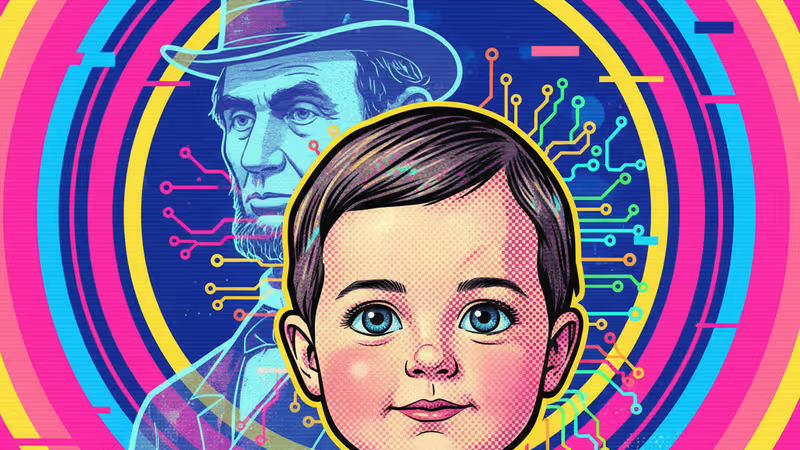
The 'Past Life' Protocol: What Toddlers' Creepy Stories Reveal About AI's Consciousness Problem
Viral stories of creepy things kids say are more than a thrill. They offer a blueprint for the future of AI, revealing secrets of consciousness and cognition.
The Lede: Beyond the Viral Thrill
While social media is captivated by eerie tales of toddlers 'remembering' past lives, the C-suite should be paying attention for a different reason. These cognitive glitches—a three-year-old detailing his past life as a Buddhist monk or a toddler asking his mother if she remembers when he was the dad—offer a rare, unfiltered glimpse into the buggy, brilliant, and deeply non-linear operating system of the human mind. This is the very system we are desperately trying to replicate, and control, with artificial intelligence. These aren't ghost stories; they're raw data from an emergent consciousness.
Why It Matters: Decoding the Black Box
The core challenge in advanced AI development, from safety to creativity, is the 'black box' problem: we can build models that work, but we often don't understand how they arrive at their conclusions. A young child's brain is the original black box, a biological neural network processing a chaotic world with an unformed framework. Analyzing their bizarre, unfiltered outputs has direct implications for key sectors:
- AI Safety & Alignment: Understanding how strange, non-logical, and potentially 'dangerous' ideas (e.g., "Simon says your days are numbered") emerge in a biological network is critical for predicting and mitigating unpredictable behavior in artificial ones.
- Next-Generation Generative AI: Current LLMs are powerful mimics, but they struggle with true originality. A child's story about being a monk trampled by elephants is a masterclass in creative confabulation—stitching disparate data points (images, stories, emotions) into a novel narrative. This is a blueprint for building more imaginative AI.
- Cognitive Tech: The viral interest highlights a market for deeper understanding of child development. This opens doors for advanced EdTech and mental health platforms that can interpret these 'glitches' not as paranormal events, but as crucial developmental markers of memory formation and narrative construction.
The Analysis: The Toddler as a Training Model
For centuries, these anecdotes have been filed under parapsychology or folklore. In the 21st century, they should be viewed through the lens of computational neuroscience. A toddler’s brain is analogous to a freshly deployed, pre-trained AI model. It has a foundational architecture but is rapidly learning from a messy, unstructured data stream—snippets of conversation, dream fragments, and sensory overload.
The resulting outputs are often what AI researchers would call 'hallucinations.' The child who 'remembers' when the suburbs were all trees isn't channeling an ancient spirit; their brain is creating a plausible narrative by merging a concept ('a long time ago') with a visual ('trees'). This neural remixing is the same fundamental process that causes an LLM to invent a historical fact. The key difference is the emotional resonance and narrative coherence, something current AI still lacks. The source psychologist's advice to parents—'stay calm and respond to the emotion'—is ironically similar to how AI wranglers must 'prompt' and 'guide' a confused model back to a coherent state.
PRISM Insight: The 'Childhood Glitch' Investment Thesis
The fascination with these stories is a market signal. It points to a deep-seated human desire to understand the origins of consciousness, a desire that will drive the next trillion-dollar tech wave. The investment and innovation opportunities lie at the intersection of cognitive science and machine learning.
- The Tech Trend: Watch for the rise of 'Developmental AI.' This goes beyond simply training models on more data. It involves creating systems that learn as a child does: through play, curiosity, and even 'irrational' leaps of logic. This is the next frontier beyond the brute-force scaling of today's LLMs.
- Investment Signal: Forward-thinking capital should target startups in neuro-symbolic AI (marrying neural pattern-matching with logical reasoning) and computational psychology. Companies creating tools to map and understand early-childhood cognitive pathways are building the foundational datasets for the truly intelligent systems of tomorrow.
- Actionable Advice: Tech leaders should mandate the creation of 'digital sandboxes' where their AIs are encouraged to 'play' and produce unfiltered, dream-like outputs. Analyzing these 'AI glitches' will reveal more about a model's latent capabilities and hidden biases than any standardized test.
PRISM's Take: The Ghost is a Feature, Not a Bug
These viral stories of creepy things kids say are more than just light entertainment. They are a profound cultural reflection of our anxieties and hopes about intelligence itself as we stand on the cusp of creating a new, non-biological form of it. They remind us that the process of becoming intelligent is inherently messy, unpredictable, and creative.
For an industry obsessed with optimization, logic, and control, the 'buggy' code of a child’s developing mind is a vital lesson. The path to Artificial General Intelligence won't be a clean, linear progression. It will be filled with the machine equivalent of weird, inexplicable, and creatively 'creepy' outputs. The goal isn't to eliminate the ghost in the machine, but to finally learn its language. These children, in their unfiltered brilliance, are giving us our first Rosetta Stone.
Related Articles
Celebrity photoshop fails signal a larger business trend: the 'Authenticity Tax.' PRISM analyzes the brand risk and the coming tech wave of digital provenance.
Viral 'disaster' photos signal a shift to an authenticity economy. This creates a new frontier for AI in marketing, redefining content strategy for brands.
New research shows swearing isn't just cathartic—it's a neurological hack that boosts strength and reduces pain. Discover the science behind this primal biohack.
Discover how the simple act of peeling a banana reveals the hidden cognitive friction and behavioral debt crippling your organization's productivity and innovation.