

The New Corner Office: Why Your $1,500 Chair is the Most Critical Career Investment You'll Make
Beyond comfort: A deep dive into why your office chair is a critical career investment, and how new players are challenging legacy giants like Herman Miller.
The Lede: The Throne of Modern Productivity
The global shift to hybrid work has fundamentally rewired the calculus of professional success. The most critical tool in a knowledge worker's arsenal is no longer the laptop or the fiber connection, but the chair they sit in for 2,000+ hours a year. Once a line item in a corporate facilities budget, the high-performance ergonomic chair has become a personal capital expenditure—the nexus of an individual's physical health, cognitive performance, and long-term career endurance.
Why It Matters: The Great Decentralization of the Workplace
We are witnessing a historic transfer of capital investment from corporate real estate to the individual's home office. This isn't just about buying a desk; it's about a fundamental re-evaluation of what constitutes 'professional infrastructure'. For executives and tech professionals, this shift has three profound, second-order effects:
- The Productivity Tax of Pain: Chronic back and neck pain from substandard seating is a silent drain on cognitive resources. The distraction and fatigue it causes directly translate to lower-quality work, missed deadlines, and career stagnation. The cost of a premium chair is dwarfed by the cost of lost productivity and potential medical bills.
- The Rise of the 'Prosumer' Office: The B2B-dominated market for high-end office furniture is being aggressively disrupted. Professionals are now the end-consumers, making sophisticated purchasing decisions based on performance, ergonomics, and long-term value, creating a new battleground between legacy giants and agile DTC competitors.
- Ergonomics as a Health Metric: In an era focused on wellness and burnout prevention, the ergonomic quality of a home workspace is becoming a key indicator of an employee's (and employer's) commitment to sustainable performance. It's moving from a 'nice-to-have' perk to a non-negotiable aspect of a competitive compensation package.
The Analysis: Deconstructing the Ergonomic Economy
Giants vs. Guerrillas: The Unbundling of the Luxury Chair
For decades, the market was dominated by titans like Herman Miller and Steelcase. Their chairs, like the iconic Herman Miller Aeron ($1,930+), were symbols of corporate prestige, backed by millions in R&D and sold through B2B channels. Their value proposition was built on uncompromising quality, extensive warranties (often 12+ years), and a proven track record.
The remote work explosion created a market vacuum that new DTC (direct-to-consumer) brands have rushed to fill. Companies like Branch, with its Ergonomic Chair Pro ($499), are executing a classic disruption playbook. They offer what many perceive as 80% of the core ergonomic features—adjustable lumbar, seat depth, 5D armrests—for less than 40% of the price. They bypass traditional dealer networks, cutting costs and speaking directly to the end-user. This forces a critical question for the consumer: are the final degrees of refinement and the brand prestige of a legacy chair worth a $1,000+ premium?
From Passive Comfort to Active Performance
The conversation around office chairs has shifted from mere comfort to active performance. It's not just about a soft cushion; it's about a system designed to support the body through various states of work. Analysis of leading models reveals key performance features that justify the investment:
- Dynamic Support: Premium chairs like the Steelcase Gesture ($1,499) are engineered to move with the body, providing consistent support whether you're leaning forward in deep focus or reclining during a call. This 'active sitting' reduces static load on the spine.
- Thermal Regulation: The material choice is a performance feature. The Aeron's signature mesh is renowned for its breathability, preventing heat buildup during long sessions—a critical factor for focus that foam cushions can't match.
- Precision Adjustability: The difference between a good chair and a great one is the granularity of control. Features like seat tilt, seat depth adjustment, and multi-directional armrests allow the user to tailor the chair to their specific body mechanics, effectively making it a bespoke piece of equipment.
PRISM Insight: Calculating Your Ergonomic ROI
For the Professional: Frame it as a Capital Investment
Avoid thinking of a premium chair as a furniture purchase. It is a long-term investment in your primary asset: your ability to think clearly and work without pain. Here's a simple ROI model:
A $1,500 chair with a 12-year warranty, used 250 workdays a year:
($1500) / (12 years * 250 days) = $0.50 per day.
The actionable question becomes: Is a full day of enhanced focus, reduced pain, and sustainable energy worth 50 cents? When negotiating for a home office stipend, present this calculation. You are not asking for a luxury item; you are requesting essential equipment to maximize your value to the company.
For the Enterprise: The New Frontier of Employee Wellness
Companies must recognize that the ergonomic quality of an employee's home setup is now part of their responsibility. A standardized home office stipend is a strategic investment with clear returns: higher productivity, lower rates of burnout and absenteeism, and a powerful tool for attracting and retaining top talent in a competitive remote landscape. Failing to address this is a direct threat to the long-term health and output of your workforce.
PRISM's Take
The office chair is the new cubicle, the new corner office, and the new conference room all in one. It is the single most important piece of hardware for the modern knowledge worker. The market fragmentation between high-priced legacy icons and value-driven DTC disruptors offers unprecedented choice, but the underlying principle remains unchanged. Investing in a high-performance ergonomic chair is no longer an indulgence; it is a foundational requirement for anyone serious about their long-term health, productivity, and career trajectory in the 21st-century economy.
Related Articles
Beyond comfort: A deep dive into why your office chair is a critical career investment, and how new players are challenging legacy giants like Herman Miller.
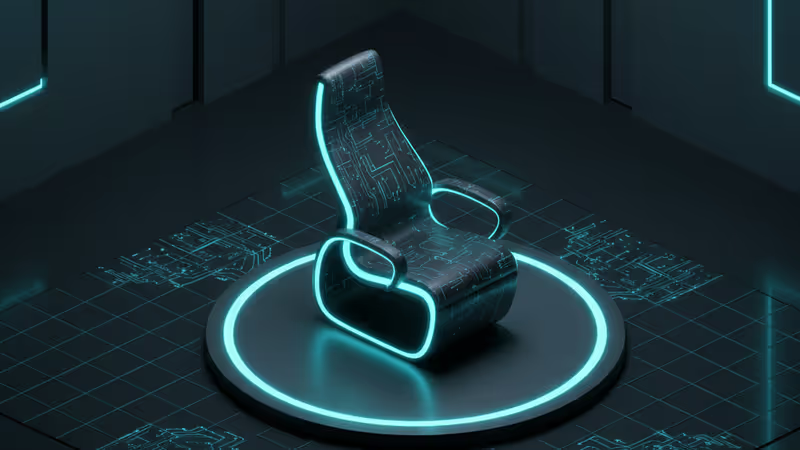
Discover why spending $1,500 on an office chair from brands like Herman Miller or Steelcase is a critical career investment, not an expense. Analysis for professionals.

OpenAI's 28-day development of Sora for Android using AI isn't just about speed. It signals a fundamental shift in software creation that will impact investors, CTOs, and developers.

OpenAI's new GPT-5.2 model signals a major shift from creative AI to reliable 'agentic workflows.' We analyze why this changes the enterprise AI landscape.