
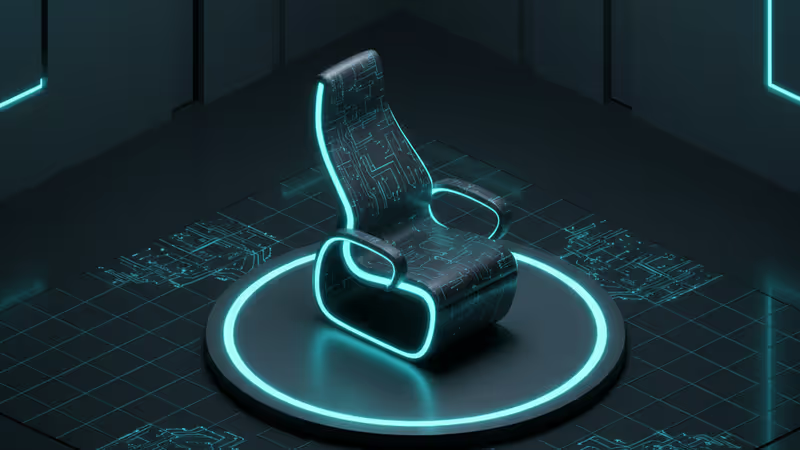
The $1,500 Office Chair: Why It's the Smartest Career Investment You'll Make This Year
Discover why spending $1,500 on an office chair from brands like Herman Miller or Steelcase is a critical career investment, not an expense. Analysis for professionals.
The Lede: The End of the $100 Office Chair
Seeing a price tag like $1,930 for a Herman Miller Aeron or $1,499 for a Steelcase Gesture can induce sticker shock. For years, office furniture was an expense borne by a corporation, an anonymous line item in a facilities budget. But the permanent shift to hybrid and remote work has fundamentally changed the equation. Your home office chair is no longer just furniture; it’s a critical piece of performance hardware, and treating it as a disposable expense is a career-limiting mistake.
Why It Matters: The Professionalization of the Home Office
The ad-hoc, 'make-do' home office of 2020 is dead. We are now in an era where the home is a primary, permanent workspace for millions of high-value knowledge workers. This shift has two profound second-order effects:
- Health as a Performance Metric: Sustained focus and cognitive output are directly linked to physical well-being. A cheap, unsupportive chair leads to back pain, fatigue, and distraction, directly eroding your most valuable asset: your attention. A high-performance ergonomic chair is an investment in uptime and cognitive endurance.
- The Rise of the 'Prosumer' Workspace: The line between consumer-grade and enterprise-grade equipment has blurred. Professionals are now curating their own high-performance work environments, and the market is responding with a tiered ecosystem of products, from accessible DTC brands like Branch to legacy B2B giants like Herman Miller pivoting to direct sales.
The Analysis: Deconstructing the Premium Chair Market
The Great Re-Framing: From Expense to Asset
The core mental shift required is viewing a premium chair not as a one-time cost, but as a long-term asset with a quantifiable return on investment. Consider the Steelcase Gesture, which costs roughly $1,500 and comes with a 12-year warranty. That amortizes to just $125 per year, or about $0.34 per day. This is a negligible cost for a tool that you use for 8+ hours daily to generate your entire income. The true cost isn't the price tag; it's the lost productivity, discomfort, and potential medical bills from using an inferior product.
Market Dynamics: Legacy Giants vs. DTC Upstarts
The current market offers unprecedented choice, driven by a classic disruption scenario.
- The Incumbents (Herman Miller, Steelcase): These brands built their reputations through massive corporate contracts. Their pivot to direct-to-consumer sales brings decades of ergonomic research and build quality to the home user, but at a premium price. Their value proposition is proven longevity and a 'gold standard' reputation.
- The Challengers (Branch): Brands like Branch have expertly targeted the gap between cheap Amazon chairs and the four-figure titans. By selling direct and focusing on core ergonomic features, the Branch Ergonomic Chair Pro ($499) offers 80% of the benefits of a premium chair for 30% of the price. This forces the entire market to be more competitive and transparent.
PRISM Insight: Your Actionable Framework
For the Individual Professional: The Value Calculation
When choosing your chair, ignore the final price and focus on the 'Performance Value Index'. Evaluate chairs on three axes:
- Adjustability: How precisely can the chair be tuned to your body? Look for seat depth adjustment, 4D armrests, and tunable lumbar support. This is the difference between a chair that 'fits' and a chair that 'disappears', letting you focus on your work.
- Build Quality & Warranty: A 7-to-12-year warranty isn't a marketing gimmick; it's a manufacturer's guarantee of material quality and engineering. A longer warranty justifies a higher upfront cost by ensuring a lower cost-per-year.
- Material Science: Consider breathability and heat dissipation. The mesh on a Herman Miller Aeron or a Branch Pro isn't just for looks; it's an engineered material designed to keep you comfortable and cool during long sessions, preventing the fatigue that comes from overheating in a foam chair.
For Business Leaders: The New Talent-Retention Tool
For companies with remote or hybrid teams, the home office stipend is evolving. Simply providing a cash amount is no longer enough. Leading companies are now treating home office ergonomics as part of their core infrastructure strategy. Partnering with brands like Branch or Herman Miller to offer employees pre-vetted, high-quality seating options is a powerful tool for talent acquisition and retention. It sends a clear signal: we invest in our people's health, focus, and long-term performance, wherever they work.
PRISM's Take
The debate over the cost of a good office chair is officially obsolete. In the new economy, where cognitive output is the primary driver of value, your physical workspace is an inseparable part of your professional toolkit. Investing in a high-performance, ergonomic chair is no longer a luxury—it's a non-negotiable component of a serious professional's career infrastructure, as fundamental as a powerful laptop or a high-speed internet connection. The market has matured to provide excellent options at every tier; failing to invest in this critical tool is a deliberate choice to operate at a disadvantage.
Related Articles
Beyond comfort: A deep dive into why your office chair is a critical career investment, and how new players are challenging legacy giants like Herman Miller.

OpenAI's 28-day development of Sora for Android using AI isn't just about speed. It signals a fundamental shift in software creation that will impact investors, CTOs, and developers.

OpenAI's new GPT-5.2 model signals a major shift from creative AI to reliable 'agentic workflows.' We analyze why this changes the enterprise AI landscape.

OpenAI reportedly built a complex app in just 28 days using AI. PRISM analyzes why this isn't just a speed boost—it's a paradigm shift that will reshape tech teams and investment strategies.