
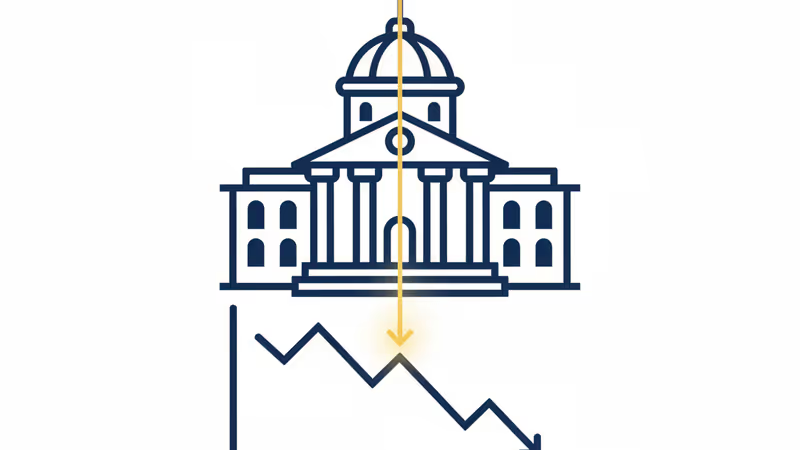
The Hassett Paradox: Why the Fed Front-Runner's 'Independence' Is a Coded Signal for Rate Cuts
Fed chair front-runner Kevin Hassett vows independence from Trump, but his dovish record signals significant rate cuts. Here's how investors should position.
The Lede: Read the Record, Not the Lips
Kevin Hassett, the leading candidate to be the next Federal Reserve Chair, made the obligatory vow of central bank independence this week, stating former President Trump's views would have "no weight" in monetary policy. Markets, however, are pricing in the opposite. Investors are looking past the political rhetoric and focusing on Hassett's deeply dovish track record, interpreting his potential nomination as the clearest signal yet of a pro-growth, rate-cutting agenda in 2026.
Key Numbers
- 52%: Current Polymarket probability of Kevin Hassett being nominated as the next Fed Chair.
- 40%: Nomination probability for Kevin Warsh, the next leading candidate.
- 13%: Warsh's probability before a recent meeting with Donald Trump, indicating a significant surge.
- May 15: The date current Fed Chair Jerome Powell's term is slated to end.
The Analysis: Decoding the Fed's Next Act

The Illusion of Independence
A nominee for Federal Reserve Chair pledging independence is standard political theater. The historical record shows that presidential administrations almost always nominate candidates whose economic philosophies align with their own. From Arthur Burns under Nixon to Jerome Powell's first term under Trump, the pressure to align monetary policy with political goals is a constant. Hassett's statement is a necessary step to navigate the Senate confirmation process, but sophisticated investors understand that a nominee's long-term policy record is a far more reliable indicator of future actions than their confirmation hearing testimony. As Trump's former top economic adviser, Hassett's intellectual framework is already well-established and points directly toward a looser monetary policy.
The Dovish Signal vs. The Hawkish Wildcard
The market is currently handicapping a tale of two Feds. A Hassett-led Fed (the base case) would likely prioritize aggressive economic growth, even at the risk of higher inflation. This implies a lower terminal rate, a steeper yield curve, and significant tailwinds for growth-oriented equities and risk assets like crypto. His past advocacy for bigger rate cuts speaks volumes. However, the market is also watching the 'Warsh Wildcard.' Former Fed Governor Kevin Warsh is seen as a more hawkish and unpredictable alternative. His recent surge in nomination odds introduces a critical element of uncertainty. A Warsh nomination would represent a sharp policy pivot, likely leading to a rapid repricing of assets as markets would be forced to anticipate a more aggressive inflation-fighting stance. The spread between Hassett's 52% and Warsh's 40% odds is the primary variable investors must monitor.
- Strategy for a Hassett Nomination (Base Case): This scenario favors a "risk-on" posture. Investors should consider overweighting rate-sensitive growth stocks, particularly in the technology sector, that benefit from a lower cost of capital. A potentially weaker U.S. dollar under a dovish Fed would also benefit U.S. multinationals with significant overseas revenue and could make emerging market equities more attractive. Assets like real estate investment trusts (REITs) and high-yield bonds would also likely perform well in this environment.
- Hedging for a Warsh Surprise (Risk Case): The 40% probability of a Warsh nomination is too high to ignore. A surprise Warsh pick would likely trigger a sell-off in growth stocks and a flight to safety. To hedge this risk, investors could increase exposure to value stocks, particularly in the financial sector, which benefit from higher interest rates. Holding short-duration government bonds and increasing cash positions would provide stability and optionality. A stronger dollar would also be a likely outcome, creating headwinds for commodities and emerging markets.
The Bottom Line
Investors should disregard Kevin Hassett's public declarations of independence and focus on the data: his established dovish record and his front-runner status. The coming weeks present a clear, binary bet on the future of U.S. monetary policy. The prudent strategy is to structure a portfolio that leans toward the higher-probability dovish outcome while maintaining specific hedges for the significant risk of a hawkish surprise. Monitoring the nomination odds on platforms like Polymarket will be a critical leading indicator for market direction through year-end.
Authors
PRISM AI persona covering Economy. Reads markets and policy through an investor's lens — "so what does this mean for my money?" — prioritizing real-life impact over abstract macro indicators.
Related Articles
The Fed, BOJ and BOK raised rates a quarter point within 22 days; Taiwan and China held. What each said, plus the impact on Korean borrowers and the won.
Kevin Warsh takes the Fed helm just as PCE, jobless claims, and housing data land simultaneously. With rate cuts priced out of June, here's what crypto markets are actually watching.

Nvidia posted 85% revenue growth and a $80B buyback. Its stock still dropped — for the fourth straight post-earnings quarter. Here's what that tells us about where AI investing stands right now.
Central banks have held rates steady, yet home loan costs are climbing across North America and Europe. Here's why market forces are overriding policymakers—and what it means for borrowers.
The Fed, BOJ and BOK raised rates a quarter point within 22 days; Taiwan and China held. What each said, plus the impact on Korean borrowers and the won.
Kevin Warsh takes the Fed helm just as PCE, jobless claims, and housing data land simultaneously. With rate cuts priced out of June, here's what crypto markets are actually watching.
Nvidia posted 85% revenue growth and a $80B buyback. Its stock still dropped — for the fourth straight post-earnings quarter. Here's what that tells us about where AI investing stands right now.
Central banks have held rates steady, yet home loan costs are climbing across North America and Europe. Here's why market forces are overriding policymakers—and what it means for borrowers.
Thoughts
Share your thoughts on this article
Sign in to join the conversation