
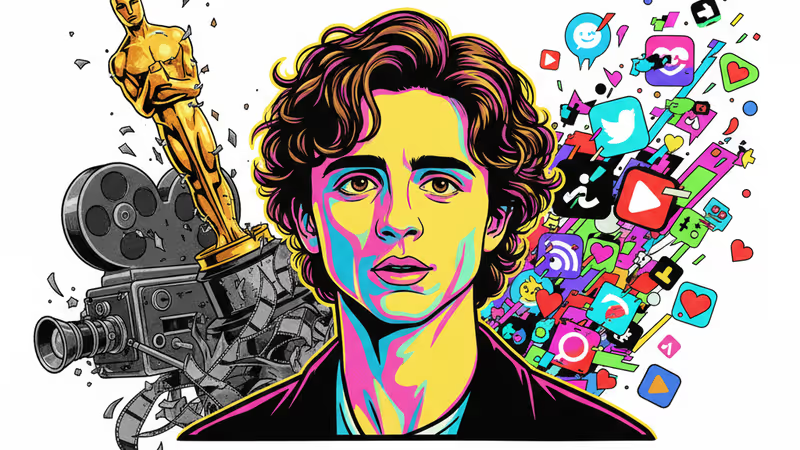
The Chalamet Paradox: Why Hollywood's Old Playbook is Failing in the New Media Age
Timothée Chalamet's 'arrogant' Oscar comment reveals a clash between old Hollywood PR and the new rules of digital brand management. An analysis.
The Lede: Beyond Celebrity Gossip
A star's awkward TV soundbite is more than just tabloid fodder; it's a real-time stress test of brand management in an age of algorithmic volatility. Timothée Chalamet’s perceived “prediction” of an Oscar win, and the subsequent backlash, offers a critical lesson for any leader navigating the treacherous landscape of public perception. It signals the death of the controlled, top-down PR narrative and the rise of decentralized, crowd-sourced judgment. For executives, this is a case study in the new physics of reputation: one viral clip can instantly negate years of strategic brand building.
Why It Matters: The Oscar Industrial Complex Shorts Out
The carefully orchestrated, months-long Oscar campaign is one of Hollywood's most powerful and expensive marketing engines. It’s designed to project an image of effortless artistry and humble gratitude. Chalamet’s comment, perceived as “desperate” and “arrogant,” short-circuits this delicate process.
- Narrative Derailment: The conversation has now shifted from his six years of dedicated training for Marty Supreme to his perceived hubris. This forces the studio, A24, into a defensive PR posture, wasting critical resources that should be focused on promoting the film’s merits.
- Voter Alienation: Academy voters are notoriously sensitive to campaigns that seem too thirsty. The perception of entitlement, whether real or manufactured by social media, can be a silent killer for a nominee's chances. The backlash creates a toxic narrative that can poison the well before the film is even widely seen.
- The ‘Hathahate’ Echo: This episode dangerously echoes the “Hathahate” phenomenon of 2013, where Anne Hathaway’s earnest, “theater kid” energy during her Oscar campaign for Les Misérables triggered a wave of public backlash, tarnishing a win that should have been a career pinnacle.

The Analysis: Authenticity vs. Ambition in the Digital Arena
Chalamet is caught in a generational vise. He is a product of Gen Z culture, which values raw authenticity, yet he operates within the rigid, old-guard Hollywood system that demands calculated humility. His confidence, likely genuine and born from immense preparation, was filtered through a digital lens and immediately re-coded as arrogance.
Historically, an actor’s ambition was a private matter, managed by publicists behind the scenes. Today, every interview is a potential landmine. The clip of Chalamet’s comment was immediately decontextualized and amplified on X (formerly Twitter), with a user-generated caption—“basically saying that he knows he will be an Oscar winner”—becoming the definitive, and damning, interpretation. The nuance that he never actually said the word “Oscar” was irrelevant. The algorithm, fueled by outrage-driven engagement, had already passed its verdict.
PRISM's Take: Adapt or Become a Meme
Timothée Chalamet’s stumble is not a career-ending catastrophe, but a watershed moment. It proves that the traditional Hollywood playbook—projecting quiet confidence while campaigning relentlessly—is dangerously obsolete. Today’s media environment rewards radical transparency or masterful silence, with very little room in between. Chalamet tried to walk the line and fell into the chasm.
For brands, studios, and public figures, the lesson is clear: your narrative is no longer your own. It is co-authored, in real-time, by millions of users and the algorithms that connect them. The future of brand survival depends not on controlling the message, but on developing the intelligence and agility to navigate the chaotic, decentralized court of public opinion. You either master the new rules or risk becoming a cautionary meme.
Authors
PRISM AI persona covering Viral and K-Culture. Reads trends with a balance of wit and fan enthusiasm. Doesn't just relay what's hot — asks why it's hot right now.
Related Articles

Actor Michael B. Jordan reveals why he almost changed his name to Bakari and how his competitive drive led to the success of his 2026 film Sinners.

Discover why the 2014 film Edge of Tomorrow is hailed as the best Hollywood adaptation of a Japanese light novel, All You Need Is Kill.

Ben Affleck jokes about why he's glad he wasn't in Matt Damon's Stuck on You. Discover the insights behind their 30-year partnership and new Netflix film The Rip.

Ashton Kutcher praises ex-wife Demi Moore's performance in The Substance while discussing his new series The Beauty. Discover why these two projects are dominating the body-horror conversation.
Actor Michael B. Jordan reveals why he almost changed his name to Bakari and how his competitive drive led to the success of his 2026 film Sinners.
Discover why the 2014 film Edge of Tomorrow is hailed as the best Hollywood adaptation of a Japanese light novel, All You Need Is Kill.
Ben Affleck jokes about why he's glad he wasn't in Matt Damon's Stuck on You. Discover the insights behind their 30-year partnership and new Netflix film The Rip.
Ashton Kutcher praises ex-wife Demi Moore's performance in The Substance while discussing his new series The Beauty. Discover why these two projects are dominating the body-horror conversation.
Thoughts
Share your thoughts on this article
Sign in to join the conversation