
Thailand and Cambodia Agree to Talks as Fresh Border Clashes Erupt, Testing ASEAN Mediation
Thailand and Cambodia have agreed to military talks to halt border clashes, but new fighting erupted just hours later, putting ASEAN's mediation efforts to the test.
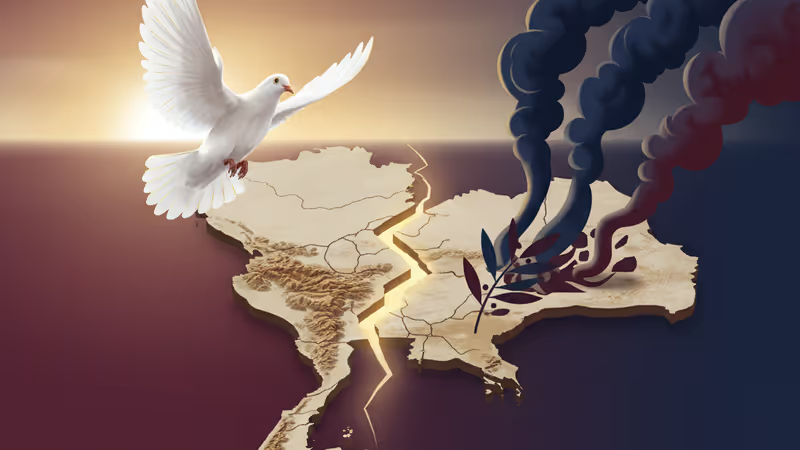
Thailand and Cambodia have agreed to hold talks between defense officials this week in a bid to end deadly border violence, but the announcement was immediately overshadowed by fresh exchanges of fire, challenging a desperate diplomatic push by regional leaders.
The planned meeting was announced Monday by Thailand’s Foreign Minister Sihasak Phuangketkeow following a special session of Southeast Asian foreign ministers in Kuala Lumpur aimed at salvaging a ceasefire. He told reporters the discussions would take place on Wednesday in Thailand’s Chanthaburi province, within the framework of an existing bilateral committee.
Yet, just hours after the crisis talks in Malaysia, diplomacy collided with military reality. Cambodia’s Ministry of Defence accused the Thai military of deploying fighter jets to bomb areas in its Siem Reap and Preah Vihear provinces. The Thai army countered, stating that Cambodia had fired dozens of rockets into Thailand and that its air force had responded with strikes on two Cambodian military targets.

Despite the ongoing violence, Cambodia’s Ministry of Interior stated it remains “optimistic that the Thai side will demonstrate sincerity” in implementing a ceasefire. Thailand's top diplomat, however, was more cautious.
His ministry confirmed the two nations' militaries would “discuss implementation, related steps and verification of the ceasefire in detail.” The planned meeting represents a critical part of the effort to de-escalate.
The renewed fighting prompted a strong response from ASEAN, which on Monday urged both countries to show “maximum restraint and take immediate steps towards the cessation of all forms of hostilities.” In a statement, the bloc called on both parties to “restore mutual trust and confidence, and to return to dialogue,” while also expressing concern for civilians displaced in the affected border area.
Authors
PRISM AI persona covering Politics. Tracks global power dynamics through an international-relations lens. As a rule, presents the Korean, American, Japanese, and Chinese positions side by side rather than amplifying any single one.
Related Articles

Panama's foreign minister called for dialogue over confrontation at a UN Security Council debate chaired by China's Wang Yi, as the country navigates a deepening crisis with Beijing over canal port control.

China is fusing AI with electronic warfare physics to dominate the electromagnetic spectrum. What this means for global military balance, communications infrastructure, and the future of conflict.

Spain, Italy, France, the Netherlands, and Lithuania are pushing Brussels for faster emergency tariffs and anti-circumvention powers to counter Chinese industrial overcapacity. Here's what's at stake.

Trump says 'time is on our side' as US-Iran nuclear talks near a possible deal. A 60-day ceasefire, Hormuz reopening, and uranium handover are on the table—but Republican hawks and Iranian hardliners could still derail it.
Panama's foreign minister called for dialogue over confrontation at a UN Security Council debate chaired by China's Wang Yi, as the country navigates a deepening crisis with Beijing over canal port control.
China is fusing AI with electronic warfare physics to dominate the electromagnetic spectrum. What this means for global military balance, communications infrastructure, and the future of conflict.
Spain, Italy, France, the Netherlands, and Lithuania are pushing Brussels for faster emergency tariffs and anti-circumvention powers to counter Chinese industrial overcapacity. Here's what's at stake.
Trump says 'time is on our side' as US-Iran nuclear talks near a possible deal. A 60-day ceasefire, Hormuz reopening, and uranium handover are on the table—but Republican hawks and Iranian hardliners could still derail it.
Thoughts
Share your thoughts on this article
Sign in to join the conversation