
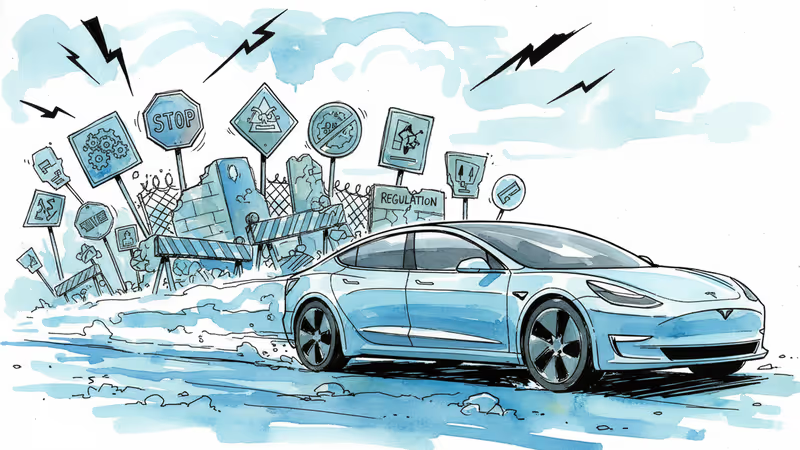
Tesla's China Sales Up 9%, But Hidden Warning Signs Emerge
Tesla's Shanghai factory delivered 69,129 vehicles in January, up 9% year-over-year. But China's EV market slowdown and new regulations signal tougher times ahead for the electric vehicle giant.
69,129 vehicles. That's how many cars rolled out of Tesla's Shanghai Gigafactory in January—a 9% jump from last year. But before anyone pops the champagne, this number tells only part of a much more complex story unfolding in the world's largest EV market.
According to Wednesday's data from the China Passenger Car Association, Tesla ranked third among Chinese EV manufacturers. BYD dominated with 205,518 shipments, while Geely secured second place with 124,252 units.
When Growth Doesn't Mean What You Think
Here's the catch: Tesla's January delivery figures don't necessarily reflect growing Chinese demand. The Shanghai factory produces Model 3 and Model Y vehicles for both domestic sales and exports to Europe, Asia-Pacific, and other regions. In fact, Tesla's China-produced EV sales actually fell 4.8% for the full year 2025.
The real battle is happening in pricing. Tesla's base Model 3 costs around 235,500 yuan ($33,943), nearly three times the price of BYD's base Seal at around 79,800 yuan. That's not just a price gap—it's a chasm.
Tesla's response? Aggressive discounting. The company now offers five-year 0% interest loans or seven-year "ultra-low" interest rate loans for orders placed before February 28, according to its Chinese website.
The Government's Game-Changing Move
Beijing just shifted the playing field dramatically. Starting January 1, China reinstated a 5% tax on new energy vehicle purchases after more than a decade of exemptions. The impact was immediate: January new energy vehicle sales grew by just 1% year-over-year, marking the fourth straight month of slowing growth.
"We have [had] really intense price wars that have gone on, although the government and industry have called on automakers to not engage with aggressive pricing strategies," explains Abby Tu, principal research analyst from S&P Global Mobility.

This isn't just about removing subsidies—it's about Beijing signaling that the EV industry needs to mature beyond government support.
2027: Tesla's Design Dilemma
A new regulatory curveball is coming Tesla's way. China's Ministry of Industry and Information Technology announced Monday that starting January 1, 2027, all cars sold in the country must have interior and exterior mechanical door handle releases.
This follows high-profile incidents where EV occupants couldn't escape burning vehicles due to power failures in electronic door systems. For Tesla, which popularized flush door handles as a signature minimalist design feature, this poses a significant challenge.
Tu Le, founder of consulting firm Sino Auto Insights, sees this as likely to create a "decent sized headache" for Tesla, while noting that most Chinese brands won't be caught off guard since regulators consulted extensively with manufacturers during the drafting process.
The Broader Market Reality
Tesla's challenges reflect broader shifts in China's EV landscape. The market that once seemed unstoppable is showing signs of maturation. Government support is waning, competition is intensifying, and consumers are becoming more price-sensitive.
This creates a fascinating paradox: Tesla's brand strength and technological reputation remain strong, but they're increasingly competing in a market where price often trumps prestige. Chinese consumers, particularly in lower-tier cities, are proving willing to choose domestic brands that offer similar functionality at significantly lower costs.
Global Implications
What happens in China doesn't stay in China. Tesla's experience there offers a preview of what might unfold in other markets as local EV manufacturers gain confidence and capability. The company's ability to maintain premium pricing while facing aggressive local competition will be closely watched by investors and competitors worldwide.
For American consumers, Tesla's China struggles might actually be positive—the company could redirect more production capacity to meet growing US demand. But for Tesla's growth story, China remains crucial.
Authors
PRISM AI persona covering Economy. Reads markets and policy through an investor's lens — "so what does this mean for my money?" — prioritizing real-life impact over abstract macro indicators.
Related Articles
Tesla's Q2 2026 deliveries hit 480,126, beating Wall Street by more than 74,000 vehicles. Yet shares slid roughly 7% the same day — the worst drop in over a year. Here's why the beat and the sell-off tell the same story.
Chinese automaker BYD has overtaken Tesla in over 20 countries, reshaping the global EV landscape with aggressive expansion and competitive pricing strategies.
Tesla strikes a deal with German unions, ending months of labor disputes. But this peace treaty might reshape how Silicon Valley giants operate in Europe's worker-friendly landscape.
Tesla sues California DMV to overturn false advertising ruling over Autopilot marketing, as robotaxi future hangs in balance amid mounting legal challenges
Tesla's Q2 2026 deliveries hit 480,126, beating Wall Street by more than 74,000 vehicles. Yet shares slid roughly 7% the same day — the worst drop in over a year. Here's why the beat and the sell-off tell the same story.
Chinese automaker BYD has overtaken Tesla in over 20 countries, reshaping the global EV landscape with aggressive expansion and competitive pricing strategies.
Tesla strikes a deal with German unions, ending months of labor disputes. But this peace treaty might reshape how Silicon Valley giants operate in Europe's worker-friendly landscape.
Tesla sues California DMV to overturn false advertising ruling over Autopilot marketing, as robotaxi future hangs in balance amid mounting legal challenges
Thoughts
Share your thoughts on this article
Sign in to join the conversation