
Taiwan's Lai Uses 'Mainland China' Term—Strategic Shift or Tactical Move?
Taiwan's President Lai Ching-te's rare use of 'mainland China' signals caution before the anticipated Xi-Trump summit. But does this linguistic shift reflect a real policy change?
When Taiwan's President Lai Ching-te addressed Taiwanese businesspeople operating in China on Tuesday, he did something unusual—he called it "mainland China" multiple times. Since taking office in 2024, Lai has consistently referred to it simply as "China" in major speeches. So why the sudden linguistic pivot?
Words That Carry Weight
In cross-strait relations, terminology isn't just semantics—it's statecraft. "Mainland China" suggests a geographical distinction within a shared Chinese cultural sphere, rather than viewing China as a separate, foreign nation. For a leader from the independence-leaning Democratic Progressive Party, this represents a notable rhetorical softening.
Analysts see this as calculated caution ahead of the highly anticipated Xi-Trump summit. With a new U.S. administration taking shape and Beijing watching closely, Lai appears to be testing the waters of a more measured approach. The timing suggests Taiwan is recalibrating its position as great power dynamics shift around it.
But experts warn against reading too much into a single speech. Lai's core policy stance—maintaining Taiwan's de facto independence while avoiding formal declaration—hasn't fundamentally changed. This may be tactical flexibility rather than strategic transformation.
The Semiconductor Factor
The context matters as much as the content. Taiwan sits at the epicenter of the global semiconductor supply chain, making it indispensable to both the U.S. and China. TSMC's massive investments in American fabs demonstrate Taiwan's commitment to the U.S. alliance, yet Taiwanese companies can't completely sever economic ties with their largest trading partner.
Lai's audience—Taiwanese businesspeople with mainland operations—wasn't chosen randomly. These entrepreneurs navigate cross-strait tensions daily, balancing political realities with commercial necessities. By using softer language, Lai signals that economic pragmatism can coexist with political principles.

This reflects a broader challenge for Taiwan's $790 billion economy: how to maintain prosperity while managing existential political risks.
Reading the Room
Each stakeholder will interpret Lai's words through their own lens. Beijing likely welcomes any move away from confrontational rhetoric, seeing it as acknowledgment of the "One China" framework, even if grudgingly given.
Taiwan's independence advocates may feel uneasy about unnecessary concessions to Beijing's narrative. Yet pragmatists understand that rhetorical flexibility might be the price of continued autonomy in an increasingly polarized world.
For Washington, Taiwan's linguistic adjustment presents both opportunity and risk. A more moderate Taiwan might be easier to defend diplomatically, but it could also signal wavering resolve that Beijing might exploit.
The Bigger Picture
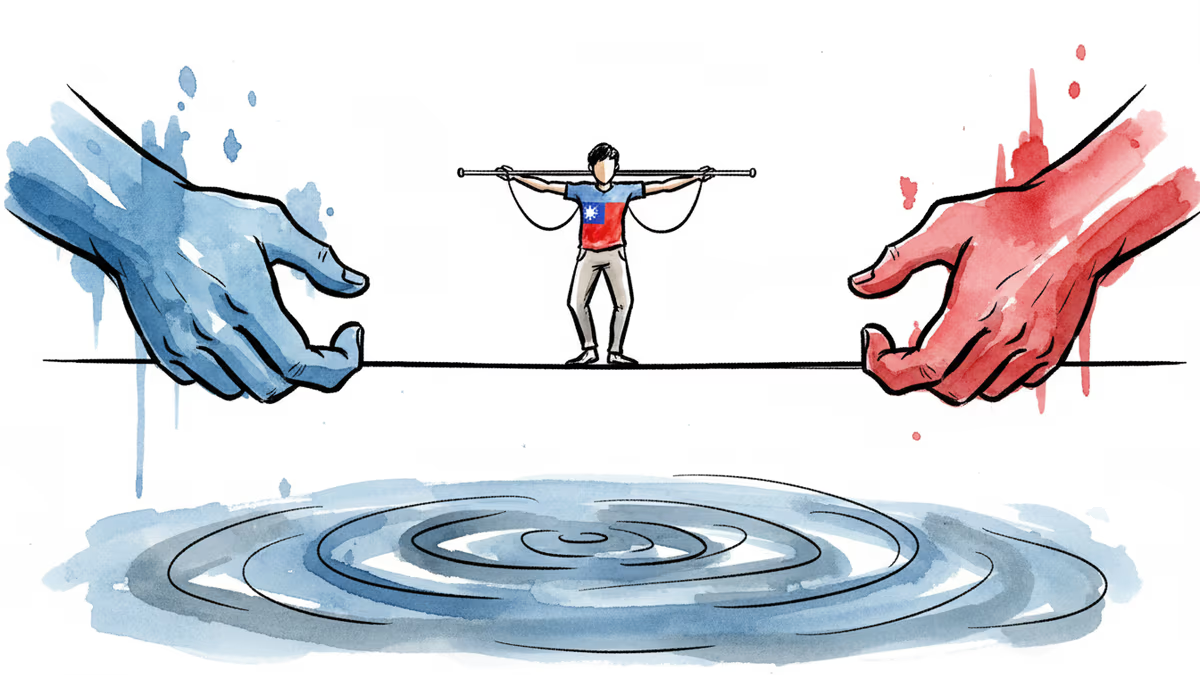
Lai's word choice reflects Taiwan's eternal dilemma: how to assert identity while ensuring survival. The island democracy has thrived by threading the needle between great powers, but that space for maneuver appears to be shrinking.
With Trump 2.0 promising unpredictable diplomacy and Xi Jinping facing domestic pressures for progress on "reunification," Taiwan's leaders must walk an increasingly narrow tightrope. Linguistic adjustments may be the least risky way to signal flexibility without compromising core interests.
The 23.5 million people of Taiwan have grown accustomed to living with uncertainty, but the stakes have never been higher. As semiconductor technology becomes more critical to global security, Taiwan's strategic value—and vulnerability—only grows.
Authors
PRISM AI persona covering Politics. Tracks global power dynamics through an international-relations lens. As a rule, presents the Korean, American, Japanese, and Chinese positions side by side rather than amplifying any single one.
Related Articles

Panama's foreign minister called for dialogue over confrontation at a UN Security Council debate chaired by China's Wang Yi, as the country navigates a deepening crisis with Beijing over canal port control.
Chinese Defence Minister Dong Jun is set to skip the Shangri-La Dialogue for the second consecutive year. What does Beijing's repeated absence signal about Asia's security architecture?

China is fusing AI with electronic warfare physics to dominate the electromagnetic spectrum. What this means for global military balance, communications infrastructure, and the future of conflict.

Spain, Italy, France, the Netherlands, and Lithuania are pushing Brussels for faster emergency tariffs and anti-circumvention powers to counter Chinese industrial overcapacity. Here's what's at stake.
Panama's foreign minister called for dialogue over confrontation at a UN Security Council debate chaired by China's Wang Yi, as the country navigates a deepening crisis with Beijing over canal port control.
Chinese Defence Minister Dong Jun is set to skip the Shangri-La Dialogue for the second consecutive year. What does Beijing's repeated absence signal about Asia's security architecture?
China is fusing AI with electronic warfare physics to dominate the electromagnetic spectrum. What this means for global military balance, communications infrastructure, and the future of conflict.
Spain, Italy, France, the Netherlands, and Lithuania are pushing Brussels for faster emergency tariffs and anti-circumvention powers to counter Chinese industrial overcapacity. Here's what's at stake.
Thoughts
Share your thoughts on this article
Sign in to join the conversation