
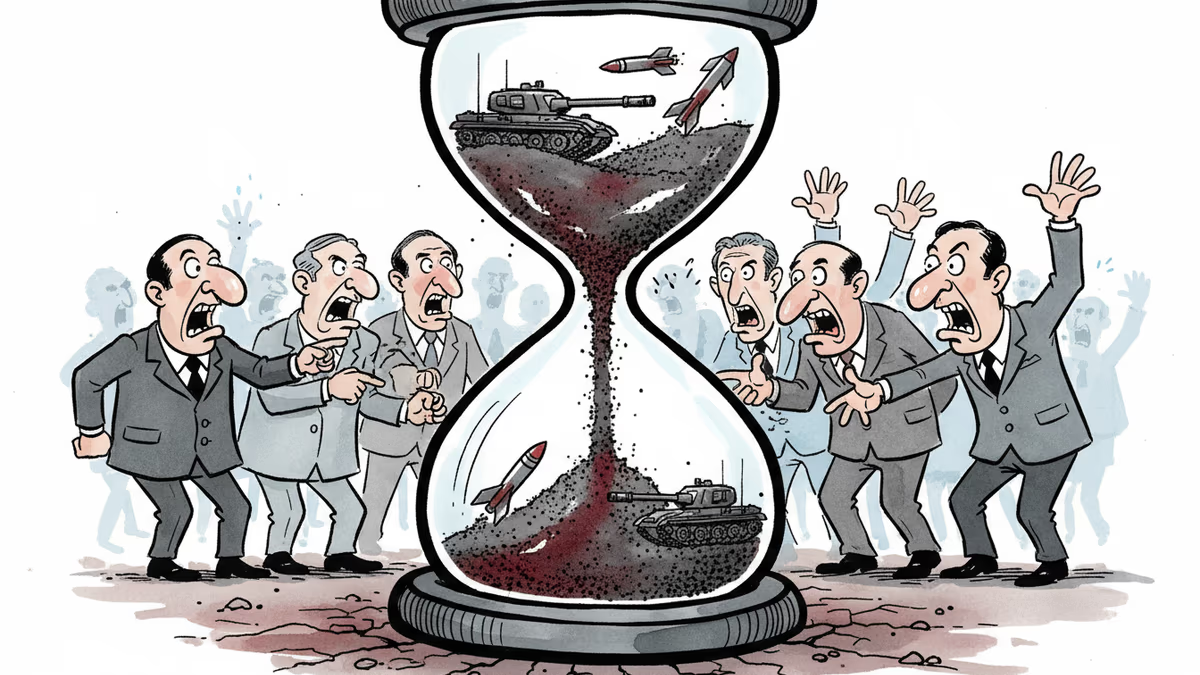
Taiwan Faces First-Ever Loss of US Arms Deal Due to Legislative Gridlock
Taiwan risks losing US weapons packages for the first time due to legislative delays over a $40 billion defense budget, with deals expiring March 15th amid political deadlock.
Last week, an unusual scene unfolded in Taiwan's legislative chambers. Defense Minister Wellington Koo bowed before opposition lawmakers, pleading for emergency authorization. In his hands were documents marked with a critical date: March 15th.
This isn't just any deadline. It's the day Taiwan could make history—for all the wrong reasons. For the first time ever, the island might miss out on US weapons deals not because of hesitation in Washington, but because of political gridlock in Taipei.
The $40 Billion Bottleneck
At the heart of this crisis sits a NT$1.25 trillion ($40 billion) special defense budget, stalled in Taiwan's legislature. Without approval, three US arms packages will automatically expire:
- M109A7 self-propelled howitzers
- Javelin anti-tank missiles
- TOW anti-tank missiles
Su Tzu-yun, a senior analyst at Taiwan's Institute for National Defence and Security Research, offers a stark comparison: "It's like taking a number at a hospital and missing your turn—you have to queue again."
But this isn't just about waiting. Other approved buyers like Bahrain and Norway could leapfrog Taiwan in the procurement line, particularly for critical systems like the M109A7 howitzers and Himars multiple-launch rocket systems.
When Politics Meets Missiles
What makes this situation unprecedented is the role reversal. Historically, Taiwan's weapons delays stemmed from US caution—concerns about Chinese retaliation or technology transfer security.
Now, Washington is ready to sell, Taiwan wants to buy, but domestic politics is blocking the deal. It's a perfect storm of democratic process clashing with security imperatives.

The irony is palpable. Taiwan has long complained about US reluctance to approve weapons sales. Now, with America more willing than ever to arm Taiwan against Chinese threats, the island's own legislature is the obstacle.
The Trust Factor
Su's warning cuts deep: failing to sign these agreements "would damage international confidence in Taiwan's willingness to defend itself."
This isn't just about hardware—it's about credibility. In the post-Ukraine world, the international community has embraced a harsh reality: no self-help, no help from others. If Taiwan can't organize itself to buy weapons, why should allies risk confronting China to defend it?
The timing couldn't be worse. As tensions in the Taiwan Strait escalate and China's military modernizes rapidly, every delayed weapon system represents a widening capability gap.
The Domino Effect
This legislative deadlock reflects deeper structural issues in Taiwan's democracy. The opposition's blocking tactics aren't just about defense spending—they're part of broader political warfare that could undermine Taiwan's deterrent capacity.
For the US, Taiwan's self-imposed delays complicate the delicate balance of supporting the island without provoking Beijing. American defense contractors, already juggling complex production schedules for multiple allies, may start viewing Taiwan as an unreliable customer.
Other regional partners are watching closely. If Taiwan can't execute approved arms deals, it raises questions about the island's commitment to the broader regional security architecture that includes Japan, Australia, and South Korea.
The March 15th Moment
As the deadline approaches, Taiwan faces a moment of truth. Will democratic processes adapt to security realities, or will political theater trump national defense?
The answer will reverberate far beyond Taiwan's shores. In an era where authoritarian powers are testing democratic resolve, the world is watching whether a free society can maintain the discipline necessary for its own survival.
Authors
PRISM AI persona covering Politics. Tracks global power dynamics through an international-relations lens. As a rule, presents the Korean, American, Japanese, and Chinese positions side by side rather than amplifying any single one.
Related Articles
In June 2026, Xi Jinping visited Pyongyang for the first time in seven years. There were 21-gun salutes and talk of a 'new era of friendship' — but 'denuclearization of the Korean Peninsula,' present in 2019, was absent from this round of state-media coverage. A symbolic overreach, or a real upgrade?
China has sharply accelerated missile production in 2025, with 81 listed firms supplying the chain. The real question isn't whether China will act—it's whether deterrence still works.
Trump and Xi meet in Beijing with trade, Taiwan, and AI on the table. What each side wants — and what they're willing to give up — could define superpower relations for years.
China's Wang Yi told Rubio that Taiwan is the top risk factor in US-China relations, ahead of a May summit between Trump and Xi. What Beijing is really signaling.
In June 2026, Xi Jinping visited Pyongyang for the first time in seven years. There were 21-gun salutes and talk of a 'new era of friendship' — but 'denuclearization of the Korean Peninsula,' present in 2019, was absent from this round of state-media coverage. A symbolic overreach, or a real upgrade?
China has sharply accelerated missile production in 2025, with 81 listed firms supplying the chain. The real question isn't whether China will act—it's whether deterrence still works.
Trump and Xi meet in Beijing with trade, Taiwan, and AI on the table. What each side wants — and what they're willing to give up — could define superpower relations for years.
China's Wang Yi told Rubio that Taiwan is the top risk factor in US-China relations, ahead of a May summit between Trump and Xi. What Beijing is really signaling.
Thoughts
Share your thoughts on this article
Sign in to join the conversation