

When a Swimmer Becomes a Sea Diver: Azure Spring and the Healing Drama Formula
MBN+'s 6-episode healing romance Azure Spring stars Yeri (Red Velvet) and Kang Sang-joon. We unpack what the show's casting logic, haenam premise, and anti-achievement themes reveal about K-drama's current moment.
What happens to an elite athlete when the only future she ever planned is suddenly taken away? In most dramas, the answer is a comeback arc. Azure Spring takes a different route — straight down, into the sea.
MBN+'s new 6-episode healing romance premiered in May 2026, starring Yeri of Red Velvet alongside veteran actor Kang Sang-joon. Yeri plays a competitive swimmer whose career-ending injury doesn't just close a door — it erases the entire floor plan she had for her life. With nowhere else to turn, she retreats to her mother's hometown, a small island off the Korean coast. There she meets Kang Sang-joon's character: a haenam (a male free diver who harvests seafood) who refuses to say a single word about his past. The two end up as roommates, then diving partners, then something more. The show streams globally on Kocowa+ and Viu, with one episode per week.
The Cable Mini-Series Survival Playbook
To understand Azure Spring, you need to understand where it sits in the market. The upper tier of 2026's K-drama landscape is dominated by high-budget OTT productions — Netflix's Melo Movie franchise, Disney+'s genre series, Tving's prestige originals. A 6-episode cable drama isn't competing with those. It's playing a different game entirely.
Since roughly 2022, cable mini-series have settled into a reliable survival formula: keep budgets lean, cast an idol with an existing fanbase, anchor the story in a universally legible emotion (healing, recovery, love), and deliver a self-contained narrative that rewards binge-watching in a single sitting. Azure Spring follows this playbook faithfully. No IP adaptation, no sprawling ensemble — just two leads, an island, and a premise compact enough to resolve cleanly in six hours.

The casting of Yeri is the formula's key variable. The idol-to-lead-actress pipeline has been a recognized industry path since IU's Hotel Del Luna in 2019, but the gap between a fan-service casting and a genuine acting breakthrough has almost always come down to one thing: whether the format gives the performer enough room to work. Six episodes is tight. It's enough to build chemistry and deliver emotional beats, but it's a narrow window to demonstrate dramatic range. Yeri's character — a woman whose entire identity has been stripped away by injury — is the kind of role that could be a career-defining turn. Whether the scripts give her the space to make it one is the real question going in.
Why a Male Haenyeo, and Why Now
The haenam premise deserves more attention than it's likely to get in first-impression coverage. Haenyeo — the female free divers of Jeju Island — became a global cultural symbol after UNESCO inscribed the tradition on its Intangible Cultural Heritage list in 2016, and Korean content has been drawing on that imagery ever since. But Azure Spring isn't telling a preservation story. It's doing something more specific: it's casting a man in that role, quietly inverting the gendered labor that makes haenyeo culture distinctive in the first place.
Whether that inversion becomes thematically meaningful or stays as set dressing depends entirely on the writing. A 6-episode structure doesn't leave much room for subtext. But the choice itself fits a broader pattern in recent Korean drama. My Liberation Notes (2022) centered on white-collar burnout. Castaway Diva (2023) followed an industry dropout's slow return. Azure Spring adds a third type: the athletic elite whose performance-defined identity collapses overnight. All three place people pushed outside the system at the center of the story. All three ask, quietly, what comes after the plan fails.
This isn't coincidence. It reflects something real about the social mood in South Korea in the mid-2020s — a generation that was told achievement was the path, and is now living in the gap between that promise and the reality. Healing dramas aren't just entertainment in this context; they're doing a kind of cultural processing work.
This content is AI-generated based on source articles. While we strive for accuracy, errors may occur. We recommend verifying with the original source.
Related Articles

MBC's action-comedy Fifties Professionals introduces Kwon Yul as an unpredictable new antagonist. Here's why this drama's premise matters beyond the casting news.
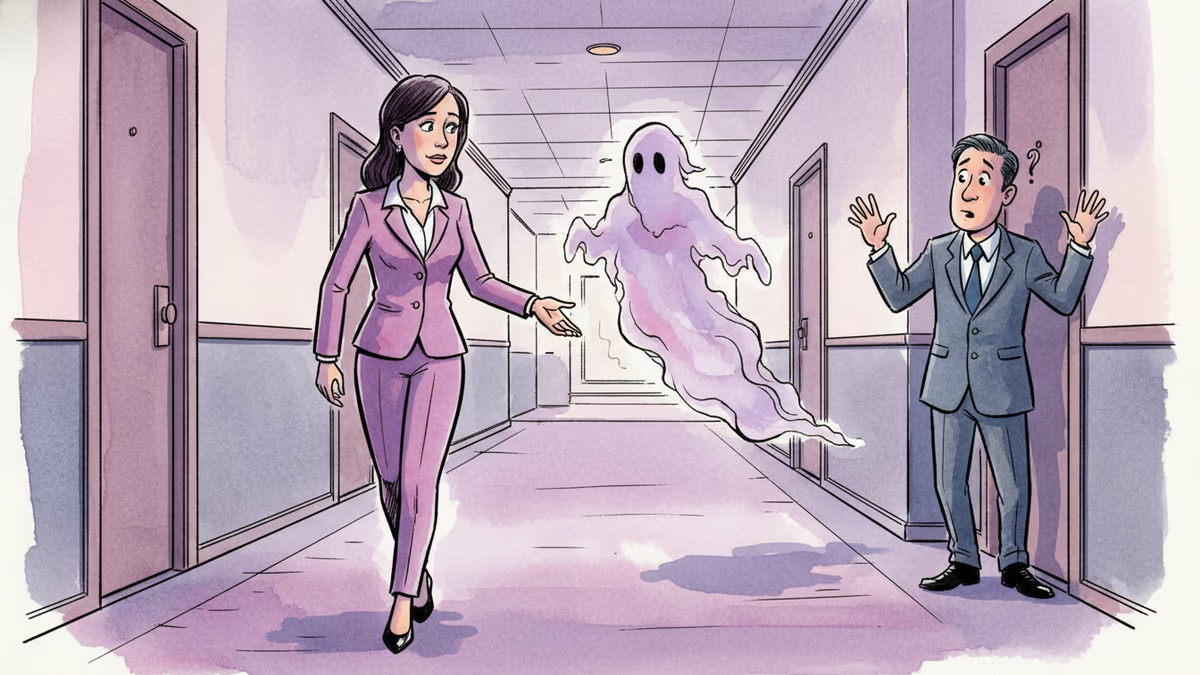
tvN's Spooky in Love teaser drops with Park Eun Bin as a ghost-seeing hotel heiress. Behind the occult romance lies a calculated industry strategy worth unpacking.
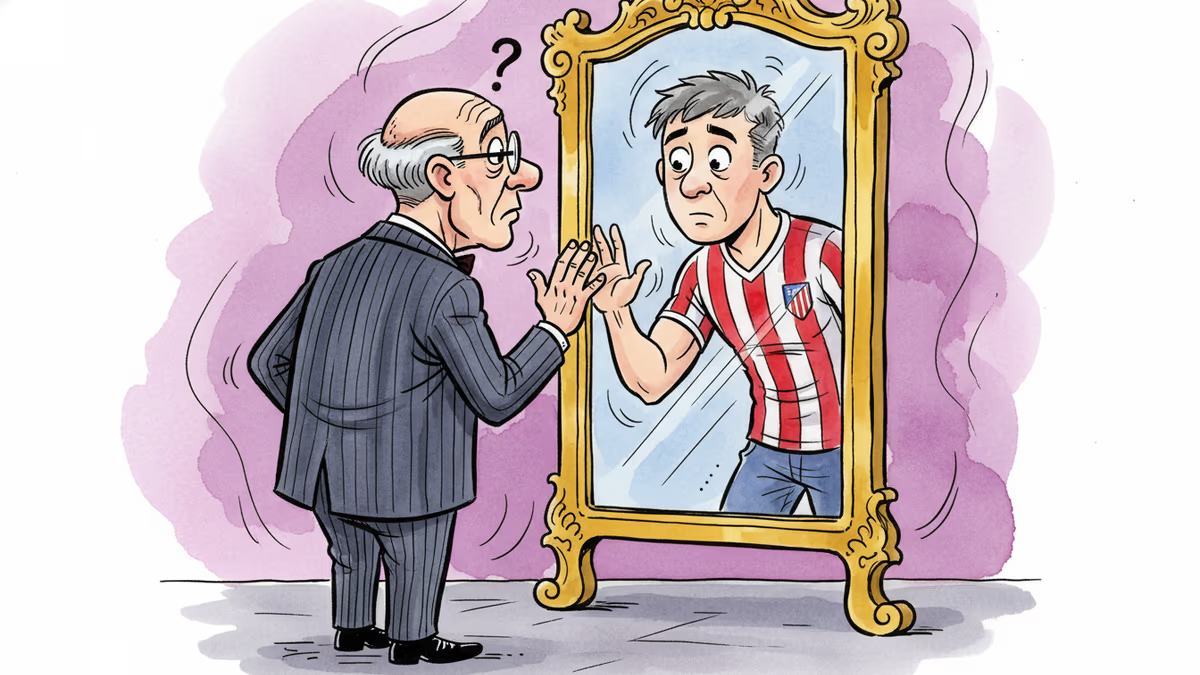
JTBC's Reborn Rookie pairs veteran actor Son Hyun Joo with idol-turned-actor Lee Jun Young in a body-swap drama. A look at the genre's industrial logic and what it signals about Korean TV's audience strategy.

JTBC's upcoming comedy crime drama Apartment casts Ji Sung, Ha Yoon-kyung, Park Byung-eun, and Moon Sori in a story where an ex-gangster enters a residents' committee election. What does the project reveal about JTBC's 2026 strategy?
MBC's action-comedy Fifties Professionals introduces Kwon Yul as an unpredictable new antagonist. Here's why this drama's premise matters beyond the casting news.
tvN's Spooky in Love teaser drops with Park Eun Bin as a ghost-seeing hotel heiress. Behind the occult romance lies a calculated industry strategy worth unpacking.
JTBC's Reborn Rookie pairs veteran actor Son Hyun Joo with idol-turned-actor Lee Jun Young in a body-swap drama. A look at the genre's industrial logic and what it signals about Korean TV's audience strategy.
JTBC's upcoming comedy crime drama Apartment casts Ji Sung, Ha Yoon-kyung, Park Byung-eun, and Moon Sori in a story where an ex-gangster enters a residents' committee election. What does the project reveal about JTBC's 2026 strategy?
Thoughts
Share your thoughts on this article
Sign in to join the conversation