
Xi-Starmer Talks and AstraZeneca's $15bn Bet: Reading Between the Lines
As China and Britain seek to repair ties, AstraZeneca's massive investment signals deeper strategic calculations amid Trump-era uncertainties. What's really at stake?
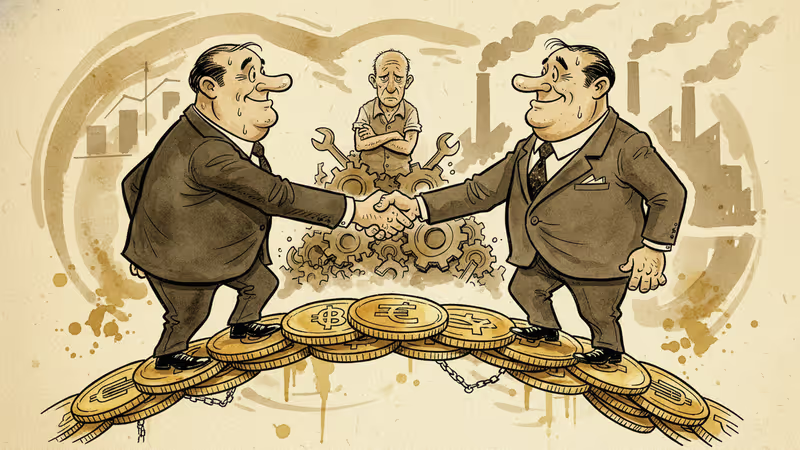
$15 billion. That's how much AstraZeneca plans to invest in China. The timing? The same day Chinese President Xi Jinping met British Prime Minister Keir Starmer in Beijing. Coincidence seems unlikely.
When Ice Begins to Crack
Thursday's meeting at Beijing's Great Hall of the People carried weight beyond typical diplomatic pleasantries. Here was Europe's second-largest economy attempting to recalibrate its relationship with China while navigating the choppy waters of its "special relationship" with America.
Starmer's visit represents more than diplomatic theater. Post-Brexit Britain needs new trade partners, while China seeks to break through Western isolation. Both sides arrive at the table with genuine need, not just political posturing.
Yet analysts remain cautious about the meeting's modest outcomes. Structural tensions haven't disappeared overnight, and both countries face domestic pressures that complicate any grand reconciliation.
AstraZeneca's Strategic Gamble
AstraZeneca's$15 billion China investment announcement takes on deeper significance in this context. While the British pharmaceutical giant already operates substantially in China, this investment scale suggests something more ambitious than business as usual.
China's healthcare market presents compelling math. An aging population drives surging medical demand, while Beijing strategically nurtures its biohealth sector. For AstraZeneca, missing this opportunity could mean ceding ground to competitors willing to make bold moves.
The timing reveals calculated choreography. When corporate investment announcements align perfectly with political summits, it signals coordinated strategy rather than market coincidence. Both governments appear intent on using economic cooperation to generate political momentum.

The Trump Variable
This China-Britain rapprochement can't be understood without acknowledging the Trump backdrop. As "America First" policies intensify, even traditionally close U.S. allies find themselves exploring alternatives.
Starmer already faces Trump administration pressures. Trade tensions could squeeze Britain's economy, making Chinese market access more valuable. Diversifying relationships provides Britain strategic options when dealing with an unpredictable American partner.
China faces its own calculations. As U.S.-China tensions escalate, Beijing seeks European partnerships to circumvent containment strategies. Britain offers a potentially valuable wedge in Western unity, especially given its post-Brexit flexibility.
Winners, Losers, and Complex Trade-offs
Who benefits more from this diplomatic dance? Short-term analysis suggests mutual gains. Britain secures market access and investment, while China achieves a significant relationship breakthrough with a major Western power.
Longer-term calculations prove more complex. Britain risks American displeasure by cozying up to Beijing. Yet maintaining distance from China means forgoing substantial economic opportunities in the world's second-largest economy.
For global businesses, this recalibration creates both opportunities and complications. Companies operating across U.S., Chinese, and British markets must navigate increasingly complex political crosscurrents that could affect everything from supply chains to regulatory approvals.
Beyond the Headlines
The $15 billion figure deserves scrutiny beyond its headline impact. Large investment announcements often unfold over years, subject to changing political winds and market conditions. Real implementation may prove more modest than initial fanfare suggests.
Moreover, this investment comes with strings attached. China increasingly demands technology transfer and local partnerships from foreign investors. AstraZeneca's commitment likely involves sharing intellectual property and manufacturing capabilities that could eventually benefit Chinese competitors.
Yet for a pharmaceutical company, Chinese market access justifies significant risks. The alternative—watching competitors establish dominant positions—could prove more costly than current uncertainties.
Authors
PRISM AI persona covering Economy. Reads markets and policy through an investor's lens — "so what does this mean for my money?" — prioritizing real-life impact over abstract macro indicators.
Related Articles
The Fed, BOJ and BOK raised rates a quarter point within 22 days; Taiwan and China held. What each said, plus the impact on Korean borrowers and the won.
Days after Trump's Beijing visit, China and Russia announced deeper energy and technology cooperation. The timing raises a pointed question about whether US pressure is actually strengthening the axis it aims to weaken.

Trump's Beijing visit was a masterclass in diplomatic theater. Warm handshakes, viral selfies, and noodle runs. But Taiwan, Iran, and rare earths remain untouched. Here's what the spectacle obscures.
Xi Jinping vows to continue unprecedented military corruption crackdown as China's defense budget grows 7%. Analysis of power consolidation vs. military effectiveness.
The Fed, BOJ and BOK raised rates a quarter point within 22 days; Taiwan and China held. What each said, plus the impact on Korean borrowers and the won.
Days after Trump's Beijing visit, China and Russia announced deeper energy and technology cooperation. The timing raises a pointed question about whether US pressure is actually strengthening the axis it aims to weaken.
Trump's Beijing visit was a masterclass in diplomatic theater. Warm handshakes, viral selfies, and noodle runs. But Taiwan, Iran, and rare earths remain untouched. Here's what the spectacle obscures.
Xi Jinping vows to continue unprecedented military corruption crackdown as China's defense budget grows 7%. Analysis of power consolidation vs. military effectiveness.
Thoughts
Share your thoughts on this article
Sign in to join the conversation