
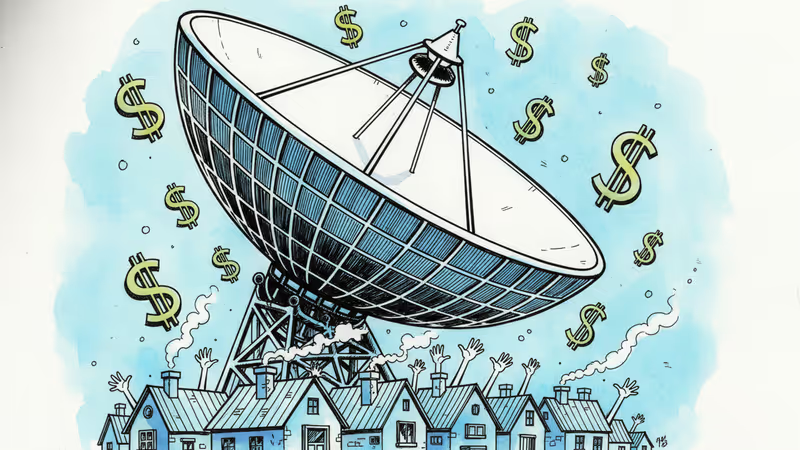
SpaceX Wants Government Money Without Government Responsibilities
SpaceX demands unprecedented terms for rural broadband subsidies - free equipment for customers, but no installation guarantees or capacity commitments.
$80 per month. That's what SpaceX is willing to charge low-income customers in government-subsidized areas for Starlink internet service. But the real story isn't in the price—it's in what the company refuses to promise in return.
Free Hardware, Paid Excuses
SpaceX has presented state governments with an unusual proposition for rural broadband subsidies. The company will provide "all necessary equipment" at no upfront cost to customers—eliminating the typical hundreds of dollars in hardware fees that have been a barrier to Starlink adoption.
On the surface, this sounds consumer-friendly. But dig deeper, and the $80 monthly cap for low-income users isn't particularly generous when Starlink's regular residential pricing ranges from $50 to $120 monthly. The company is essentially asking to be paid for offering its standard service at standard prices.
What's more telling is what SpaceX won't commit to. The company wants government payments even when residents in subsidized areas don't actually purchase Starlink service. It also refuses to guarantee that it will reserve "large portions" of network capacity specifically for these government-funded coverage areas.
Subsidies Without Strings

Perhaps most remarkably, SpaceX wants to wash its hands of installation responsibility entirely. The company won't ensure that Starlink equipment is properly installed at customer locations. Translation: we'll ship you the hardware for free, but if it doesn't work because of poor installation, that's your problem.
This approach represents a fundamental shift in how government broadband programs typically operate. Traditional telecom companies receiving federal subsidies usually face strict service requirements, coverage mandates, and performance standards. SpaceX is essentially asking for the money without the accountability.
The timing is significant. As governments worldwide grapple with digital equity and rural connectivity, SpaceX is positioning itself as both the solution and an entity that should be exempt from typical regulatory oversight. It's a bold gambit that tests how much leverage "innovative" companies can exert over public policy.
The New Rules of Corporate Welfare
This isn't just about internet service—it's about the evolving relationship between government and big tech. SpaceX is betting that its reputation as a cutting-edge space company gives it negotiating power that traditional utilities never had.
For rural residents, the implications are mixed. Free equipment could lower barriers to internet access, but the lack of installation support and capacity guarantees might leave many customers frustrated with unreliable service. Meanwhile, taxpayers fund a program where the service provider bears minimal risk or responsibility.
The broader question is whether this model will spread. If SpaceX succeeds in securing government subsidies with minimal strings attached, other tech companies will likely demand similar treatment. The precedent could reshape how public-private partnerships work across industries.
Authors
Related Articles
American Airlines just signed Starlink for 500+ aircraft. It's not just about faster inflight internet — it's a calculated move in the run-up to what could be the largest IPO in history.

SpaceX's upgraded Starship V3 completed its first test flight, deploying 20 Starlink simulators but losing the Super Heavy booster. With an IPO weeks away, the stakes just got higher.
SpaceX's IPO filing puts AI at the center, claiming a $26.5 trillion market opportunity. But can Grok compete with OpenAI and Anthropic for enterprise customers?
SpaceX filed a nearly 400-page S-1 with the SEC, targeting an IPO as early as June 12. Here's what the filing reveals—and what it doesn't.
American Airlines just signed Starlink for 500+ aircraft. It's not just about faster inflight internet — it's a calculated move in the run-up to what could be the largest IPO in history.
SpaceX's upgraded Starship V3 completed its first test flight, deploying 20 Starlink simulators but losing the Super Heavy booster. With an IPO weeks away, the stakes just got higher.
SpaceX's IPO filing puts AI at the center, claiming a $26.5 trillion market opportunity. But can Grok compete with OpenAI and Anthropic for enterprise customers?
SpaceX filed a nearly 400-page S-1 with the SEC, targeting an IPO as early as June 12. Here's what the filing reveals—and what it doesn't.
Thoughts
Share your thoughts on this article
Sign in to join the conversation