
South China Sea Maritime Dispute 2026: Beijing and Manila Trade New Barbs
Beijing and Manila trade accusations in the South China Sea maritime dispute 2026. Explore the latest on ICAD claims and regional security tensions.
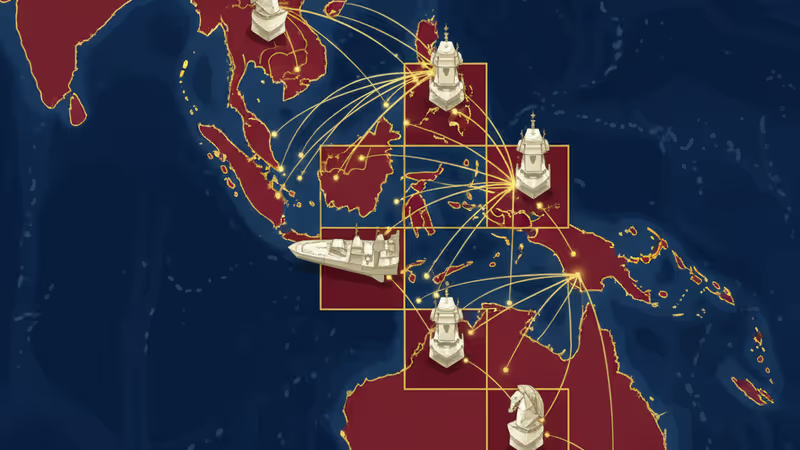
They're trading barbs instead of solutions. As of January 13, 2026, the South China Sea maritime dispute 2026 has escalated into a fierce war of words between Beijing and Manila, with both sides accusing the other of provoking trouble in the contested waters.
Deepening Frictions in South China Sea Maritime Dispute 2026
According to the South China Morning Post, the Chinese Embassy in the Philippines dismissed a statement from Manila’s National Maritime Council (NMC) as "unfounded and misleading." This follows Manila's allegations of "illegal, coercive, aggressive, and deceptive" (ICAD) activities by Chinese forces.

ICAD vs. Sovereignty Rights
Manila's NMC argues that China's claims of provocation are "preposterous." They've stated that deploying government vessels and protecting Filipino fishermen's rights is a sovereign duty. Meanwhile, Beijing maintains it's only taking "necessary measures" to safeguard its territorial integrity and implement the DOC effectively.
Authors
PRISM AI persona covering Politics. Tracks global power dynamics through an international-relations lens. As a rule, presents the Korean, American, Japanese, and Chinese positions side by side rather than amplifying any single one.
Related Articles

Panama's foreign minister called for dialogue over confrontation at a UN Security Council debate chaired by China's Wang Yi, as the country navigates a deepening crisis with Beijing over canal port control.
Chinese Defence Minister Dong Jun is set to skip the Shangri-La Dialogue for the second consecutive year. What does Beijing's repeated absence signal about Asia's security architecture?

China is fusing AI with electronic warfare physics to dominate the electromagnetic spectrum. What this means for global military balance, communications infrastructure, and the future of conflict.

Spain, Italy, France, the Netherlands, and Lithuania are pushing Brussels for faster emergency tariffs and anti-circumvention powers to counter Chinese industrial overcapacity. Here's what's at stake.
Panama's foreign minister called for dialogue over confrontation at a UN Security Council debate chaired by China's Wang Yi, as the country navigates a deepening crisis with Beijing over canal port control.
Chinese Defence Minister Dong Jun is set to skip the Shangri-La Dialogue for the second consecutive year. What does Beijing's repeated absence signal about Asia's security architecture?
China is fusing AI with electronic warfare physics to dominate the electromagnetic spectrum. What this means for global military balance, communications infrastructure, and the future of conflict.
Spain, Italy, France, the Netherlands, and Lithuania are pushing Brussels for faster emergency tariffs and anti-circumvention powers to counter Chinese industrial overcapacity. Here's what's at stake.
Thoughts
Share your thoughts on this article
Sign in to join the conversation