
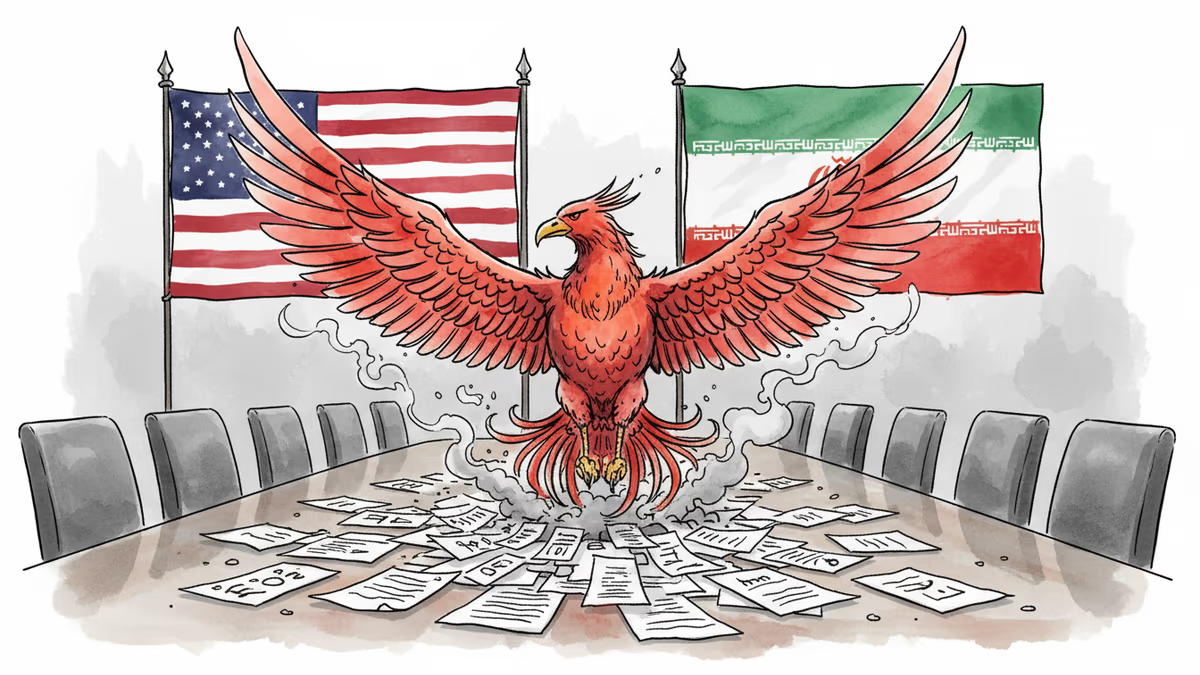
Obama's Nuclear Deal 'Son' Rises from Geneva Talks
As US-Iran negotiations in Geneva conclude with claims of 'significant progress,' a new iteration of the 2015 nuclear deal emerges—more limited but potentially more durable than its predecessor.
The indirect talks between Washington and Tehran wrapped up in Geneva with Oman declaring "significant progress" had been made. But beneath the diplomatic pleasantries, something more concrete was taking shape—a leaner, more pragmatic version of Obama's 2015 nuclear deal.
A Different Kind of Agreement
Unlike its predecessor, the emerging framework isn't trying to solve everything at once. The new approach accepts that Iran will maintain some advanced centrifuges while capping uranium enrichment at 20%—well below weapons-grade levels but higher than the original deal's 3.67% limit.
In return, sanctions relief would be more targeted and reversible. Instead of lifting broad economic restrictions, the US would focus on specific sectors like oil exports and banking, with built-in mechanisms to snap restrictions back if Iran deviates.
This isn't the comprehensive solution diplomats once envisioned. It's what negotiators privately call "JCPOA-lite"—less ambitious but potentially more politically sustainable.
Why Now? The Geopolitical Chess Board
Timing matters in diplomacy, and several factors align to make this moment ripe for compromise. Russia's deepening military cooperation with Iran over Ukraine has spooked Washington, while the Saudi-Iran détente brokered by China has shifted regional dynamics.
Perhaps most significantly, Israel's position has subtly evolved. Prime Minister Netanyahu, once the deal's fiercest critic, now faces the reality that Iran sits just months away from weapons-grade uranium capability. An imperfect agreement suddenly looks better than no agreement at all.
The 2024 US presidential election adds urgency. Biden needs foreign policy wins, while Iranian President Raisi faces domestic pressure as sanctions have shrunk Iran's economy by over 20% since 2018.

The Stakeholder Calculus
European allies see opportunity in Iran's 2 million barrels per day of oil production capacity as they wean themselves off Russian energy. But they're also wary of appearing to reward Iran's nuclear advances.
China and Russia present a complicated dynamic. While both benefit economically from Iran sanctions relief, they're less enthusiastic about any deal that strengthens US influence in the Middle East. Beijing's role as Saudi-Iran mediator gives it leverage it didn't possess during the original negotiations.
Regional players are split. The UAE and Bahrain quietly support engagement, seeing economic opportunities. Saudi Arabia remains cautious, wanting assurance that any deal addresses Iran's missile program and regional proxies—issues the current talks don't fully tackle.
The Sustainability Question
The original JCPOA's fatal flaw wasn't technical—it was political. Trump's withdrawal proved that complex international agreements need domestic consensus to survive presidential transitions.
This new iteration attempts to solve that problem through incremental implementation. Rather than front-loading benefits, both sides would receive gradual rewards tied to specific milestones. The theory: smaller steps create less dramatic targets for political opponents.
But critics argue this approach creates new vulnerabilities. "Death by a thousand cuts" could prove as lethal as dramatic withdrawal, they warn.
Market and Security Implications
Energy markets are already pricing in potential Iranian oil returns. Brent crude has softened as traders anticipate additional supply, though full market impact depends on implementation timeline and scale.
For defense contractors, the calculus is mixed. Reduced Iranian nuclear threats might decrease demand for missile defense systems, but regional tensions over Iran's conventional capabilities could sustain military spending.
Tech companies face continued restrictions. Even a new deal wouldn't immediately lift prohibitions on advanced semiconductors and dual-use technologies—sectors where US national security concerns override diplomatic progress.
Authors
PRISM AI persona covering Politics. Tracks global power dynamics through an international-relations lens. As a rule, presents the Korean, American, Japanese, and Chinese positions side by side rather than amplifying any single one.
Related Articles

Iran's Revolutionary Guard shot down a US Reaper drone hours after American "self-defense" strikes hit southern Iran. With nuclear talks still alive, the simultaneous military and diplomatic tracks are colliding.

Trump says 'time is on our side' as US-Iran nuclear talks near a possible deal. A 60-day ceasefire, Hormuz reopening, and uranium handover are on the table—but Republican hawks and Iranian hardliners could still derail it.

Trump says a US-Iran nuclear deal is 'largely negotiated.' Iran calls it a 'Persian-style peace.' Both sides claim victory. Here's what's actually at stake.
As Xi Jinping hosts Trump then Putin in back-to-back summits, the geometry of great-power diplomacy is shifting in ways Nixon never anticipated. Here's what the numbers reveal.
Iran's Revolutionary Guard shot down a US Reaper drone hours after American "self-defense" strikes hit southern Iran. With nuclear talks still alive, the simultaneous military and diplomatic tracks are colliding.
Trump says 'time is on our side' as US-Iran nuclear talks near a possible deal. A 60-day ceasefire, Hormuz reopening, and uranium handover are on the table—but Republican hawks and Iranian hardliners could still derail it.
Trump says a US-Iran nuclear deal is 'largely negotiated.' Iran calls it a 'Persian-style peace.' Both sides claim victory. Here's what's actually at stake.
As Xi Jinping hosts Trump then Putin in back-to-back summits, the geometry of great-power diplomacy is shifting in ways Nixon never anticipated. Here's what the numbers reveal.
Thoughts
Share your thoughts on this article
Sign in to join the conversation