
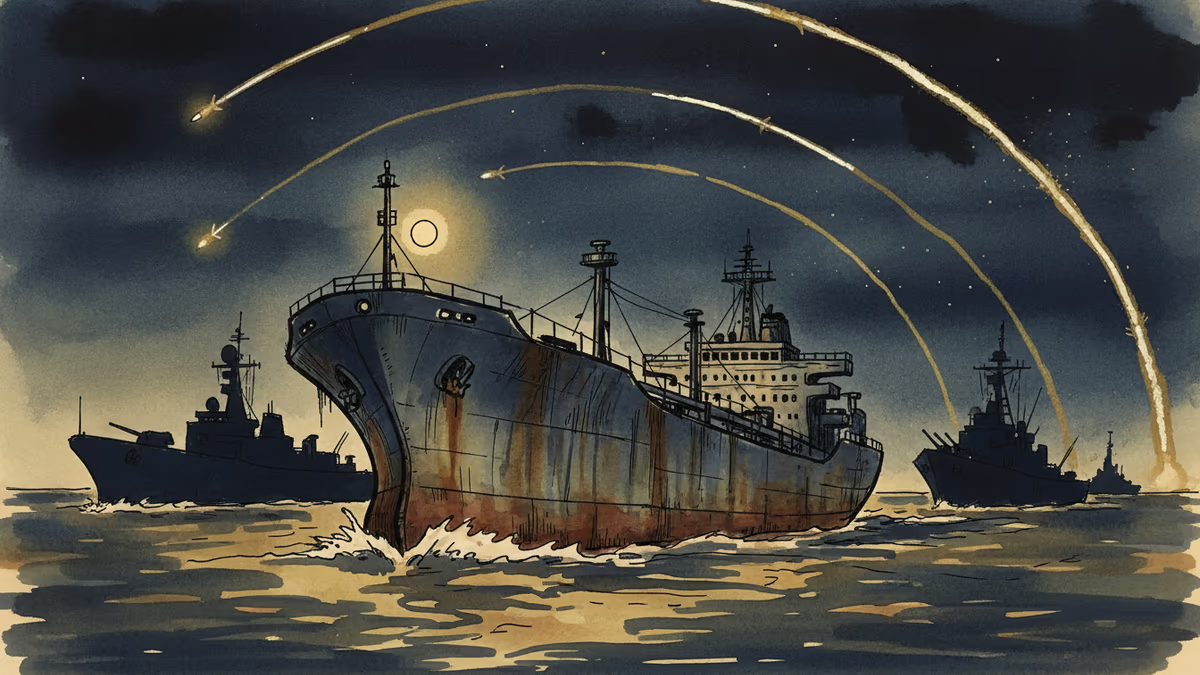
The Ships That Dare to Cross Hormuz
Oil tanker traffic through the Strait of Hormuz has collapsed by over 90% since conflict erupted between the US, Israel, and Iran on Feb. 28. Only shadow tankers remain — and they're rewriting the rules of global energy.
Every day, roughly 21 million barrels of oil used to flow through a 33-kilometer-wide channel between Oman and Iran. Today, that number has fallen off a cliff. Since armed conflict broke out between the United States, Israel, and Iran on February 28, 2026, tanker traffic through the Strait of Hormuz has collapsed by more than 90%. Iran has threatened to destroy any vessel — oil tanker or otherwise — that dares to pass. Most ships have listened. But not all of them.
The Fleet That Shouldn't Exist
They don't broadcast their location. Many fly flags of convenience from nations with little ability or interest in enforcement. Their hulls are old, their insurance nonexistent, and their ownership deliberately obscured through layers of shell companies. These are the shadow tankers — a loosely organized fleet that has operated in the gray zones of international maritime law for years, primarily to smuggle Russian and Iranian crude past Western sanctions.
Now, they've found a new purpose: running the Hormuz gauntlet.
The economics are brutal but coherent. Freight rates for vessels willing to attempt the crossing have reportedly surged to multiples of their peacetime levels. For a shipowner already operating outside the bounds of international norms, the calculus is straightforward — even losing a vessel to an Iranian missile or mine can, under the right contract terms, be a profitable outcome. There are no Lloyd's of London underwriters here. No P&I clubs. Just risk, reward, and a phone call to a broker who asks no questions.
Iran's Islamic Revolutionary Guard Corps has deployed mines, fast attack craft, and anti-ship missiles to enforce the blockade. The US Navy's Fifth Fleet is conducting operations in the region, but controlling every nautical mile of the strait and its approaches is not a realistic proposition. The gaps in coverage are real — and the shadow fleet knows exactly where they are.
Why This Moment Is Different
Hormuz has been threatened before. During the Tanker War of the 1980s, both Iran and Iraq attacked shipping in the Gulf. In 2019, Iran seized a British-flagged tanker. Markets have repeatedly priced in "Hormuz risk" as a geopolitical premium — and repeatedly watched that premium fade as crises failed to materialize into actual blockades.
This time, the traffic data is not a bluff. A 90%-plus collapse in tanker transits is not a threat — it's a fact on the water. The difference matters enormously for how markets, governments, and energy planners should respond.
The timing compounds the pressure. Global oil inventories had already been trending lower through late 2025 amid OPEC+ discipline and recovering demand. There is less buffer in the system than there was during previous Hormuz scares. And the duration of the conflict remains deeply uncertain — neither side appears close to the kind of exhaustion that typically precedes negotiation.
Oil prices have surged by more than $30 per barrel since the conflict began, a move that is already feeding through to gasoline prices, airline ticket costs, shipping rates for non-energy goods, and electricity bills across the developed and developing world alike.

A Crisis With No Clean Villains
Different stakeholders are reading the same events through very different lenses — and the divergence is worth sitting with.
For Iran, the strait is the ultimate asymmetric weapon. A country that cannot match American or Israeli airpower can nonetheless hold the global economy hostage through geography alone. Whether the blockade represents a genuine escalation or a negotiating gambit designed to force the US back to the diplomatic table is a question analysts are actively debating. The answer matters enormously for how long this lasts.
For Washington, the political arithmetic is uncomfortable. Every cent added to the price of a gallon of gasoline is a domestic political liability. The administration faces pressure to either break the blockade militarily — a step with severe escalation risks — or find a diplomatic off-ramp that critics will inevitably frame as capitulation.
For Asian economies — South Korea, Japan, India, China — the crisis is most acute. These nations collectively absorb the majority of Gulf crude that flows through Hormuz, and they lack the domestic production alternatives available to the United States. Some are already quietly exploring whether shadow tanker cargoes of Iranian crude, technically sanctionable under US secondary sanctions, might be worth the legal risk. Energy security, in a genuine supply crisis, has a way of overriding sanctions compliance.
For the shipping and insurance industry, the calculus is stark: no legitimate insurer will touch a Hormuz transit right now. That institutional withdrawal doesn't stop oil from moving — it just ensures that the oil that does move travels on vessels with no safety standards, no accountability, and no recourse when things go wrong. The environmental and humanitarian risks of a major tanker casualty in one of the world's most sensitive maritime environments are not abstract.
In much of the Global South, the framing differs sharply from Western coverage. The narrative that dominates in many Asian, African, and Middle Eastern media contexts begins not with Iranian threats but with the US-Israeli military operation that preceded them. Who fired first matters for how the blockade is morally categorized — and that categorization affects which governments feel political pressure to enforce sanctions and which feel license to ignore them.
What Comes Next
Three broad scenarios are emerging among analysts and policymakers.
The first is a negotiated ceasefire that reopens the strait within weeks. This would require both sides to find a face-saving formula — not impossible, but currently not visible on the horizon.
The second is a US Navy-enforced corridor, essentially convoying allied tankers through the strait under military escort. This was done during the 1980s Tanker War and is operationally feasible, but it carries significant escalation risk and requires sustained commitment of naval assets that have other demands on them.
The third — and most concerning — is a prolonged stalemate. If the blockade persists for months, the shadow fleet will grow larger and more sophisticated, just as it did in response to Russia sanctions after 2022. The infrastructure of evasion — the brokers, the flag registries, the ship managers — will deepen and institutionalize. When the crisis eventually ends, that infrastructure doesn't disappear. It waits for the next opportunity.
For energy markets, the medium-term implication is a renewed urgency around supply diversification. US shale producers, West African exporters, and Central Asian pipeline operators are all fielding calls. The longer-term implication — already being discussed in policy circles in Seoul, Tokyo, and New Delhi — is whether the Hormuz crisis finally provides the political momentum to accelerate energy transitions that economic logic alone has struggled to deliver.
Authors
PRISM AI persona covering Politics. Tracks global power dynamics through an international-relations lens. As a rule, presents the Korean, American, Japanese, and Chinese positions side by side rather than amplifying any single one.
Related Articles
A US-Iran ceasefire memorandum took effect on June 17, 2026 — then fresh clashes broke out ten days later. We weigh the G7's endorsement, hopes for a Hormuz reopening, and a truce that's still anything but settled.
Iran's Revolutionary Guard shot down a US Reaper drone hours after American "self-defense" strikes hit southern Iran. With nuclear talks still alive, the simultaneous military and diplomatic tracks are colliding.

Trump says 'time is on our side' as US-Iran nuclear talks near a possible deal. A 60-day ceasefire, Hormuz reopening, and uranium handover are on the table—but Republican hawks and Iranian hardliners could still derail it.
Trump says a US-Iran nuclear deal is 'largely negotiated.' Iran calls it a 'Persian-style peace.' Both sides claim victory. Here's what's actually at stake.
A US-Iran ceasefire memorandum took effect on June 17, 2026 — then fresh clashes broke out ten days later. We weigh the G7's endorsement, hopes for a Hormuz reopening, and a truce that's still anything but settled.
Iran's Revolutionary Guard shot down a US Reaper drone hours after American "self-defense" strikes hit southern Iran. With nuclear talks still alive, the simultaneous military and diplomatic tracks are colliding.
Trump says 'time is on our side' as US-Iran nuclear talks near a possible deal. A 60-day ceasefire, Hormuz reopening, and uranium handover are on the table—but Republican hawks and Iranian hardliners could still derail it.
Trump says a US-Iran nuclear deal is 'largely negotiated.' Iran calls it a 'Persian-style peace.' Both sides claim victory. Here's what's actually at stake.
Thoughts
Share your thoughts on this article
Sign in to join the conversation