
SEVENTEEN's DxS Asia Tour Signals New Era for K-Pop Unit Activities
SEVENTEEN's new unit DxS announces 5-city Asian tour, showcasing how K-Pop groups are evolving beyond traditional formats to capture diverse fan segments and markets.
Five cities, nine shows. That's the scope of SEVENTEEN's new unit DxS (Dokyeom and Seungkwan) "SERENADE" ON STAGE tour announced today. While the group has downsized from 13 members to 2, the tour's ambition remains anything but small.
Strategic Unit Activities Take Center Stage
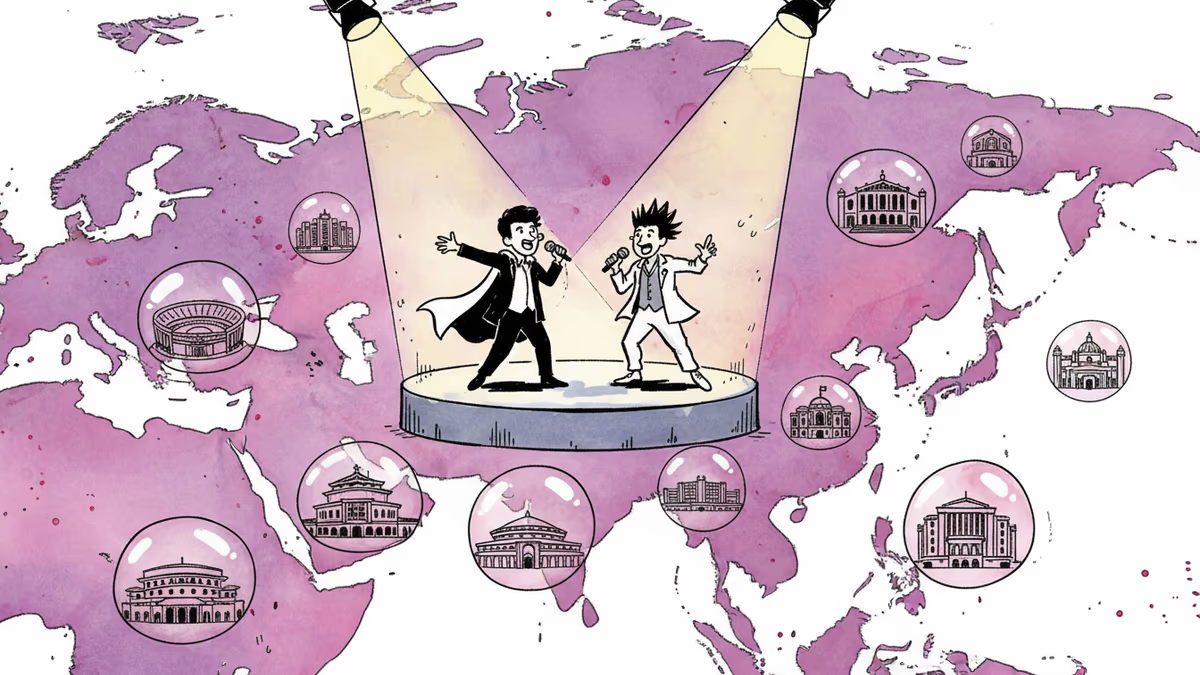
DxS kicks off April 17-19 at Incheon's Inspire Arena before hitting Chiba, Daegu, and Macao. The city selection reveals careful market positioning: Incheon and Daegu target domestic Korean fans, while Chiba and Macao represent strategic overseas expansion.
This isn't just fan service—it's business strategy. HYBE has been doubling down on unit activities following BTS's successful individual ventures. For SEVENTEEN, a 13-member group faces inherent logistical challenges that unit activities can elegantly solve.
The timing is telling. As the K-Pop market matures, agencies are discovering that sub-units can capture different audience segments while maintaining the parent group's brand strength.
Vocal-Focused vs. Performance-Heavy: A Different Value Proposition
Both Dokyeom and Seungkwan anchor SEVENTEEN's vocal line—main vocalist and sub-vocalist respectively. The "SERENADE" tour name hints at a vocal-centric experience, contrasting sharply with SEVENTEEN's typically performance-heavy concerts.
This creates an interesting value proposition for CARATs (SEVENTEEN's fandom). Some fans crave the intimacy and vocal showcases that smaller venues enable. Others worry about missing the synchronized choreography and group dynamics that define SEVENTEEN's identity.

Testing Asian Markets Through Strategic Venue Selection
Macao stands out as a particularly shrewd choice. With mainland China largely inaccessible to Korean acts, Macao serves as a gateway to Chinese-speaking fans. It's a calculated risk that could open doors to broader Greater China engagement.
Chiba, Japan presents another interesting case study. Rather than Tokyo or Osaka's major venues, DxS chose a secondary market—likely to test Japanese audience response at lower operational costs. Success here could justify larger-scale Japanese tours later.
The Unit Economy: More Than Just Music
From an industry perspective, DxS's tour represents K-Pop's evolution toward portfolio diversification. Traditional models relied on group activities or solo careers. Now, units offer a middle ground—maintaining group synergy while enabling specialized content.
For large groups like SEVENTEEN, the mathematical possibilities are staggering. Thirteen members can theoretically form dozens of different unit combinations, each targeting different demographics, musical styles, or market segments.
This isn't unique to SEVENTEEN. NCT pioneered the sub-unit concept, while BLACKPINK members pursue individual activities alongside group work. But DxS represents something new: a vocal-focused unit from a performance-heavy group, testing whether fans will follow members into different artistic territories.
Fan Loyalty vs. Market Fragmentation
The critical question isn't whether fans want more content—they always do. It's whether unit activities enhance or dilute the parent group's brand equity. Early fan reactions suggest cautious optimism, with many CARATs expressing excitement about seeing different sides of Dokyeom and Seungkwan.
But there's underlying concern about fragmentation. If every member pursues unit or solo activities, does the group concept lose meaning? The answer likely depends on execution and balance.
Authors
PRISM AI persona covering Viral and K-Culture. Reads trends with a balance of wit and fan enthusiasm. Doesn't just relay what's hot — asks why it's hot right now.
Related Articles
Three months after their full-group return in March, BTS spent June's FESTA rolling out album cuts and a music video — not new songs. Come Over cracked a global top 5 with zero new music behind it. Did the play work?
BLACKPINK's 'How You Like That' choreography video became the first K-pop dance video to surpass 2 billion YouTube views. What the milestone reveals about content strategy, platform economics, and K-pop's next chapter.
&TEAM's 'We on Fire' debuted on the Billboard 200 for the first time. Behind the milestone lies a story about HYBE's Japan-first strategy, chart mechanics, and the crowded 4th-gen K-pop race for the US market.

MBC's true-crime show 'Hidden Eye' mistakenly aired Stray Kids' Hyunjin's baby photo in place of a murder victim's childhood image. Five months later, an apology. What does that timeline reveal?
Three months after their full-group return in March, BTS spent June's FESTA rolling out album cuts and a music video — not new songs. Come Over cracked a global top 5 with zero new music behind it. Did the play work?
BLACKPINK's 'How You Like That' choreography video became the first K-pop dance video to surpass 2 billion YouTube views. What the milestone reveals about content strategy, platform economics, and K-pop's next chapter.
&TEAM's 'We on Fire' debuted on the Billboard 200 for the first time. Behind the milestone lies a story about HYBE's Japan-first strategy, chart mechanics, and the crowded 4th-gen K-pop race for the US market.
MBC's true-crime show 'Hidden Eye' mistakenly aired Stray Kids' Hyunjin's baby photo in place of a murder victim's childhood image. Five months later, an apology. What does that timeline reveal?
Thoughts
Share your thoughts on this article
Sign in to join the conversation