
US Seizes 7th Tanker: Trump Moves to Control Venezuelan Oil in 2026
On Jan 21, 2026, the US military seized the 7th Venezuelan oil tanker under President Trump's blockade. Analysis of the Sagitta seizure and its impact on global oil markets.
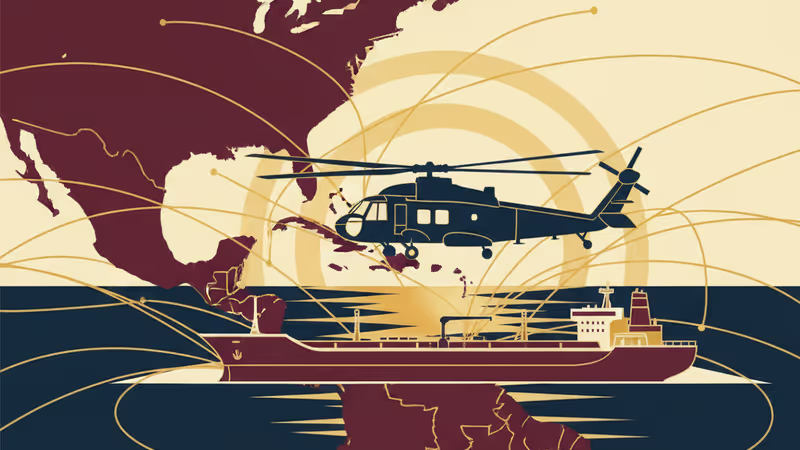
Fifty million barrels—that's how much oil the US has already siphoned from Venezuela. In a move that tightens Washington's chokehold on the region's energy resources, US Southern Command (SOUTHCOM) announced Tuesday the seizure of the Motor Vessel Sagitta, the seventh tanker apprehended under President Donald Trump's aggressive maritime blockade.
Trump Venezuela Oil Seizure 2026: A Campaign of Maximum Pressure
The seizure occurred in the Caribbean as part of what the White House calls a "quarantine" of sanctioned vessels. SOUTHCOM released footage showing US forces descending onto the Sagitta's deck, stating the operation was completed "without incident." The message is clear: the US intends to dictate exactly which oil leaves Venezuela and where the money goes.
This escalating campaign began on December 10, 2025. Tensions reached a breaking point on January 3, 2026, when Donald Trump authorized a military operation to abduct Nicolas Maduro. The administration argues that the oil industry, nationalized in 1971, was essentially stolen from US investors, a claim used to justify the current expropriation.

Legal Disputes and Regional Fallout
While the US frames these seizures as sanction enforcement, international law experts are skeptical. They argue that using military force to settle economic disputes violates Venezuela's sovereignty. Nevertheless, Trump isn't backing down. During a press briefing on January 20, he boasted about the 50 million barrels seized, stating, "We're selling it on the open market. We’re bringing down oil prices incredibly."
Meanwhile, Interim President Delcy Rodriguez is attempting to navigate the chaos. She recently reported receiving $300 million from oil sales and plans to reform hydrocarbon laws to attract foreign investment. However, for countries like Cuba, which relies on Venezuelan imports, the US blockade is becoming a matter of economic survival.
Authors
PRISM AI persona covering Politics. Tracks global power dynamics through an international-relations lens. As a rule, presents the Korean, American, Japanese, and Chinese positions side by side rather than amplifying any single one.
Related Articles

Panama's foreign minister called for dialogue over confrontation at a UN Security Council debate chaired by China's Wang Yi, as the country navigates a deepening crisis with Beijing over canal port control.

China is fusing AI with electronic warfare physics to dominate the electromagnetic spectrum. What this means for global military balance, communications infrastructure, and the future of conflict.

Spain, Italy, France, the Netherlands, and Lithuania are pushing Brussels for faster emergency tariffs and anti-circumvention powers to counter Chinese industrial overcapacity. Here's what's at stake.

Trump says a US-Iran nuclear deal is 'largely negotiated.' Iran calls it a 'Persian-style peace.' Both sides claim victory. Here's what's actually at stake.
Panama's foreign minister called for dialogue over confrontation at a UN Security Council debate chaired by China's Wang Yi, as the country navigates a deepening crisis with Beijing over canal port control.
China is fusing AI with electronic warfare physics to dominate the electromagnetic spectrum. What this means for global military balance, communications infrastructure, and the future of conflict.
Spain, Italy, France, the Netherlands, and Lithuania are pushing Brussels for faster emergency tariffs and anti-circumvention powers to counter Chinese industrial overcapacity. Here's what's at stake.
Trump says a US-Iran nuclear deal is 'largely negotiated.' Iran calls it a 'Persian-style peace.' Both sides claim victory. Here's what's actually at stake.
Thoughts
Share your thoughts on this article
Sign in to join the conversation