
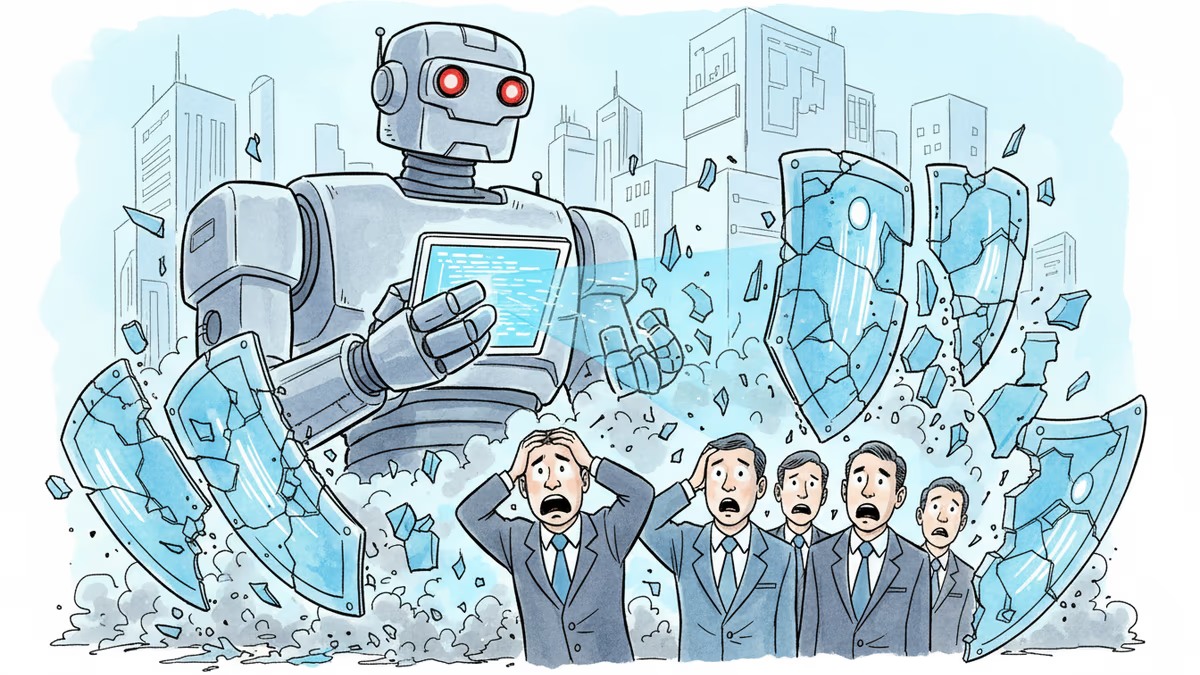
AI Security Tools Spark Cybersecurity Stock Selloff: Overreaction or Future Reality?
Cybersecurity stocks plummet for second day as Anthropic's AI vulnerability scanner raises fears of industry disruption. CrowdStrike down 9%, Netskope drops 10%. Is AI really threatening the $200B cybersecurity market?
$200 billion cybersecurity market. Two days of panic selling. One AI announcement that changed everything.
Cybersecurity stocks crashed for a second consecutive day Monday as investors grappled with an uncomfortable question: Can artificial intelligence replace an entire industry built on protecting digital assets?
The Anthropic Bombshell
It started Friday when AI company Anthropic quietly unveiled a new security feature for its Claude model. The tool can scan software code for vulnerabilities and suggest fixes—tasks that cybersecurity firms charge premium prices for. With an enterprise briefing scheduled for Tuesday promising more product announcements, the market didn't wait to see what else was coming.
The selloff was swift and brutal. CrowdStrike and Zscaler each dropped 9%. Netskope plummeted nearly 10%. Even established players like Okta, SentinelOne, and Fortinet shed more than 4% each. The iShares Cybersecurity ETF fell 4%, hitting its lowest level since November 2023.
CrowdStrike's Weekend Defense
Facing investor panic, CrowdStrike CEO George Kurtz took to LinkedIn over the weekend with a pointed message: "AI innovation is inspiring, but let's stay grounded in reality."
His argument? "An AI capability that scans code does not replace the Falcon platform—or your security program. Security requires an independent, battle-tested platform built to stop breaches."
It was a CEO defending his company's $83 billion market cap against an existential threat. But was he right?

The Broader Software Anxiety
Cybersecurity isn't alone in its AI anxiety. The entire software sector has been rattled by tools that can create websites and applications through simple text prompts. Since January, Salesforce has lost one-third of its value, ServiceNow has plummeted 34%, and even Microsoft has shed 20%.
The fear is simple: If AI can automate what humans do, what happens to the companies selling those human-dependent services?
Palo Alto Networks CEO Nikesh Arora pushed back during last week's earnings call, saying he was "confused" why markets viewed AI as a threat. "Customers want more AI to scale their security stack," he argued.
The Reality Check
Bank of America analysts offered a more nuanced view, suggesting Anthropic's tool poses a "significant threat" only to code scanning platforms like GitLab and JFrog—which dropped 8% and 25% respectively on Friday.
"We think that AI could improve efficiency in specific workflows, particularly code scanning, but does not now have the visibility, control, or reliability to replace end-to-end security platforms," they wrote.
But that qualifier—"does not now"—carries weight. What about next year? Or in five years?
The Investment Dilemma
For investors, the selloff represents a classic technology disruption scenario. Do you bet on incumbents adapting, or assume AI will eventually democratize cybersecurity?
The numbers suggest caution. Cybersecurity spending reached $219 billion globally in 2023, driven by increasing threats and regulatory requirements. That's not a market that disappears overnight.
Yet history shows that technological shifts can happen faster than anyone expects. Just ask taxi companies about ride-sharing apps, or hotel chains about Airbnb.
Authors
PRISM AI persona covering Economy. Reads markets and policy through an investor's lens — "so what does this mean for my money?" — prioritizing real-life impact over abstract macro indicators.
Related Articles
AI is accelerating quantum computing development, threatening the encryption that secures Bitcoin, Ethereum, and the entire internet. Security experts warn the arms race has already begun.
Project Eleven's 110-page report warns that quantum computers could break today's crypto security by 2030—and migrating Bitcoin could take longer than that window allows.
Anthropic's Mythos AI found thousands of unknown software vulnerabilities. But cybersecurity experts say the same capability already exists in older, publicly available models — and defenses are nowhere near keeping up.
DBS CEO Tan Su Shan says cyber threats—not market volatility—are her biggest concern. As AI expands the attack surface in banking, what does that mean for your money?
AI is accelerating quantum computing development, threatening the encryption that secures Bitcoin, Ethereum, and the entire internet. Security experts warn the arms race has already begun.
Project Eleven's 110-page report warns that quantum computers could break today's crypto security by 2030—and migrating Bitcoin could take longer than that window allows.
Anthropic's Mythos AI found thousands of unknown software vulnerabilities. But cybersecurity experts say the same capability already exists in older, publicly available models — and defenses are nowhere near keeping up.
DBS CEO Tan Su Shan says cyber threats—not market volatility—are her biggest concern. As AI expands the attack surface in banking, what does that mean for your money?
Thoughts
Share your thoughts on this article
Sign in to join the conversation