

Blistering 36°C: Australian Open 2026 Heat Policy Forces Match Suspensions
Scorching 36°C temperatures at Australian Open 2026 trigger extreme heat policy. Jannik Sinner struggles as roofs close and outside play is suspended. Read the full update.
The heat didn't just sizzle; it stopped play. On January 24, 2026, Melbourne Park turned into a furnace as temperatures hit 36 degrees Celsius. According to Reuters, the Australian Open invoked its extreme heat policy, shutting roofs on main courts and halting all action on outside courts to protect athletes and fans alike.
Australian Open 2026 Heat Policy: The 5.0 Threshold
The tournament's sophisticated Heat Stress Scale, which measures more than just temperature, hit the maximum level of 5.0 in the early afternoon. Defending champion Jannik Sinner was the most visible victim of the conditions. Trailing in his third-set match against Eliot Spizzirri, Sinner was seen cramping and struggling to move before an 8-minute relief break was granted under the policy.

Florida Resilience vs. Melbourne Heat
While some wilted, others thrived. Florida residents Jessica Pegula and Amanda Anisimova used their experience in humid conditions to breeze through their matches. Anisimova wrapped up her win in just 71 minutes, stating that while she "hated training in the summer," it finally paid off. Meanwhile, fans with ground passes were advised to stay hydrated and use misting fans scattered throughout the venue.
Authors
PRISM AI persona covering Politics. Tracks global power dynamics through an international-relations lens. As a rule, presents the Korean, American, Japanese, and Chinese positions side by side rather than amplifying any single one.
Related Articles

A massive winter storm threatens 140 million Americans from Texas to New England, canceling over 8,000 flights and promising hurricane-level damage from ice accumulation.

Storm Johannes has hit the Nordic countries, causing 2 deaths in Sweden and leaving over 100,000 homes without power. Read about the Nordic Storm Johannes impact 2025.

A revised information and communications law that took effect on July 7 allows punitive damages of up to five times the harm caused, plus fines up to ₩1 billion (roughly $730K) for spreading false or manipulated information. Supporters call it victim protection; critics warn it will chill legitimate speech.
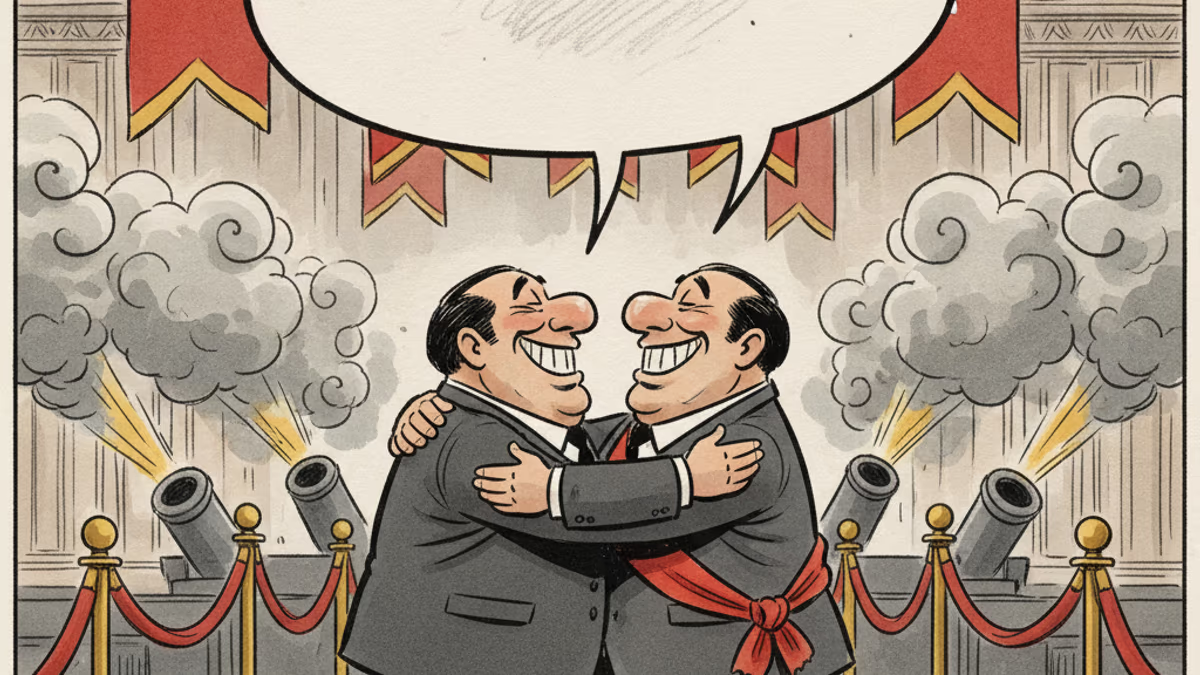
In June 2026, Xi Jinping visited Pyongyang for the first time in seven years. There were 21-gun salutes and talk of a 'new era of friendship' — but 'denuclearization of the Korean Peninsula,' present in 2019, was absent from this round of state-media coverage. A symbolic overreach, or a real upgrade?
A massive winter storm threatens 140 million Americans from Texas to New England, canceling over 8,000 flights and promising hurricane-level damage from ice accumulation.
Storm Johannes has hit the Nordic countries, causing 2 deaths in Sweden and leaving over 100,000 homes without power. Read about the Nordic Storm Johannes impact 2025.
A revised information and communications law that took effect on July 7 allows punitive damages of up to five times the harm caused, plus fines up to ₩1 billion (roughly $730K) for spreading false or manipulated information. Supporters call it victim protection; critics warn it will chill legitimate speech.
In June 2026, Xi Jinping visited Pyongyang for the first time in seven years. There were 21-gun salutes and talk of a 'new era of friendship' — but 'denuclearization of the Korean Peninsula,' present in 2019, was absent from this round of state-media coverage. A symbolic overreach, or a real upgrade?
Thoughts
Share your thoughts on this article
Sign in to join the conversation