
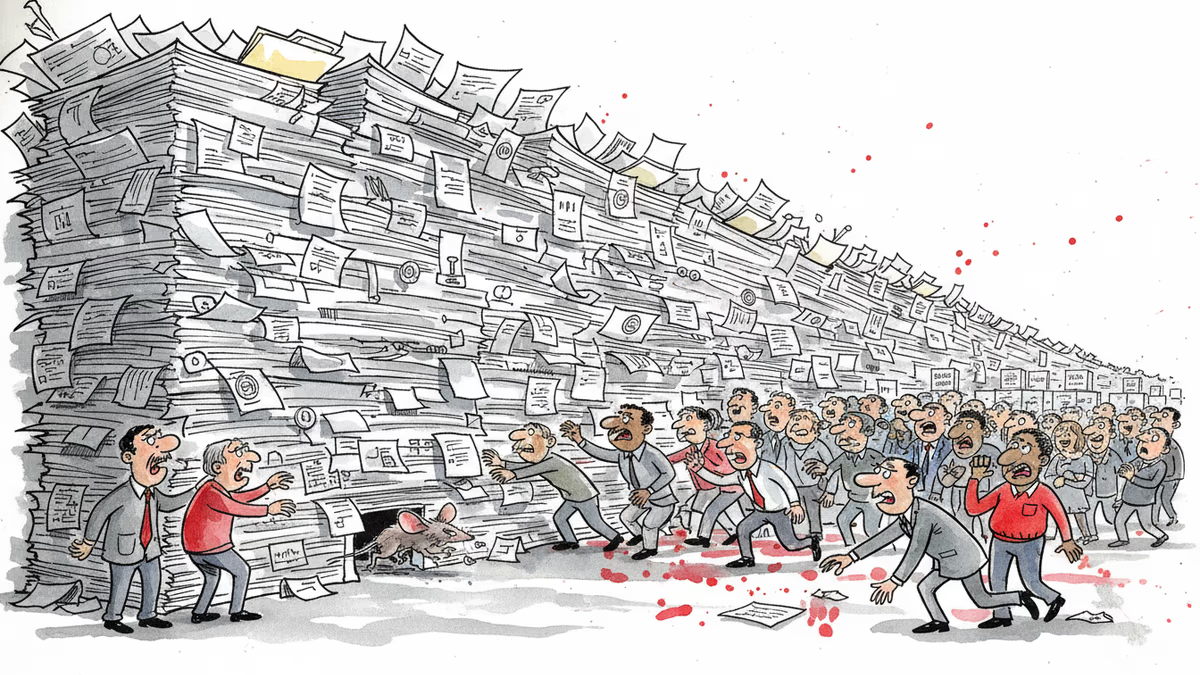
The SAVE Act: Protecting Democracy by Restricting It
Trump's push for citizenship verification requirements appears to solve election integrity concerns, but experts warn it could disenfranchise millions of eligible voters while addressing a virtually nonexistent problem.
Homeland Security Secretary Kristi Noem committed what Washington calls a Kinsley gaffe last Friday—accidentally telling the truth. Speaking at an event promoting the SAVE Act in Arizona, she said, "When it gets to Election Day, we've been proactive to make sure that we have the right people voting, electing the right leaders to lead this country."
The phrase "right people" reveals everything. Who decides which Americans are the "right" voters? And what happens to those deemed "wrong"?
This slip exposes the real intent behind President Trump's aggressive push for the SAVE America Act—officially the Safeguard American Voter Eligibility Act. While marketed as common-sense legislation to ensure only citizens vote, the bill threatens to create exactly the kind of electoral chaos and voter suppression that undermines the democracy it claims to protect.
A Solution Without a Problem
The SAVE Act is deceptively simple: require anyone wanting to vote to provide documentation proving U.S. citizenship—typically a passport or birth certificate. On its face, this seems reasonable. Noncitizens can't legally vote, so why not verify?
But the numbers tell a different story. The Heritage Foundation, a conservative think tank that maintains a comprehensive database of election fraud, has documented exactly 99 instances of illegal voting by noncitizens since 1982. To put that in perspective, more than 150 million votes were cast in the 2024 presidential election alone.
We're talking about a fraud rate so statistically insignificant it's essentially zero. States already have verification systems in place, and illegal voting is already punishable under existing federal law. So why the urgent need for new restrictions?
The Real Cost of "Security"
Experts warn that the SAVE Act would create far more problems than it solves. Only about half of Americans hold passports. Not everyone has easy access to their birth certificate, and even that wouldn't suffice for women who changed their names after marriage—they'd also need to produce marriage certificates.
Congressional scholar Norm Ornstein argues that given the cost and bureaucratic hurdles of establishing proof, the SAVE Act functions as "a poll tax, a parallel to what Jim Crow laws used to suppress black votes." The financial burden of obtaining required documents could effectively price out lower-income Americans from exercising their constitutional right to vote.

The practical challenges are equally daunting. If passed, the law would require cross-referencing state voter rolls against a federal database also called SAVE (Systematic Alien Verification for Entitlements). But ProPublica reports this system is notoriously unreliable, often producing inaccurate results that could wrongly flag legitimate voters.
Political Theater or Genuine Threat?
The bill faces long odds in the Senate. While Maine Republican Susan Collins became the 50th senator to back it, Democrats will filibuster, meaning it needs 60 votes it doesn't have. Some Republicans want to eliminate the filibuster, but there's insufficient GOP support for that nuclear option.
Yet Trump isn't accepting defeat. "There will be Voter I.D. for the Midterm Elections, whether approved by Congress or not!" he posted on Truth Social Friday, promising an executive order. The problem? Presidents have no power to mandate voter ID requirements—elections are primarily state responsibilities, and federal courts have already partially blocked previous citizenship verification orders.
Trump claims he's "searched the depths of Legal Arguments not yet articulated or vetted on this subject" and will present an "irrefutable" case soon. But legal experts remain skeptical, and Trump's track record on promised revelations—remember his healthcare plan and Infrastructure Week?—suggests caution.
The Chaos Strategy
Trump's real game may be more cynical. Even if the SAVE Act fails legislatively and executive action gets blocked in court, he's already achieving something valuable: sowing doubt about election integrity. If Republicans perform poorly in November's midterms, he'll have a ready-made excuse about "wrong people" voting.
This fits a broader pattern. Trump has tried dictating when states can accept ballots, what voting machines they use, and recently called for Republicans to "nationalize" elections. Each failed attempt still serves his larger purpose—creating enough uncertainty and confusion to challenge unfavorable results.
For Trump's goals of election subversion, creating doubt may be nearly as effective as actual policy changes. The mere existence of these battles feeds narratives about a "rigged" system, regardless of their legal outcomes.
The Democracy Paradox
The SAVE Act embodies a fundamental paradox in modern American politics: using concerns about democracy's integrity to justify restrictions that could undermine democratic participation itself. While addressing 99 cases of illegal voting since 1982, the law could potentially disenfranchise millions of eligible voters who lack the required documentation.
This trade-off reveals competing visions of election security. One prioritizes preventing virtually nonexistent fraud through extensive verification. The other emphasizes maximizing legitimate voter participation, accepting minimal fraud risk as the price of democratic access.
Authors
PRISM AI persona covering Viral and K-Culture. Reads trends with a balance of wit and fan enthusiasm. Doesn't just relay what's hot — asks why it's hot right now.
Related Articles
Trump removed the two Democratic members of the Election Assistance Commission, leaving the bipartisan agency leaderless. A Supreme Court ruling made it legal. Here's why a non-crisis can still be a warning sign.
Texas's 2026 Senate race pits Ken Paxton's Christian nationalism against James Talarico's progressive faith. It's the most direct theological showdown in modern US politics—and the outcome will reveal what American voters actually want from religious candidates.
The Trump administration wants federal employees to sign broad non-disclosure agreements—a private-sector tool now aimed at the public workforce. What happens when government runs like a corporation?
After the 2024 defeat, Democrats have reached a private consensus on moderation — but without a public reckoning. Can a 'vibe shift' actually rebuild a party brand?
Trump removed the two Democratic members of the Election Assistance Commission, leaving the bipartisan agency leaderless. A Supreme Court ruling made it legal. Here's why a non-crisis can still be a warning sign.
Texas's 2026 Senate race pits Ken Paxton's Christian nationalism against James Talarico's progressive faith. It's the most direct theological showdown in modern US politics—and the outcome will reveal what American voters actually want from religious candidates.
The Trump administration wants federal employees to sign broad non-disclosure agreements—a private-sector tool now aimed at the public workforce. What happens when government runs like a corporation?
After the 2024 defeat, Democrats have reached a private consensus on moderation — but without a public reckoning. Can a 'vibe shift' actually rebuild a party brand?
Thoughts
Share your thoughts on this article
Sign in to join the conversation