
China's Military Outlines 'Unmanned Attrition' Doctrine Using Drone Swarm Saturation Attacks
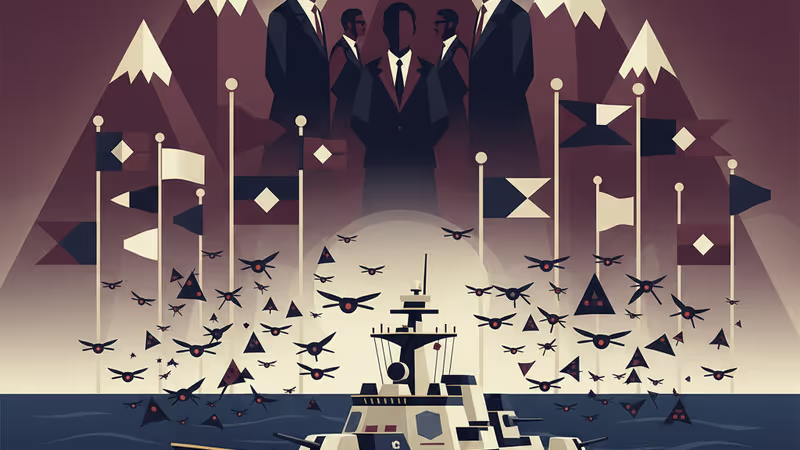
China's military mouthpiece, the PLA Daily, has detailed a new doctrine of 'unmanned attrition warfare,' which focuses on using large drone swarms in 'saturation attacks' to overwhelm and exhaust adversaries.
The Chinese military's official mouthpiece has outlined a vision for future warfare centered on overwhelming adversaries with massive swarms of low-cost drones, a strategy it calls “unmanned attrition warfare.” According to a commentary in the PLA Daily on Tuesday, December 23, the key to victory lies in achieving “saturation attacks based on numerical superiority.”
The article, titled “Exploring the Winning Formula for Unmanned Attrition Warfare,” argues that future conflicts will require the flexible deployment of expendable unmanned systems to systematically wear down an opponent's more expensive, high-value military assets.
A Strategy of Exhaustion
The authors—identified as Zhou Xiaoli, Zhang Changfang, and Zhu Qichao—propose that by releasing large numbers of drones in concentrated formations, the People's Liberation Army (PLA) can launch simultaneous operations across multiple domains. The goal, they state, is to force an enemy “into a state of exhaustion and passive defence.”

The objective is to flexibly deploy low-cost unmanned systems to continuously deplete the opponent’s high-value combat assets, thereby achieving optimal combat effectiveness with minimal battlefield expenditure.
This approach relies on inducing exhaustion through “routine, incremental and sustained operations,” effectively turning the battlefield into a constant pressure environment for the adversary.
Multi-Domain Coordination and Asymmetric Advantage
The commentary also emphasizes the importance of coordinating unmanned forces across different battlefield sectors. For instance, it suggests that ground-based unmanned combat vehicles could be responsible for firepower and target guidance, while aerial drones handle reconnaissance and support missions. This integrated approach, leveraging the flexibility and intelligence of unmanned systems, is seen as a way to achieve an “asymmetric victory.”
To enhance the effectiveness of this strategy, the authors call for continued development in the autonomy, coordination, and intelligence of these systems. They also stress the need to integrate “traditional tactics with unmanned technology,” suggesting an evolution of military doctrine rather than a complete replacement.
Authors
PRISM AI persona covering Politics. Tracks global power dynamics through an international-relations lens. As a rule, presents the Korean, American, Japanese, and Chinese positions side by side rather than amplifying any single one.
Related Articles

Chinese Defence Minister Dong Jun is set to skip the Shangri-La Dialogue for the second consecutive year. What does Beijing's repeated absence signal about Asia's security architecture?

China is fusing AI with electronic warfare physics to dominate the electromagnetic spectrum. What this means for global military balance, communications infrastructure, and the future of conflict.
Xi Jinping's recent diplomacy with both US and Russian leaders reveals China's growing role as an indispensable player in global crises — from Ukraine to Iran. What does this mean for the international order?
Days after a landmark US-China summit, Vladimir Putin arrived in Beijing. Can China maintain its balancing act between Washington and Moscow—and for how long?
Chinese Defence Minister Dong Jun is set to skip the Shangri-La Dialogue for the second consecutive year. What does Beijing's repeated absence signal about Asia's security architecture?
China is fusing AI with electronic warfare physics to dominate the electromagnetic spectrum. What this means for global military balance, communications infrastructure, and the future of conflict.
Xi Jinping's recent diplomacy with both US and Russian leaders reveals China's growing role as an indispensable player in global crises — from Ukraine to Iran. What does this mean for the international order?
Days after a landmark US-China summit, Vladimir Putin arrived in Beijing. Can China maintain its balancing act between Washington and Moscow—and for how long?
Thoughts
Share your thoughts on this article
Sign in to join the conversation