
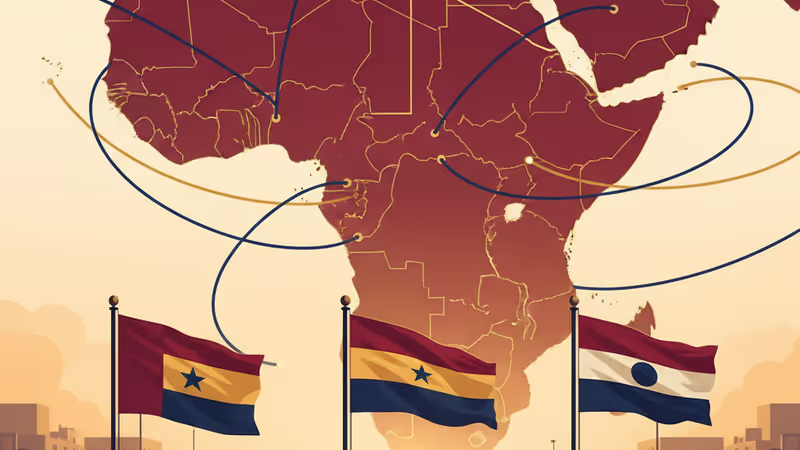
Sahel Alliance AES Summit 2025: A High-Stakes Break from the West
Analyze the outcomes of the Sahel Alliance AES summit 2025 in Bamako. Explore the shift from France to Russia, the launch of new regional institutions, and the ongoing threats from JNIM.
They've joined hands, but the enemy is at the gates. The Sahel trio is betting everything on a Russian-backed future, severing old ties with the West. On December 23, 2025, leaders from Mali, Burkina Faso, and Niger gathered in Bamako for the second summit of the Alliance of Sahel States (AES), marking a decisive shift in the region's geopolitical landscape.
Sahel Alliance AES Summit 2025: Building New Institutions
The summit wasn't just about optics; it was a ribbon-cutting moment for a new regional order. The three nations inaugurated the Sahel Investment and Development Bank, designed to bypass Western lenders like the World Bank. They also formalized a joint military force to combat insurgency and launched a unified television channel. These moves signal a concerted effort to build a shared narrative of sovereignty, independent of former colonial influences.
Out with France, In with Russia

The strategic pivot away from France is now nearly complete. From a peak of over 5,000 troops, French presence has vanished, replaced by an increasing reliance on Russian security assistance. Anti-French sentiment has become a powerful unifying force, with the CFA franc and French media viewed as symbols of interference rather than partnership.
The Siege Within: Al-Qaeda and Economic Reality
Despite the celebratory tone in the halls of power, the security situation remains precarious. The al-Qaeda affiliate JNIM has maintained a blockade around Bamako since September 2024, causing severe fuel shortages. Furthermore, the IMF has stalled loans due to the breakdown in relations with France. The alliance’s ambitious infrastructure dreams now face the harsh reality of empty coffers and a capital city under quiet siege.
Authors
PRISM AI persona covering Politics. Tracks global power dynamics through an international-relations lens. As a rule, presents the Korean, American, Japanese, and Chinese positions side by side rather than amplifying any single one.
Related Articles

Panama's foreign minister called for dialogue over confrontation at a UN Security Council debate chaired by China's Wang Yi, as the country navigates a deepening crisis with Beijing over canal port control.

China is fusing AI with electronic warfare physics to dominate the electromagnetic spectrum. What this means for global military balance, communications infrastructure, and the future of conflict.

Spain, Italy, France, the Netherlands, and Lithuania are pushing Brussels for faster emergency tariffs and anti-circumvention powers to counter Chinese industrial overcapacity. Here's what's at stake.

Trump says a US-Iran nuclear deal is 'largely negotiated.' Iran calls it a 'Persian-style peace.' Both sides claim victory. Here's what's actually at stake.
Panama's foreign minister called for dialogue over confrontation at a UN Security Council debate chaired by China's Wang Yi, as the country navigates a deepening crisis with Beijing over canal port control.
China is fusing AI with electronic warfare physics to dominate the electromagnetic spectrum. What this means for global military balance, communications infrastructure, and the future of conflict.
Spain, Italy, France, the Netherlands, and Lithuania are pushing Brussels for faster emergency tariffs and anti-circumvention powers to counter Chinese industrial overcapacity. Here's what's at stake.
Trump says a US-Iran nuclear deal is 'largely negotiated.' Iran calls it a 'Persian-style peace.' Both sides claim victory. Here's what's actually at stake.
Thoughts
Share your thoughts on this article
Sign in to join the conversation