
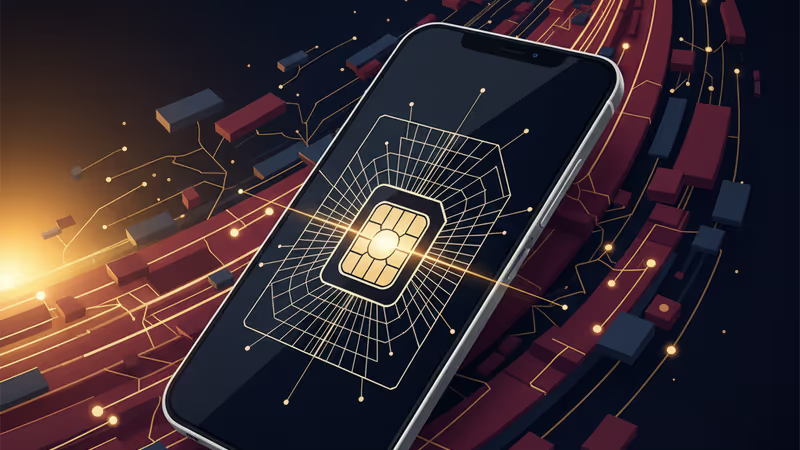
South Korea Rolls Out Mandatory Face Scans for New Phone Numbers to Combat Scams
South Korea has begun a trial for mandatory facial recognition when registering new mobile numbers to fight financial scams, raising questions about biometric data privacy and government surveillance.
The South Korean government has launched a trial for a new policy requiring real-time facial recognition to register a mobile phone number, a move aimed at cracking down on financial scams that use illegally registered accounts. According to Yonhap news agency, the trial began on Tuesday, December 23, 2025, with the policy set to be officially implemented in March 2026.
The country's three major mobile carriers—SK Telecom Co., KT Corp., and LG Uplus Inc.—as well as mobile virtual network operators (MVNOs), will be required to enforce the procedure for both in-person and remote sign-ups.
Under the new system, applicants must scan their face using PASS, an identification app developed by the three carriers. The app verifies a match between the live scan and the photo on the applicant's official ID card.
Amid rising concerns about the collection of sensitive biometric information, the government stated that the data will not be stored. Officials claim the process is solely for one-time verification. In addition to this measure, the government also plans to revise laws to compel carriers to notify users of the risks associated with illegally registered phones and to increase their oversight of retailers to prevent fraudulent subscriptions.
This content is AI-generated based on source articles. While we strive for accuracy, errors may occur. We recommend verifying with the original source.
Related Articles

The U.S. nuclear-powered submarine USS Greeneville arrived in Busan, South Korea, on Dec. 23, 2025, for a port call aimed at strengthening the U.S.-South Korea alliance amid regional tensions with North Korea.

A Seoul court will rule on extending the detention of ex-President Yoon Suk Yeol, accused of using a drone operation as a pretext for his failed martial law bid. The decision could keep him jailed for another six months amid multiple trials.
The US FCC has banned approvals for new drone models from China's DJI and all other foreign makers, citing national security risks. The move is a major escalation in US-China tech tensions but does not affect existing drones.

South Korea confirmed its 17th case of H5N1 bird flu this winter at a quail farm in Jincheon. Authorities are implementing quarantine measures and nationwide farm inspections to prevent further spread.