

Geopolitical Fault Lines Deepen: Ukraine Conflict Intensifies Amid Strategic Strikes and Stalled Diplomacy
Ukraine conflict escalates with strategic strikes on energy & military assets, intensified fighting, and cautious diplomatic overtures. Analyzes geopolitical impact, economic shifts, and the future of financial warfare and drone tech.
The conflict in Ukraine continues to escalate, with intensified fighting, strategic infrastructure targeting, and a renewed, yet fragile, push for diplomacy. Recent days have seen significant military actions and critical political pronouncements that underscore the deepening complexity of the war, casting a long shadow over global stability and critical economic sectors.
The Lede: Why Boardrooms Should Pay Attention
For global executives, the ongoing conflict in Ukraine is far from a localized crisis; it's a persistent tremor in the foundations of international stability, directly impacting energy markets, supply chain resilience, and the future of international law. The latest escalations – from sustained missile barrages on vital port cities like Odesa to Ukrainian deep strikes on Russian energy assets in the Caspian Sea and military targets in Crimea – signify a critical phase where both sides are broadening their operational scope. Concurrently, renewed proposals for trilateral talks involving the U.S. highlight the persistent, if often frustrated, search for off-ramps in a conflict with no clear end. The implications for commodity prices, maritime trade routes, and geopolitical risk assessments are immediate and profound.
Why It Matters: Second-Order Effects Ripple Globally
The recent events in Ukraine carry significant second-order effects:
- Energy Market Volatility: Ukrainian strikes on Lukoil oil rigs in the Caspian Sea, coupled with previous attacks, signal an increased willingness to target critical energy infrastructure far from the immediate front lines. This not only directly impacts Russia's revenue streams but injects fresh uncertainty into global oil and gas markets, potentially driving up prices and complicating energy security strategies for nations dependent on stable supplies.
- Black Sea Geopolitics & Trade: Russia’s continued missile attacks on Odesa and Pivdennyi explicitly aim to undermine Ukraine’s access to the Black Sea. This tactic directly threatens the flow of grain and other critical exports from Ukraine, exacerbating global food security concerns and impacting maritime insurance costs and shipping routes for all nations trading through the region.
- Precedent for Asset Seizure: President Zelenskyy's renewed push for European leaders to seize frozen Russian assets to fund Ukraine’s war effort represents a significant escalation in economic warfare. Such a move, if enacted, would set a far-reaching precedent in international law regarding sovereign assets, potentially chilling foreign investment in countries perceived as geopolitical rivals and reshaping the landscape of global finance.
- Evolution of Warfare: The demonstrated effectiveness of long-range drone strikes by Ukraine against targets deep within Russian-controlled territory and even the Caspian Sea highlights the accelerating role of asymmetric warfare and advanced drone technology. This forces military planners globally to reassess defense strategies against such sophisticated, adaptable threats.
The Analysis: Escalation, Stagnation, and Strategic Patience
The current phase of the Ukraine conflict, as highlighted by these developments, reflects a complex interplay of battlefield realities, diplomatic maneuvering, and economic pressures. Militarily, both sides are seeking to gain strategic advantage. Russia's claimed advances in Svitle and Vysoke, though geographically limited, underscore its sustained pressure in the east. Ukraine's responses, however, are increasingly asymmetric and long-range, aiming to degrade Russia's military and economic capacity far from the front, such as the destruction of fighter jets in Crimea and the strikes on Caspian Sea oil rigs. This suggests a shift towards attrition and strategic targeting rather than rapid territorial gains.
Diplomatically, the proposal for trilateral talks (Ukraine, Russia, U.S. national security advisors) reflects Washington's persistent efforts to find a diplomatic off-ramp, or at least a mechanism for de-escalation. However, President Zelenskyy’s skepticism, while acknowledging the U.S. role, is well-founded. Past initiatives have faltered due to irreconcilable demands and a fundamental distrust between Moscow and Kyiv. The core issue remains Russia's maximalist territorial demands and Ukraine's insistence on full sovereignty. Talks confined to prisoner swaps or a leaders' meeting on specific humanitarian issues might find traction, but comprehensive peace negotiations appear distant, particularly as Kyiv pushes back against wartime elections, reinforcing its sovereignty against external pressures.
The debate over seizing frozen Russian assets adds another layer of complexity. It represents a potential financial shockwave, not just for Russia, but for the entire international banking system, raising questions about legal frameworks and the sanctity of sovereign reserves in an era of heightened geopolitical tensions.
PRISM Insight: The Tech-Military Nexus and Financial Warfare Frontier
The ongoing conflict is a crucible for military innovation and financial statecraft. Ukraine's repeated, successful deep strikes, particularly against naval vessels and distant energy infrastructure, are a testament to advancements in intelligence, surveillance, and reconnaissance (ISR) fused with increasingly sophisticated and autonomous drone technology. This trend signifies a shift towards affordable, precision-guided asymmetric capabilities that can project power far beyond traditional front lines, challenging conventional military doctrines and forcing accelerated investment in counter-drone and layered air defense systems globally. Furthermore, the discussion surrounding asset seizure highlights the evolving nature of financial warfare. Beyond traditional sanctions, the move to repurpose seized sovereign assets represents a new, aggressive frontier, requiring unprecedented coordination among international financial institutions and legal experts to navigate the complex implications for global capital flows and the rule of law.
PRISM's Take: A New Normal of Persistent Instability
The latest developments in Ukraine paint a stark picture: the conflict is not merely enduring but evolving into a more unpredictable, strategically expansive struggle. Neither side appears capable of a decisive military victory, nor willing to concede key objectives. This perpetuates a 'new normal' of persistent geopolitical instability, characterized by an ongoing cycle of escalation and limited diplomatic outreach. Businesses and governments must operate under the assumption that this conflict, and its far-reaching consequences – from disrupted supply chains and energy price volatility to the weaponization of finance and acceleration of military technology – will remain a central fixture of the international landscape for the foreseeable future. Strategic resilience, diversified supply lines, and a keen understanding of evolving geopolitical risks are no longer optional but essential for navigating this increasingly fragmented and contested global order.
Related Articles
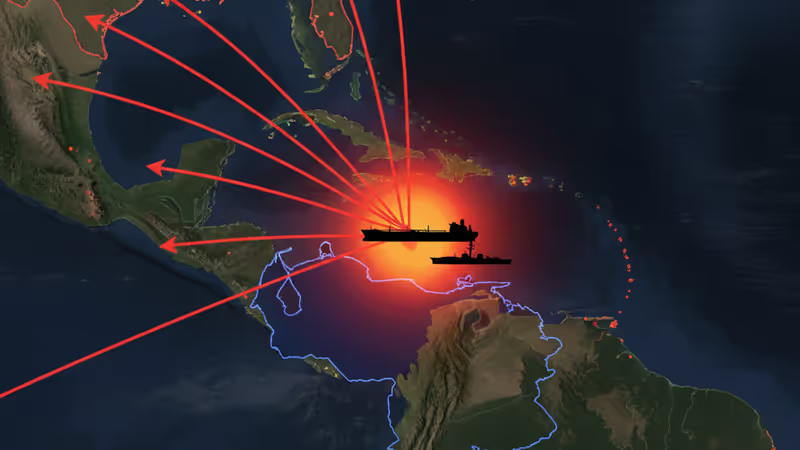
US seizure of an unsanctioned oil tanker off Venezuela marks a dangerous escalation, testing international law and regional stability in the Caribbean.
Prolonged visa delays are compelling tech companies to restrict international travel for skilled workers, raising concerns about global talent mobility and US economic competitiveness.

Analysis of the deep divisions within NATO and EU on Ukraine aid, exploring escalation risks, geopolitical implications, and impacts on defense, energy, and tech sectors.

Analyze global instability: from localized violence and geopolitical stalemates to humanitarian crises. Understand systemic risks, business impact, and adaptive strategies.