
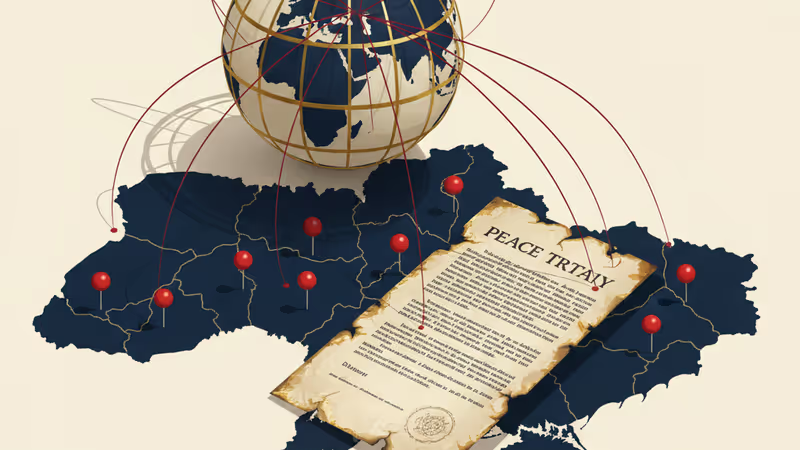
Russia Rejects Changes to U.S. Peace Plan, Dimming Hopes for Ukraine War Endgame
Russia has rejected European and Ukrainian amendments to a U.S.-led peace proposal, casting doubt on the prospects for a diplomatic end to the war as fighting intensifies in the Sumy region.
Russia has dismissed amendments made by European countries and Ukraine to a U.S.-proposed peace plan, signaling a significant setback in diplomatic efforts to end the nearly four-year-long war.
Recent Diplomatic Timeline
- November 2025: A U.S.-drafted proposal for ending the war is leaked to the media.
- December 19 (Fri): U.S. officials hold talks with European and Ukrainian counterparts.
- December 20-21 (Sat-Sun): Russian special envoy Kirill Dmitriev meets with U.S. special envoy Steve Witkoff and Jared Kushner in Miami, Florida.
"I am sure that the proposals that the Europeans and Ukrainians have made or are trying to make definitely do not improve the document and do not improve the possibility of achieving long-term peace," Yury Ushakov, a top foreign policy aide to President Vladimir Putin, was quoted as saying by Russian news agencies on Sunday.
Context: The Contentious U.S. Proposal
The U.S.-drafted plan, which surfaced last month, sparked concern in European and Ukrainian capitals. Critics feared it favored too many of Russia's wartime demands and that President Donald Trump's administration might push Kyiv into conceding too much territory and sovereignty.
In response, European and Ukrainian negotiators have met with Trump's envoys to incorporate their own proposals, though the current draft's exact contents remain undisclosed. Ushakov's stark remarks followed a weekend of talks in Miami between Putin's special envoy, Kirill Dmitriev, and U.S. officials, including special envoy Steve Witkoff and Trump's son-in-law Jared Kushner.
Following parallel talks between his team and U.S. officials on Friday, Ukrainian President Volodymyr Zelenskyy stressed the need for further coordination with allies. "There is a shared sense that after the work by our diplomatic team in the United States, we should now hold consultations with European partners in a broader circle," Zelenskyy posted on X on Sunday.
Zelenskyy had previously said on Saturday that Ukraine would support a U.S. proposal for three-way talks with the U.S. and Russia if it could facilitate prisoner exchanges and pave the way for a leaders' summit.
However, Ushakov flatly rejected the idea, stating that a proposal for three-way talks "had not been seriously discussed by anyone and that it was not being worked on." Russia claims European leaders are deliberately trying to scuttle the talks by introducing conditions they know Moscow will find unacceptable. Meanwhile, Russia's military has continued its advance, taking 12-17 square kilometers (4.6 to 6.6 square miles) of Ukrainian territory per day in 2025.
Fighting Intensifies on the Ground
As diplomacy stalls, the conflict rages on. The Ukrainian army reported on Sunday it was battling an attempted Russian breakthrough in the northern Sumy region. This follows reports that Moscow forcibly relocated 50 people from a border village there, marking a renewed Russian push in an area largely spared from intense ground combat since Ukraine's swift 2022 counter-offensive.
"Fighting is currently ongoing in the village of Grabovske," Ukraine's joint task force said, adding its troops were "making efforts to drive the occupiers back into Russian territory."
Underscoring the intensity of the war, Zelenskyy said that over the past week alone, "Russia has launched approximately 1,300 attack drones, nearly 1,200 guided aerial bombs, and nine missiles of various types" against Ukraine.
Related Articles

Amid fierce debate over 'America First,' US foreign policy is at a critical juncture. An analysis of the multifaceted challenges, from tensions with China to evolving alliances.
A look at the world's most telling moments from the third week of December 2025. From scenes of loss in Gaza and Hong Kong to protests in Brussels and Minneapolis, this is the week in photos.
In the final week of 2025, Asia grapples with a deepening Thai-Cambodian border conflict, India's aviation sector turmoil, and critical economic decisions from Japan to China. PRISM breaks down the key events.

Three months after taking office, Japanese PM Sanae Takaichi's approval rating holds strong at 75%. This gives her a mandate to tackle a BOJ rate hike and tense China relations, but challenges loom.