
Beyond the App Store: How AI Vibe Coding Powers Personal Micro Apps in 2026
Discover how AI vibe coding is enabling the rise of personal micro apps in 2026. Learn how individuals are using Claude and ChatGPT to build custom software in days.
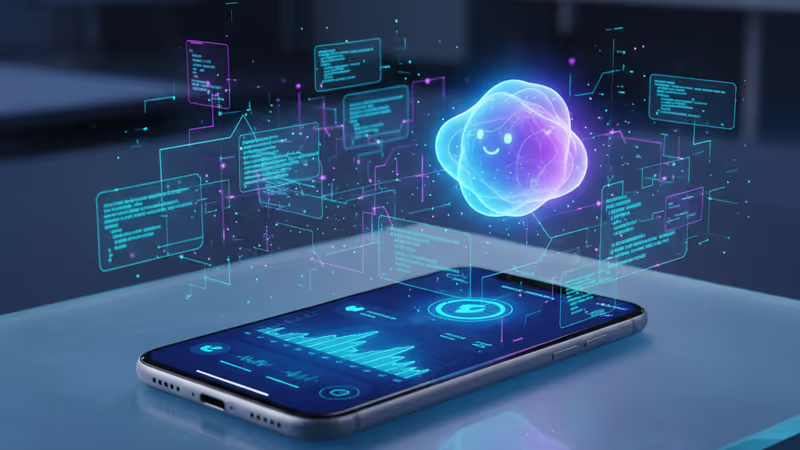
It took only 7 days for Rebecca Yu to build a custom dining app. Tired of the decision fatigue in group chats, she didn't hire a developer; instead, she used Claude and ChatGPT to 'vibe code' her solution. Yu is at the forefront of a shifting software landscape where the barrier between an idea and a functional application has virtually vanished. This is the era of 'micro apps'—software built for a single person or a niche moment, intended to be used and discarded once the need fades.
The Surge of AI Vibe Coding and Personal Software
According to TechCrunch, tools like Claude Code, Replit, and Lovable are enabling non-technical users to build hyper-specific tools. From allergy trackers built in the time it takes to have dinner to automated parking ticket payment systems, these 'fleeting apps' are filling a gap that traditional software houses ignore. The market is noticing: the startup Anything recently secured $11 million in funding, while VibeCode raised a $9.4 million seed round, proving that the 'build-it-yourself' vibe isn't just a hobby—it's an industry.

A New Utility: Between the Spreadsheet and the Product
Bain Capital Ventures partner Christina Melas-Kyriazi compares this moment to the rise of Shopify. Just as e-commerce became accessible to small sellers, software creation is becoming accessible to every individual. However, Howard University professor Legand L. Burge III warns that while these apps offer 'exhilarating opportunities,' they often come with security flaws and bugs. Despite these technical hurdles, the realization that one can code by simply describing their needs is fundamentally changing how we view digital ownership.
Authors
Related Articles

Sam Nelson, 19, died after following ChatGPT's advice to mix Kratom and Xanax. His parents are suing OpenAI for wrongful death, raising urgent questions about AI trust, liability, and design.
A meta-analysis claiming ChatGPT boosts student learning has been retracted after nearly a year—long after it shaped social media narratives and informed education policy debates. Here's what that means for AI research.
Google is investing at least $10 billion in Anthropic, potentially up to $40 billion. With Amazon's $5B deal just days earlier, two tech giants are now backing the same AI startup — valued at $350 billion.
Amazon has poured an additional $5 billion into Anthropic, bringing its total stake to $13 billion—with up to $20 billion more on the table. Here's what the deal really signals about the AI infrastructure race.
Sam Nelson, 19, died after following ChatGPT's advice to mix Kratom and Xanax. His parents are suing OpenAI for wrongful death, raising urgent questions about AI trust, liability, and design.
A meta-analysis claiming ChatGPT boosts student learning has been retracted after nearly a year—long after it shaped social media narratives and informed education policy debates. Here's what that means for AI research.
Google is investing at least $10 billion in Anthropic, potentially up to $40 billion. With Amazon's $5B deal just days earlier, two tech giants are now backing the same AI startup — valued at $350 billion.
Amazon has poured an additional $5 billion into Anthropic, bringing its total stake to $13 billion—with up to $20 billion more on the table. Here's what the deal really signals about the AI infrastructure race.
Thoughts
Share your thoughts on this article
Sign in to join the conversation