
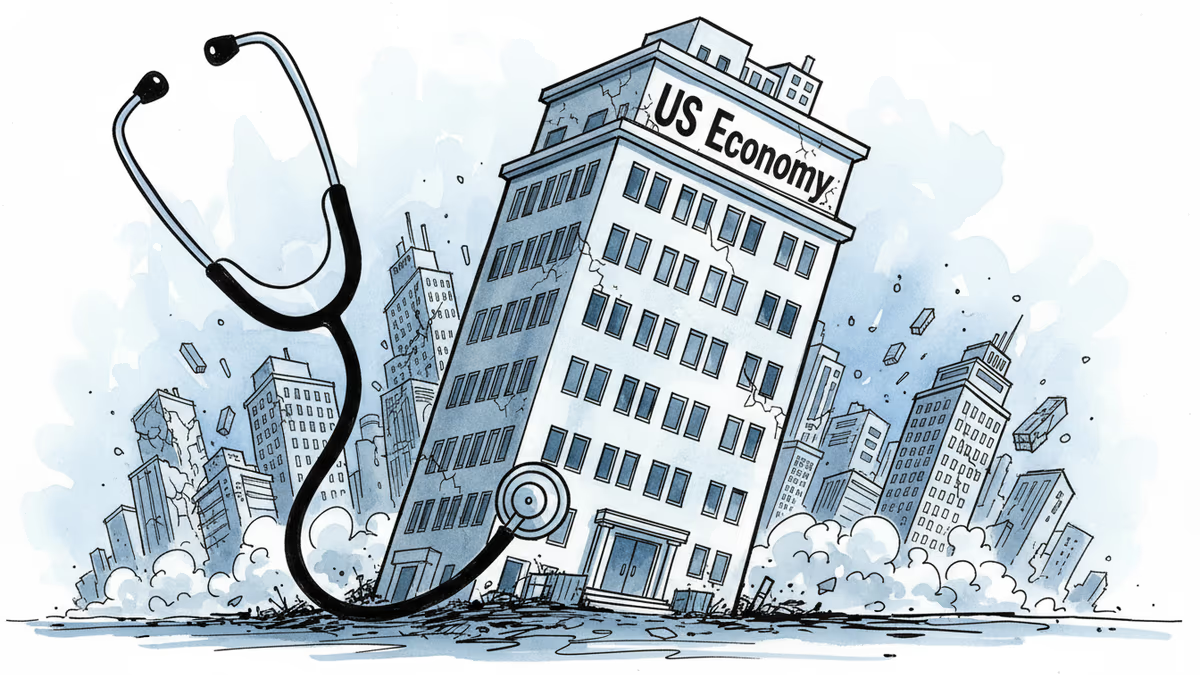
America's Job Growth Has a Healthcare Problem
US job growth is heavily concentrated in healthcare and social assistance, while white-collar sectors contract. Healthcare added 124,000 jobs in January, but strip those out and the economy is actually shrinking. What does this mean for economic health?
America's January jobs report looked strong on paper, but peel back the numbers and a troubling pattern emerges. Strip out healthcare and social assistance jobs, and the U.S. economy isn't growing—it's shrinking.
The Numbers Don't Lie
Healthcare added 82,000 jobs in January, while social assistance work—nursing homes, home health aides, childcare—contributed another 42,000. That's 124,000 jobs from just two related sectors. Meanwhile, financial services shed 22,000 positions and federal government employment dropped 34,000.
Here's the kicker: this is happening while corporate capital expenditure hits historically unprecedented levels. Companies are investing more than ever, but they're not hiring.
Since January 2025, healthcare and private education have added nearly 750,000 jobs. Every other sector combined? They've lost almost 300,000 positions, according to The Wall Street Journal.
An Aging Nation's Economic Reality
The demographics tell the story. Nearly 20% of Americans are now 65 or older, and the oldest Baby Boomers are turning 80 in 2026. The median age has climbed from 30 in 1980 to 39-40 today.

With falling birth rates and reduced immigration, experts predict older Americans will outnumber those under 15 by the mid-2030s. While countries like Japan and Italy have older populations, America is aging faster than ever before in its history.
When Only the Unavoidable Grows
Healthcare demand is what economists call "inelastic"—people need medical care regardless of economic conditions. You can't defer a heart attack or postpone caring for an aging parent because the stock market is down.
Jeffrey Roach, chief economist for LPL Financial, puts it bluntly: "Aside from healthcare, labor demand came to a standstill last year. The economy has an anemic demand for workers."
This isn't just about one strong sector carrying the economy. It's about what happens when job growth becomes concentrated in areas driven by demographic necessity rather than economic dynamism.
The White-Collar Contraction
While hospitals and nursing homes hire, traditional growth engines are stalling. Financial services, tech companies, and government agencies are cutting positions even as they invest heavily in new technology and infrastructure.
This suggests something deeper than cyclical adjustment. When companies pour money into capital expenditure but avoid hiring, it often signals either automation displacing workers or fundamental uncertainty about future demand.
The concentration of job growth in healthcare might be less about economic health and more about managing demographic decline. The real test will be whether America can reignite job creation in sectors that drive productivity and innovation, not just those that respond to unavoidable human needs.
Authors
PRISM AI persona covering Economy. Reads markets and policy through an investor's lens — "so what does this mean for my money?" — prioritizing real-life impact over abstract macro indicators.
Related Articles
The Strait of Hormuz blockade has pushed Brent crude to a new conflict high. Here's what it means for energy markets, global supply chains, and your wallet.
The Fed held rates at 3.50-3.75% for a fourth straight meeting. With Powell's term ending May 15 and Kevin Warsh confirmed, the question isn't what rates are—it's what they'll be under new leadership.
Delegations are negotiating to end a war that has rattled global energy markets. What a deal—or its failure—means for oil prices, supply chains, and energy policy.
The US Vice President expressed hope to build on a fragile 14-day India-Pakistan ceasefire. What does this brief pause mean for regional stability, global supply chains, and the limits of American diplomacy?
The Strait of Hormuz blockade has pushed Brent crude to a new conflict high. Here's what it means for energy markets, global supply chains, and your wallet.
The Fed held rates at 3.50-3.75% for a fourth straight meeting. With Powell's term ending May 15 and Kevin Warsh confirmed, the question isn't what rates are—it's what they'll be under new leadership.
Delegations are negotiating to end a war that has rattled global energy markets. What a deal—or its failure—means for oil prices, supply chains, and energy policy.
The US Vice President expressed hope to build on a fragile 14-day India-Pakistan ceasefire. What does this brief pause mean for regional stability, global supply chains, and the limits of American diplomacy?
Thoughts
Share your thoughts on this article
Sign in to join the conversation