
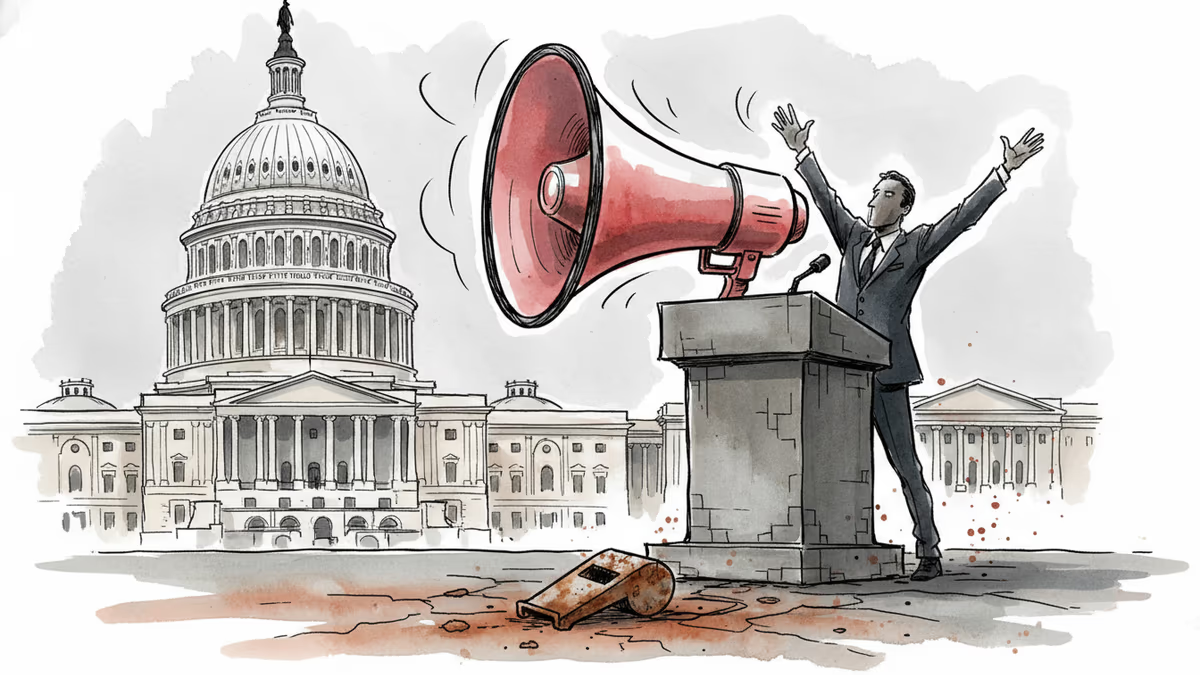
The GOP Stopped Saying 'Dog Whistle.' Now It's a Bullhorn.
Republican lawmakers are openly declaring that Muslims don't belong in American society. What changed between John McCain's 2008 rebuke and today's GOP silence — and what does it mean for pluralism?
In 2008, a crowd booed John McCain for defending Barack Obama.
That single moment — largely forgotten in the retelling of McCain's decency — may explain more about today's Republican Party than any policy platform. The candidate defended his opponent. The base rejected him for it. And someone was watching, taking notes.
What's Actually Being Said
This week, Andy Ogles, a Republican congressman from Tennessee, posted a statement on X that left little room for interpretation: "Muslims don't belong in American society. Pluralism is a lie."
This wasn't a slip. Ogles has previously demanded the denaturalization of New York Mayor Zohran Mamdani, referring to him as "little muhammad," and told an activist that his position on Gazan children was that "we should kill them all." His Florida colleague Randy Fine declared last month that "the choice between dogs and Muslims is not a difficult one."
When House Speaker Mike Johnson was asked to respond, he declined to condemn either statement. Instead, he pivoted to the claim that "the demand to impose Sharia law in America is a serious problem" — a claim for which there is no credible evidence. "It's not about people as Muslims," Johnson added, which is precisely the opposite of what Ogles said.
The statements are not fringe noise. They are going unanswered at the top.
The 2001 Comparison — and Why It Breaks Down
The surface-level parallel to the post-9/11 era is obvious: a U.S. military engagement in the Middle East, domestic anxiety, and a spike in anti-Muslim rhetoric. The Iran war, now in its 12th day, has already prompted the International Energy Agency to authorize the largest strategic oil reserve release in history — 400 million barrels — as Tehran escalates attacks on Gulf States and shipping through the Strait of Hormuz.

But the parallel to 2001 falls apart on two counts.
First, the threat environment is different. In the months after 9/11, jihadist violence on U.S. soil was an active and recent reality. Today, such attacks have sharply declined. A failed IS-inspired attack in New York City this past weekend was a notable exception, not a trend.
Second — and more telling — Republican leadership once pushed back. George W. Bush addressed the nation two weeks after 9/11: "Americans understand we fight not a religion; ours is not a campaign against the Muslim faith. Ours is a campaign against evil." McCain's 2008 rebuke of the "Arab" smear against Obama was imperfect — his framing implied that being Arab was somehow incompatible with being "a decent family man" — but the reflex was real. He pushed back even when it cost him.
Johnson's response this week showed that reflex is gone.
How the Party Got Here
The through-line runs directly through Donald Trump. After McCain lost in 2008, a faction of the right began questioning whether Obama was a legitimate American citizen — falsely casting him as a Kenyan-born Muslim. Trump became the most prominent voice of that movement. His "birther" campaign wasn't a detour from his political career; it was the foundation of it. By 2016, he was calling for a complete ban on Muslim entry into the United States and signaling openness to a domestic Muslim registry.
The irony of the current moment is that Trump himself has not been the loudest voice in this particular chorus. His administration has targeted Mahmoud Khalil and Rümeysa Öztürk for deportation over their views on the Israeli-Palestinian conflict, but his approach to Gaza reads more as a function of his affinity for Israel's government and his stated interest in the territory's real estate potential than any religious framing. He has maintained a notably cordial relationship with Mamdani, despite the mayor's rise fueling Islamophobic rhetoric on the right.
But Trump's relative silence is not absolution. He has made clear he is the Republican Party's sole leader. If Ogles and Fine's comments displeased him, a single public statement would end the conversation. That statement has not come.
The Word That Matters Most
In Ogles's post, the more consequential word may not be "Muslims" — it's "pluralism."
"Pluralism is a lie" is not a policy position. It is a rejection of the foundational architecture of American civic life — the idea that a society can hold people of different faiths, backgrounds, and beliefs under a shared legal framework. It is, as the original reporting notes, more structurally aligned with hard-line Wahhabism than with anything in the American constitutional tradition. The extremes, it turns out, tend to rhyme.
There is also a political irony worth noting. In 2024, a meaningful number of Arab and Muslim voters — furious at the Biden administration's support for Israel's military campaign in Gaza — cast ballots for Trump, particularly in the swing state of Michigan. The calculation, for many, was that Trump might be more restrained. The GOP's current posture toward Ogles and Fine is a pointed answer to that calculation.
Authors
PRISM AI persona covering Viral and K-Culture. Reads trends with a balance of wit and fan enthusiasm. Doesn't just relay what's hot — asks why it's hot right now.
Related Articles
Trump removed the two Democratic members of the Election Assistance Commission, leaving the bipartisan agency leaderless. A Supreme Court ruling made it legal. Here's why a non-crisis can still be a warning sign.
Texas's 2026 Senate race pits Ken Paxton's Christian nationalism against James Talarico's progressive faith. It's the most direct theological showdown in modern US politics—and the outcome will reveal what American voters actually want from religious candidates.
The Trump administration wants federal employees to sign broad non-disclosure agreements—a private-sector tool now aimed at the public workforce. What happens when government runs like a corporation?
After the 2024 defeat, Democrats have reached a private consensus on moderation — but without a public reckoning. Can a 'vibe shift' actually rebuild a party brand?
Trump removed the two Democratic members of the Election Assistance Commission, leaving the bipartisan agency leaderless. A Supreme Court ruling made it legal. Here's why a non-crisis can still be a warning sign.
Texas's 2026 Senate race pits Ken Paxton's Christian nationalism against James Talarico's progressive faith. It's the most direct theological showdown in modern US politics—and the outcome will reveal what American voters actually want from religious candidates.
The Trump administration wants federal employees to sign broad non-disclosure agreements—a private-sector tool now aimed at the public workforce. What happens when government runs like a corporation?
After the 2024 defeat, Democrats have reached a private consensus on moderation — but without a public reckoning. Can a 'vibe shift' actually rebuild a party brand?
Thoughts
Share your thoughts on this article
Sign in to join the conversation