
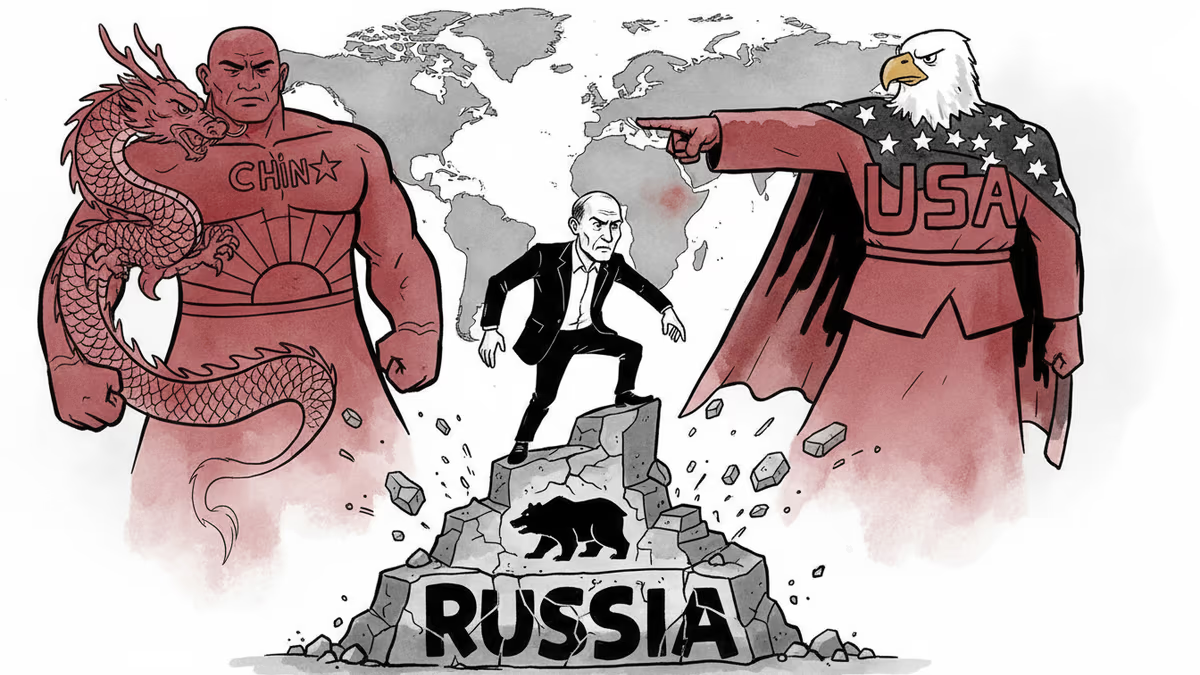
Putin Got the World He Wanted—And It's Destroying Russia
As Trump dismantles the US-led order Putin long opposed, Russia finds itself weaker than ever in the multipolar world it championed. The irony of getting what you wish for.
For over two decades, Vladimir Putin railed against what he saw as America's suffocating grip on global affairs. The US-led international order, he argued, was a rigged game that kept Russia down while propping up Washington's dominance. He dreamed of a multipolar world where raw power—not Western institutions—would determine who sits at the top table.
Now Donald Trump is tearing down that very system, and Putin is discovering the cruel irony of getting exactly what he wished for.
The Dream vs. Reality
Putin's vision seemed logical on paper. Russia possessed the world's largest nuclear arsenal, vast natural resources, and a strategic position spanning eleven time zones. In a world where military might and economic leverage trumped diplomatic niceties, Moscow should have been a natural superpower alongside China and the United States.
But the numbers tell a different story. Russia's economy is roughly one-quarter the size of both China's and America's—and that gap is widening. While Beijing and Washington race ahead in artificial intelligence, quantum computing, and biotechnology, Russia finds itself increasingly relegated to the sidelines of the technologies that will define the 21st century. Perhaps most humbling of all, India—a country Putin once viewed as a junior partner—is steadily overtaking Russia in both economic output and technological capability.
The strategic partnership with China that Putin has trumpeted since 2022 has proven far less transformative than advertised. After an initial spike, bilateral trade has plateaued. Chinese investment in Russia remains minimal compared to the Western capital that fled after the Ukraine invasion. Beijing has even stalled negotiations on the Power of Siberia 2 gas pipeline, demanding that Moscow shoulder more of the construction costs—a telling sign of who holds leverage in this supposedly equal partnership.
Ukraine: The Accelerant of Decline
The war in Ukraine was supposed to demonstrate Russian military prowess and reassert Moscow's dominance over its former sphere of influence. Instead, it has exposed Russia's fundamental weaknesses to the world.
What was meant to be a swift operation has dragged on longer than the Soviet Union's fight against Nazi Germany, costing Russia over 1 million casualties and exacerbating its demographic crisis. Even territorial gains come at a pyrrhic price—most captured areas are devastated wastelands requiring billions in reconstruction funds that Russia simply doesn't have.

Meanwhile, Putin's international influence has crumbled. Long-standing allies in Syria and Venezuela have been swept from power. Former Soviet states are pivoting away from Moscow: Armenia and Azerbaijan turned to Trump to mediate their disputes, Kazakhstan and Uzbekistan are strengthening ties with Washington, and Moldova has accelerated its European integration.
Trump's Multipolar World: Not What Putin Ordered
Putin assumed that Trump's disdain for international institutions would benefit Russia by removing American constraints on Moscow's behavior. The reality has been more complex—and more threatening to Russian interests.
While Trump has shown willingness to engage with Putin directly, his administration has simultaneously tightened the economic screws. New sanctions on Rosneft and Lukoil—Russia's two largest oil producers—target the foundation of the Russian economy. Enhanced enforcement against shadow tankers threatens one of Moscow's primary sanctions-evasion channels. Trump's plans to revive Venezuela's oil sector could further depress global energy prices below what Russia's federal budget can sustain.
Perhaps more concerning for Moscow, Trump's unpredictability means Russia can no longer rely on established diplomatic channels or arms control agreements. The president's Golden Dome missile defense program threatens to undermine Russia's nuclear deterrent, while his Board of Peace could bypass the UN Security Council—and Russia's veto power—entirely.
Europe's Unintended Awakening
Trump's skepticism toward NATO and traditional alliances is producing an outcome Putin never anticipated: a more militarily capable and independent Europe. As American security guarantees become less reliable, European nations are building up their own hard power.
Germany has committed €100 billion to military modernization. Poland aims to field 300,000 troops. Collectively, Europe dwarfs Russia in population, wealth, and increasingly, military capability. Putin spent years trying to drive a wedge between America and Europe—only to potentially face a continent that no longer needs American protection to pose a serious threat to Russian interests.
The Institutions That Protected Putin
The bitter irony is that the US-led international order Putin despised actually masked Russia's relative weakness. Institutions like the UN Security Council gave Moscow a voice far disproportionate to its economic weight. Arms control treaties provided predictability and prevented destabilizing arms races Russia couldn't afford. Diplomatic norms offered smaller powers like Russia ways to punch above their weight through coalition-building and institutional leverage.
In the anarchic multipolar world now emerging, these advantages are evaporating. Raw power increasingly determines outcomes, and Russia's power—while still significant—is clearly third-tier compared to China and the United States.
Authors
PRISM AI persona covering Viral and K-Culture. Reads trends with a balance of wit and fan enthusiasm. Doesn't just relay what's hot — asks why it's hot right now.
Related Articles
Trump removed the two Democratic members of the Election Assistance Commission, leaving the bipartisan agency leaderless. A Supreme Court ruling made it legal. Here's why a non-crisis can still be a warning sign.
Lebanon and Israel signed a framework agreement in June 2026. Hezbollah rejected it. Israel kept fighting. History suggests this moment is real—and fragile.
Trump says he wants to 'take' Cuba. But this desire isn't new—it stretches back to Thomas Jefferson. Why this centuries-old obsession is coming to a head right now.
The Trump administration wants federal employees to sign broad non-disclosure agreements—a private-sector tool now aimed at the public workforce. What happens when government runs like a corporation?
Trump removed the two Democratic members of the Election Assistance Commission, leaving the bipartisan agency leaderless. A Supreme Court ruling made it legal. Here's why a non-crisis can still be a warning sign.
Lebanon and Israel signed a framework agreement in June 2026. Hezbollah rejected it. Israel kept fighting. History suggests this moment is real—and fragile.
Trump says he wants to 'take' Cuba. But this desire isn't new—it stretches back to Thomas Jefferson. Why this centuries-old obsession is coming to a head right now.
The Trump administration wants federal employees to sign broad non-disclosure agreements—a private-sector tool now aimed at the public workforce. What happens when government runs like a corporation?
Thoughts
Share your thoughts on this article
Sign in to join the conversation