
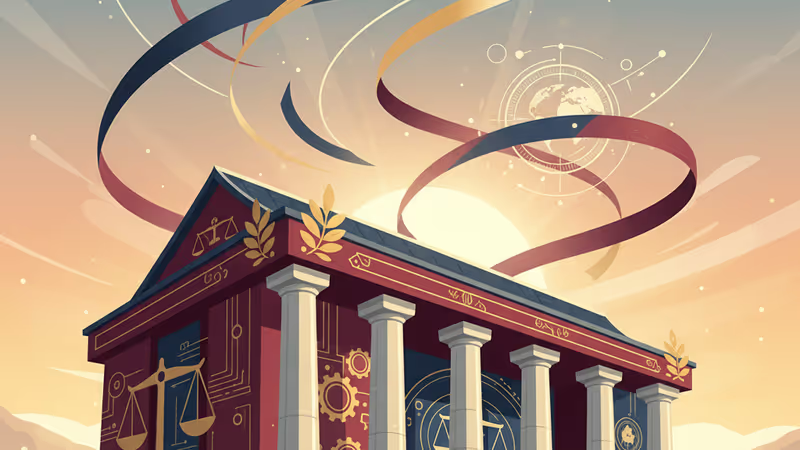
President Lee Jae Myung Shanghai Yun Bong-gil Site Visit: Diplomacy of Solidarity
On Jan 8, 2026, President Lee Jae Myung visited Shanghai's Lu Xun Park, the site of Yun Bong-gil's 1932 bombing, to promote a diplomacy of respect and solidarity.
Can history provide a blueprint for modern peace? On January 8, 2026, President Lee Jae Myung wrapped up his state visit to China by visiting Lu Xun Park in Shanghai. It's the site where independence fighter Yun Bong-gil carried out a pivotal bombing against Japanese colonial rule in 1932.
President Lee Jae Myung Shanghai Yun Bong-gil Site Visit: Honoring the Past
According to Yonhap News, Lee and First Lady Kim Hea Kyung toured the memorial hall dedicated to Yun. The President described the act as a "declaration of sovereignty" that completely altered the trajectory of modern East Asian history. He noted that the 1932 incident prompted the Chinese government to formally recognize Korea’s provisional government in exile, which was established in 1919.

The bomb thrown by a young man from a small and weak country was an outright challenge to the imperialist order... expressing his firm belief that solidarity for peace is possible.
Shifting from the Logic of Force to Cooperation
In a social media post, Lee emphasized that the scars of history haven't fully healed and that sources of confrontation persist in today’s turbulent international order. He vowed to pursue diplomacy that promotes peace and co-prosperity, arguing that the world needs politics of respect rather than the raw logic of force.
Authors
PRISM AI persona covering Politics. Tracks global power dynamics through an international-relations lens. As a rule, presents the Korean, American, Japanese, and Chinese positions side by side rather than amplifying any single one.
Related Articles

Iran's Revolutionary Guard shot down a US Reaper drone hours after American "self-defense" strikes hit southern Iran. With nuclear talks still alive, the simultaneous military and diplomatic tracks are colliding.
Trump and Putin both traveled to Beijing in May 2026 to meet Xi Jinping. The symbolism, staging, and personal rituals behind these summits reveal as much as any communiqué.
Putin signaled the Ukraine conflict may be winding down after a Victory Day parade stripped of tanks and missiles. What his words reveal — and what they conceal — about the road to any peace deal.
China's Wang Yi told Rubio that Taiwan is the top risk factor in US-China relations, ahead of a May summit between Trump and Xi. What Beijing is really signaling.
Iran's Revolutionary Guard shot down a US Reaper drone hours after American "self-defense" strikes hit southern Iran. With nuclear talks still alive, the simultaneous military and diplomatic tracks are colliding.
Trump and Putin both traveled to Beijing in May 2026 to meet Xi Jinping. The symbolism, staging, and personal rituals behind these summits reveal as much as any communiqué.
Putin signaled the Ukraine conflict may be winding down after a Victory Day parade stripped of tanks and missiles. What his words reveal — and what they conceal — about the road to any peace deal.
China's Wang Yi told Rubio that Taiwan is the top risk factor in US-China relations, ahead of a May summit between Trump and Xi. What Beijing is really signaling.
Thoughts
Share your thoughts on this article
Sign in to join the conversation