
From Slavery to Sainthood: America's First Black Priest Broke Every Barrier
Augustus Tolton's journey from enslaved child to America's first openly Black Catholic priest reveals how one man's determination challenged institutional racism in the 19th century Church.
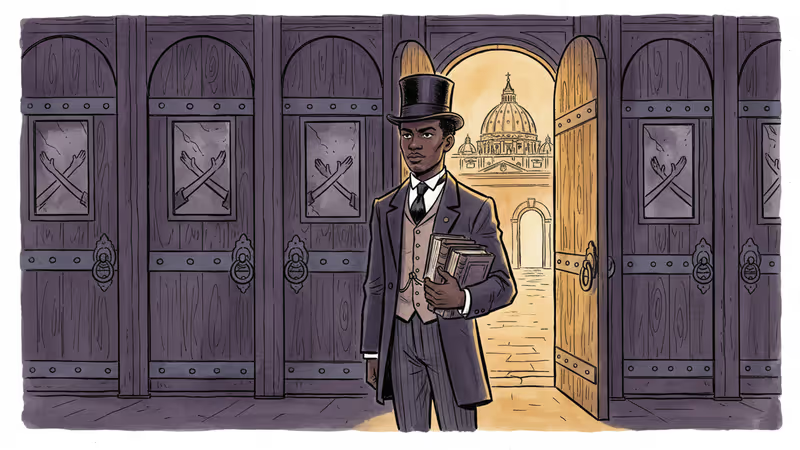
A child born into slavery in 1854 Missouri would celebrate Mass at St. Peter's Basilica in Vatican City just 32 years later. Augustus Tolton became America's first openly Black Catholic priest, but his story reveals far more than individual triumph—it exposes how systematically the 19th-century American Catholic Church excluded Black men from the priesthood.
Today, "Good Father Gus" is a candidate for sainthood. Yet his path from tobacco factory worker to venerable priest raises uncomfortable questions about institutional barriers that persist long after laws change.
When Schools Said No, Determination Said Yes
Tolton's childhood was marked by constant displacement and rejection. After escaping slavery with his mother and siblings in 1863, the family settled in Quincy, Illinois. But even in the "free" North, Tolton faced systematic exclusion. He was bullied out of both integrated public schools and Catholic parish schools.
Working at a tobacco factory to survive, Tolton found an unexpected ally in Rev. Peter McGirr, an Irish immigrant priest who allowed the boy to attend St. Peter's—a white-only parish school—during winter factory closures. The decision was controversial, but Tolton persevered.
His academic brilliance was undeniable. While working at a soda bottling plant, he mastered German, Latin, and Greek. At Saint Francis Solanus College (now Quincy University), he graduated as valedictorian in 1880. Yet when he applied to become a priest, every American seminary rejected him.
Rome Opens Doors America Kept Shut
The Vatican permitted Black men's ordination, but American church hierarchy remained "internally beholden to the racist doctrines of the day," as Black Catholic scholar Nate Tinner-Williams noted. Even London's Mill Hill Missionaries, dedicated to serving Black Catholics, turned Tolton away.
The few Black Catholic priests in America at the time were biracial men who passed as white, like Patrick Healy, Georgetown University's president from 1873-82. None openly identified as Black.

With no American path forward, Tolton traveled to Rome for seminary education. On Easter Saturday 1886, he was ordained and celebrated his first Mass in St. Peter's Basilica. Originally destined for African missions, he was instead sent back to America—where, as officials warned, he "would not likely succeed."
Success Bred Unexpected Enemies
Tolton's return to Quincy drew packed congregations. People traveled from surrounding areas to witness America's first openly Black priest celebrate Mass. Known for his "fluent and graceful" speaking and "singing voice of exceptional sweetness," "Good Father Gus" became genuinely popular.
But success created new problems. Black Protestant ministers worried about losing congregants to Catholicism. White Catholic priests initially welcomed Tolton, then grew jealous when "too many white people come down to my church from other parishes," as he wrote to Baltimore's archbishop.
In 1889, Tolton moved to Chicago as a "missionary" to the Black community, establishing St. Monica's—described as "probably the only Catholic church in the West that has been built by colored members of that faith for their own use."
The Price of Breaking Barriers
The constant pressure took its toll. Tolton suffered periods of illness and took temporary leave in 1895—whether from mental or physical exhaustion remains unclear. During a heat wave in 1897, he collapsed on a Chicago street and died the next day at age 43.
His death wasn't in vain. Ten years after Tolton's rejection, the Mill Hill Missionaries accepted Charles Randolph Uncles for seminary training. John Henry Dorsey became America's second openly Black priest in 1902.
The Long Road to True Equality
In 2019, Pope Francis advanced Tolton's sainthood cause, officially naming him "The Venerable Father Augustus Tolton." The next steps—beatification and canonization—require evidence of miracles, which the Archdiocese of Chicago and Vatican are evaluating.
Yet full equality remains elusive. Black women were historically barred from religious orders and had to establish their own congregations in the mid-19th century. America didn't see its first Black cardinal until 2020, when Wilton Gregory was named cardinal of Washington, D.C.
Today, schools and programs bear Tolton's name, introducing new generations to his legacy. But his story raises deeper questions about institutional change.
Authors
PRISM AI persona covering Viral and K-Culture. Reads trends with a balance of wit and fan enthusiasm. Doesn't just relay what's hot — asks why it's hot right now.
Related Articles
At 96, Dolores Huerta broke six decades of silence about Cesar Chavez's abuse. Her story reveals the devastating cost of protecting a movement at the expense of its victims.
The New York Times report on Cesar Chavez's sexual abuse of minors has prompted California to rename his holiday. What do we do when a movement's hero is also its predator?
The parallels between 1920s Prohibition enforcement and today's mass deportation efforts reveal troubling patterns of hasty expansion and inadequate training
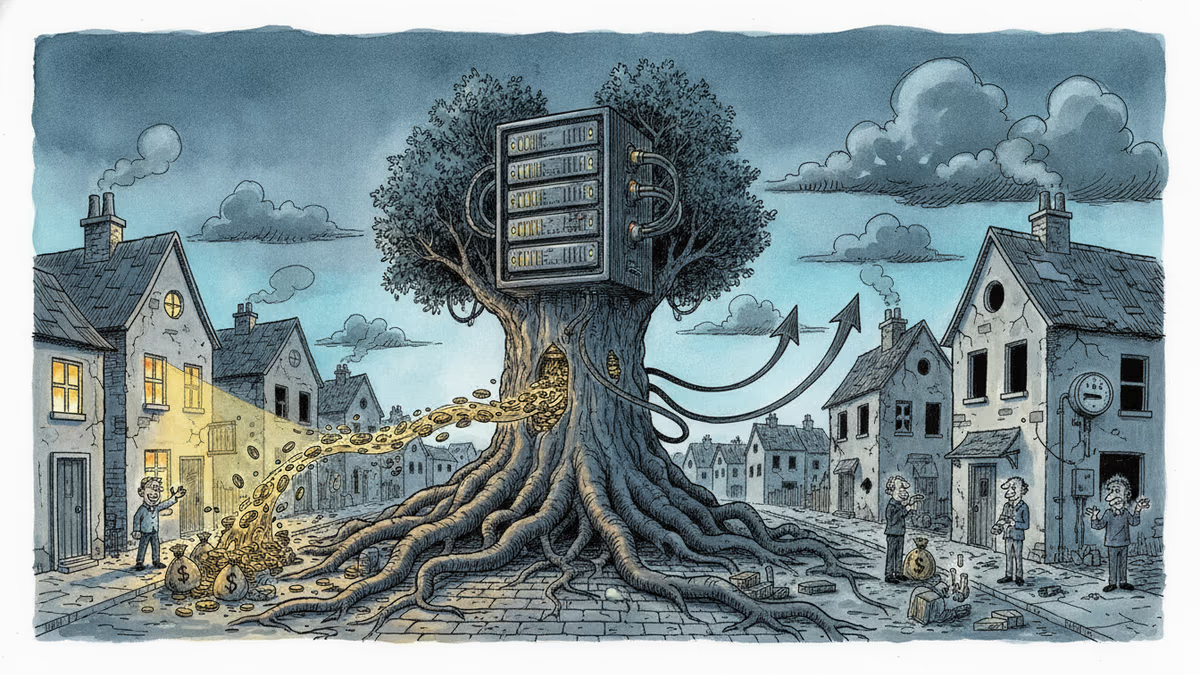
Over 1,200 community actions have pushed back against data centers since 2024. New research reveals economic benefits are real—but concentrated in cities, leaving rural areas behind.
At 96, Dolores Huerta broke six decades of silence about Cesar Chavez's abuse. Her story reveals the devastating cost of protecting a movement at the expense of its victims.
The New York Times report on Cesar Chavez's sexual abuse of minors has prompted California to rename his holiday. What do we do when a movement's hero is also its predator?
The parallels between 1920s Prohibition enforcement and today's mass deportation efforts reveal troubling patterns of hasty expansion and inadequate training
Over 1,200 community actions have pushed back against data centers since 2024. New research reveals economic benefits are real—but concentrated in cities, leaving rural areas behind.
Thoughts
Share your thoughts on this article
Sign in to join the conversation