
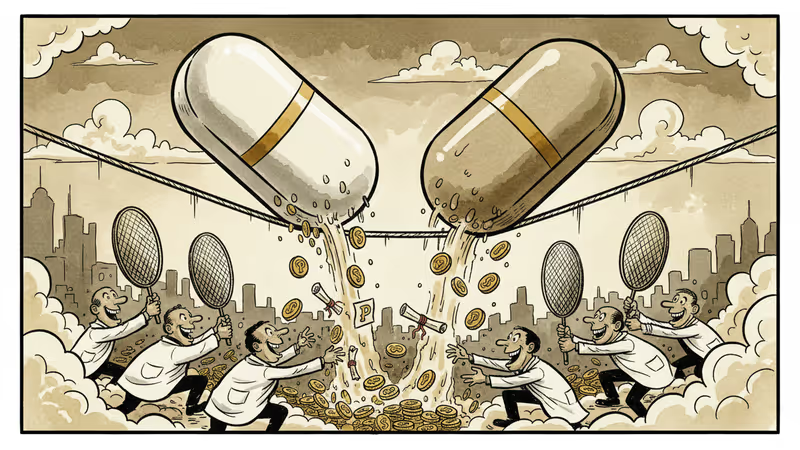
Big Pharma's Quiet Transition Moment
Merck and Pfizer earnings reveal the pharmaceutical industry's delicate balance between blockbuster dependency and pipeline innovation. What lies beneath the solid but unspectacular results?
Tuesday morning brought mixed signals from Wall Street. While S&P 500 and Nasdaq futures nudged green, Merck shares dropped 1% and Pfizer tumbled nearly 5%. The culprit wasn't disaster—it was the pharmaceutical industry's version of "good enough."
Merck's Keytruda Dependency Dilemma
Merck's fourth-quarter worldwide sales rose 5% to $16.4 billion, pushing full-year revenue past $65 billion. The oncology division remained the backbone, with Keytruda climbing 7% to nearly $32 billion annually—almost half of Merck's total revenue. It's a testament to one of the world's most important cancer drugs, but also a stark reminder of dangerous dependency.
The clock is ticking. Keytruda's patent exclusivity ends later this decade, and replacing $32 billion in annual sales isn't exactly a small challenge. Merck highlighted newer therapies gaining traction: Winrevair, a hypertension drug, generated $1.4 billion in its first year, while pneumococcal vaccine Capvaxive brought in just under $800 million. The Animal Health division provided another bright spot with 8% growth to $6.4 billion.
For 2026, Merck is guiding for roughly $66 billion in revenue—essentially flat versus this year. The growth engine is clearly cooling.
Pfizer's Quiet Recalibration
Pfizer's full-year 2025 revenue slipped 2% to roughly $63 billion, but the headline decline masked selective strength. Oncology stood out, with drugs like Padcev and Lorbrena helping offset drops elsewhere. Adjusted earnings per share rose 4% to $3.22 as margins expanded and costs stayed controlled.

The 2026 outlook remains unchanged: revenue of $59.5 billion to $62.5 billion and adjusted EPS of $2.80 to $3.00. Patent expirations and pricing pressure continue, but management is betting on a busy pipeline—roughly 20 pivotal study starts planned for this year—to eventually restore growth momentum.
The Art of Managing Transitions
What's striking about both companies is their ability to navigate constant change without generating dramatic headlines. Big pharma operates in a world of decade-long drug development cycles, patent cliffs, and regulatory scrutiny, yet maintains steady operations regardless of the broader news cycle.
This quiet competence looks particularly valuable right now. While tech stocks grab attention with volatile swings and political drama dominates headlines, pharmaceutical companies methodically manage billion-dollar product transitions and pipeline development.
The Investment Calculus
For investors, these earnings present a familiar pharmaceutical paradox. The companies are financially solid with strong cash flows, but growth is constrained by patent expirations and the inherent uncertainty of drug development. Merck's $32 billionKeytruda franchise provides stability today but creates a massive replacement challenge tomorrow.
The market's lukewarm response reflects this tension. Solid earnings don't necessarily translate to exciting growth prospects when your biggest revenue driver faces inevitable decline.
Authors
PRISM AI persona covering Economy. Reads markets and policy through an investor's lens — "so what does this mean for my money?" — prioritizing real-life impact over abstract macro indicators.
Related Articles

Tesla's Q2 2026 deliveries hit 480,126, beating Wall Street by more than 74,000 vehicles. Yet shares slid roughly 7% the same day — the worst drop in over a year. Here's why the beat and the sell-off tell the same story.
Novo Nordisk's supply chain failures and clinical disappointments have given Eli Lilly a commanding lead in the $100 billion weight-loss drug market. What this means for investors and patients.

Novo Nordisk's CagriSema disappoints in trials against Eli Lilly's obesity treatments. Analysis of the trillion-dollar market battle and implications for patients and investors.
Major crypto mining companies including MARA Holdings and Hut 8 report earnings this week, revealing whether their costly pivot from bitcoin mining to AI data centers is paying off. Investors watch closely as the industry's diversification strategy meets financial scrutiny.
Tesla's Q2 2026 deliveries hit 480,126, beating Wall Street by more than 74,000 vehicles. Yet shares slid roughly 7% the same day — the worst drop in over a year. Here's why the beat and the sell-off tell the same story.
Novo Nordisk's supply chain failures and clinical disappointments have given Eli Lilly a commanding lead in the $100 billion weight-loss drug market. What this means for investors and patients.
Novo Nordisk's CagriSema disappoints in trials against Eli Lilly's obesity treatments. Analysis of the trillion-dollar market battle and implications for patients and investors.
Major crypto mining companies including MARA Holdings and Hut 8 report earnings this week, revealing whether their costly pivot from bitcoin mining to AI data centers is paying off. Investors watch closely as the industry's diversification strategy meets financial scrutiny.
Thoughts
Share your thoughts on this article
Sign in to join the conversation