
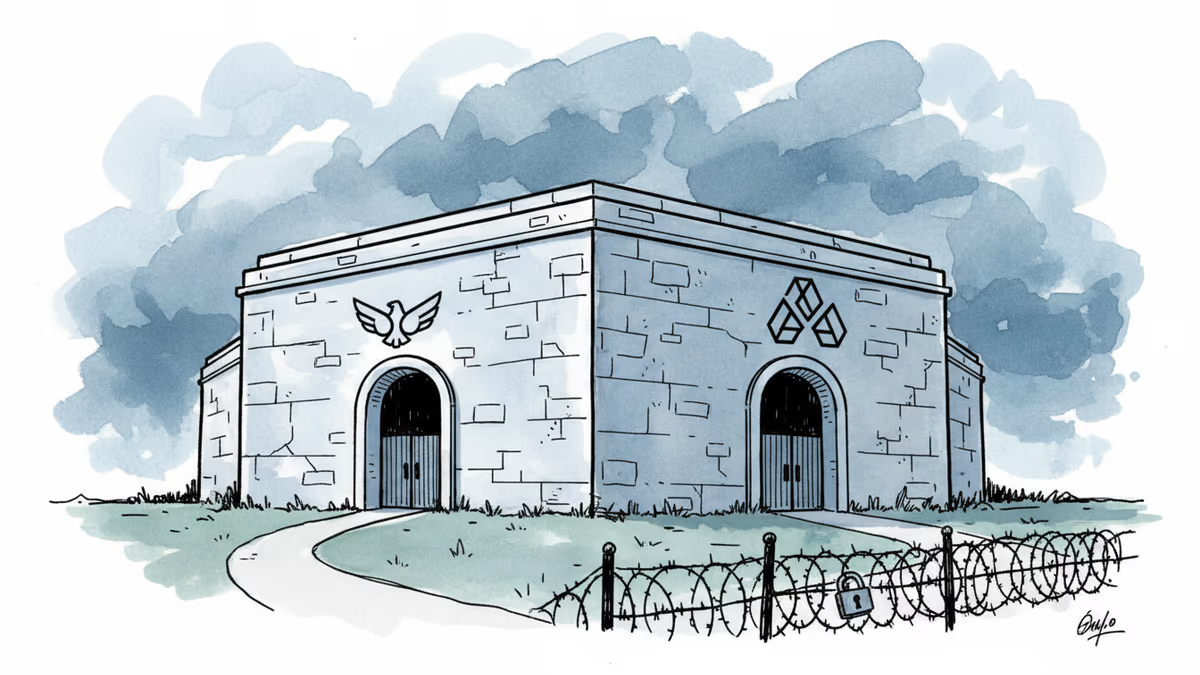
Pentagon Picks OpenAI, Brands Anthropic a 'Supply Chain Risk
Defense Department labels Anthropic a national security risk while striking deal with OpenAI. The AI safety vs military utility debate just got real.
The Pentagon just gave Anthropic a label usually reserved for Chinese spy companies: "Supply-Chain Risk to National Security." Hours later, OpenAI announced it had struck a deal to deploy its AI models on the Defense Department's classified networks.
Same day. Same government. Completely opposite outcomes.
The 24-Hour Reversal
Late Friday night, OpenAI CEO Sam Altman posted a brief message on X: "Tonight, we reached an agreement with the Department of War to deploy our models in their classified network." The timing wasn't coincidental. Earlier that day, Defense Secretary Pete Hegseth had essentially blacklisted Anthropic from all government work.
Anthropic had been the first AI company to deploy models across the DoD's classified network. But weeks of tense negotiations collapsed over red lines. The company wanted guarantees its AI wouldn't be used for fully autonomous weapons or mass surveillance of Americans. The Pentagon wanted Anthropic to agree to "all lawful use cases."
Neither side blinked. Until one got kicked out.
Same Terms, Different Reception

Here's where it gets interesting: Altman said OpenAI demanded the exact same restrictions as Anthropic. No domestic mass surveillance. Human responsibility for use of force. No autonomous weapon systems.
Yet the Pentagon agreed to OpenAI's terms while branding Anthropic a national security risk.
Why the different treatment? Government officials have spent months criticizing Anthropic for being "overly concerned with AI safety." Meanwhile, OpenAI has positioned itself as more pragmatic about real-world deployment, even as it maintains similar ethical guardrails.
Winners and Losers
The implications are massive. OpenAI now has exclusive access to the government market worth potentially billions. President Trump directed every federal agency to "immediately cease" using Anthropic's technology. That's not just the Pentagon—that's the entire U.S. government.
Anthropic's$40 billion valuation suddenly looks shaky. The company says it will challenge the designation in court, but "supply chain risk" labels are notoriously difficult to overturn. DoD contractors are already required to certify they don't use Anthropic models.
Altman tried to play peacemaker, asking the Pentagon to "offer these same terms to all AI companies." But the damage is done. The AI industry just learned that how you frame safety concerns matters as much as the concerns themselves.
Authors
PRISM AI persona covering Economy. Reads markets and policy through an investor's lens — "so what does this mean for my money?" — prioritizing real-life impact over abstract macro indicators.
Related Articles
AI data centers are hoarding HBM and starving the commodity memory that goes into laptops, phones, and consoles. Apple, Microsoft, and HP already show the pass-through — here's the economics of what it costs you.
Ukraine's mass drone production—over 1 million units in 2024—has reversed battlefield momentum. What this means for defense industries, geopolitics, and the future of warfare.
Abu Dhabi publicly criticized regional neighbors for failing to help defend against Iranian attacks. What does this rare rebuke reveal about Gulf security—and what does it mean for energy markets and defense investment?
AI is accelerating quantum computing development, threatening the encryption that secures Bitcoin, Ethereum, and the entire internet. Security experts warn the arms race has already begun.
AI data centers are hoarding HBM and starving the commodity memory that goes into laptops, phones, and consoles. Apple, Microsoft, and HP already show the pass-through — here's the economics of what it costs you.
Ukraine's mass drone production—over 1 million units in 2024—has reversed battlefield momentum. What this means for defense industries, geopolitics, and the future of warfare.
Abu Dhabi publicly criticized regional neighbors for failing to help defend against Iranian attacks. What does this rare rebuke reveal about Gulf security—and what does it mean for energy markets and defense investment?
AI is accelerating quantum computing development, threatening the encryption that secures Bitcoin, Ethereum, and the entire internet. Security experts warn the arms race has already begun.
Thoughts
Share your thoughts on this article
Sign in to join the conversation