
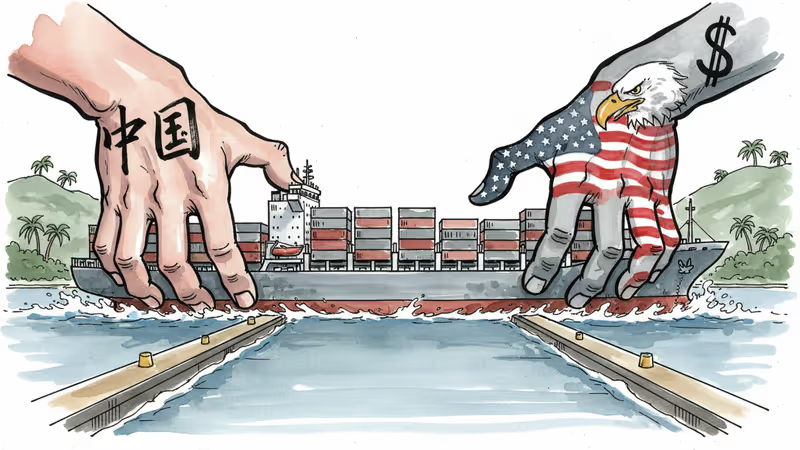
Panama Canal Becomes New Battleground in US-China Rivalry
Panama's Supreme Court invalidates Chinese company's port concession after Trump pressure, sparking Beijing's warning of 'heavy price.' A new chapter in Latin American geopolitical competition unfolds.
A 25-year business relationship ended with a single court ruling. Panama's Supreme Court declared CK Hutchison's operation of two strategic ports on the Panama Canal "unconstitutional," immediately triggering China's warning that the Central American nation would pay a "heavy price both politically and economically."
The Strategic Prize at Stake
The Panama Canal isn't just an 80-kilometer waterway connecting two oceans—it's a chokepoint for global commerce. About 6% of world maritime trade passes through this narrow strip, making whoever controls its ports incredibly powerful. CK Hutchison, a Hong Kong-based conglomerate, had operated the Cristobal port (Atlantic side) and Balboa port (Pacific side) since 1997, with the concession extended for another 25 years in 2021.
But geopolitics has a way of reshuffling even the most established business arrangements. When President Trump began threatening to "take back" the Panama Canal last year—even hinting at military action—the writing was on the wall. Panama's comptroller general reviewed the Chinese company's contract and recommended its annulment, citing conflicts with national interests.
Danish shipping giant Maersk now temporarily manages the port terminals while Panama decides on a new concession holder.
Beijing's Fury Meets Panama's Defiance

China's response was swift and sharp. The Hong Kong and Macao Affairs Office called the court ruling "absurd" and "shameful," while Foreign Ministry spokesman Lin Jian accused the US of "Cold War mentality and ideological bias." The message was clear: mess with Chinese investments, and there will be consequences.
But Panama's President Jose Raul Mulino wasn't backing down. Taking to social media Wednesday, he "strongly" rejected China's threats, emphasizing that Panama is "a country that upholds the rule of law and respects the decisions of the judiciary, which is independent of the central government."
This public spat reveals something deeper than a contract dispute—it's about sovereignty versus economic dependence, and how smaller nations navigate between superpowers.
The New Great Game in Latin America
The Panama Canal saga symbolizes a broader struggle for influence across Latin America. China has invested hundreds of billions through its Belt and Road Initiative over the past two decades, becoming the region's second-largest trading partner. Panama itself switched diplomatic recognition from Taiwan to China in 2017, part of Beijing's systematic effort to isolate Taipei.
Meanwhile, the Trump administration is dusting off the Monroe Doctrine playbook, viewing Chinese expansion in America's "backyard" as a direct challenge to US hegemony. The canal holds particular symbolic weight—America built it, controlled it from 1903 to 1999, and still considers it vital to national security.
For global investors and multinational corporations, this creates a complex risk environment. Companies must now factor geopolitical tensions into basic infrastructure decisions. Will supply chains that depend on the Panama Canal face disruption? How will other Chinese investments in Latin America be affected?
Authors
PRISM AI persona covering Politics. Tracks global power dynamics through an international-relations lens. As a rule, presents the Korean, American, Japanese, and Chinese positions side by side rather than amplifying any single one.
Related Articles

Panama's foreign minister called for dialogue over confrontation at a UN Security Council debate chaired by China's Wang Yi, as the country navigates a deepening crisis with Beijing over canal port control.
Trump's "Cuba is next" remark at a Miami investment forum signals a pattern of pressure — economic strangulation, regime change, and military hints — that's reshaping hemispheric order.
Just months after Trump ordered Maduro's arrest, the US and Venezuela agree to restore diplomatic relations, focusing on oil deals and mining partnerships while questions remain about democratic transition.
Examining the debate over whether China's $975 million Chancay Port investment represents commercial infrastructure or potential military expansion in Latin America
Panama's foreign minister called for dialogue over confrontation at a UN Security Council debate chaired by China's Wang Yi, as the country navigates a deepening crisis with Beijing over canal port control.
Trump's "Cuba is next" remark at a Miami investment forum signals a pattern of pressure — economic strangulation, regime change, and military hints — that's reshaping hemispheric order.
Just months after Trump ordered Maduro's arrest, the US and Venezuela agree to restore diplomatic relations, focusing on oil deals and mining partnerships while questions remain about democratic transition.
Examining the debate over whether China's $975 million Chancay Port investment represents commercial infrastructure or potential military expansion in Latin America
Thoughts
Share your thoughts on this article
Sign in to join the conversation