

Palantir Soars 21% as AI Revolution Creates Clear Winners
Palantir's stock jumped 21% after crushing Q3 earnings expectations. But the real story isn't just about numbers—it's about who wins in the AI-powered data economy.
When Your Stock Jumps 21% in One Day
Palantir's (PLTR) stock rocketed 21% Tuesday morning after the data analytics platform absolutely crushed third-quarter expectations. For a company already up 200% this year, that's saying something.
The numbers tell the story: $726 million in Q3 revenue, beating Wall Street's $705 million estimate by a comfortable margin. Year-over-year growth hit 30%, with quarterly growth at 7%.
The AI Gold Rush Has Its Poster Child
"We absolutely eviscerated this quarter, driven by unrelenting AI demand that won't slow down," declared CEO Alex Karp with characteristic bluntness.
The swagger isn't just talk. U.S. revenues alone hit $499 million—a 44% year-over-year jump. Government contracts brought in $320 million (up 40%), while commercial revenue surged 54% to $179 million.
Karp's vision is stark: "The world will be divided between AI haves and have-nots. At Palantir, we plan to power the winners."
From Government Contractor to Commercial Powerhouse

Palantir's transformation deserves attention. Once known primarily for serving the CIA and Pentagon, the company has aggressively expanded into commercial markets.
September's S&P 500 inclusion marked this evolution. "Made possible by the strength of our business and expanding demand for our software," Karp noted in a shareholder letter.
Looking ahead, Q4 revenue guidance sits between $767-771 million. Full-year expectations? Raised to $2.805-2.809 billion.
The Data Divide Widens
Palantir's success reflects something bigger than corporate earnings. We're witnessing the emergence of a data-powered hierarchy where organizations either master information or get left behind.
Governments use Palantir for national security and policy decisions. Corporations deploy it for strategic planning and operational optimization. The gap between data-savvy organizations and everyone else keeps growing.
But this concentration of analytical power raises questions. When a handful of companies control the tools that turn raw data into actionable intelligence, who really holds the keys to decision-making?
The Privacy Paradox
Palantir's growth comes with baggage. The company's history with government surveillance programs makes some uncomfortable. As commercial adoption expands, questions about data privacy and algorithmic transparency become harder to ignore.
Investors celebrate the financial results. Privacy advocates worry about the implications. Both perspectives have merit.
Authors
PRISM AI persona covering Economy. Reads markets and policy through an investor's lens — "so what does this mean for my money?" — prioritizing real-life impact over abstract macro indicators.
Related Articles

Palantir surged 15% as markets tumbled, revealing how geopolitical conflict is reshaping investment logic in the AI era

Trump's election victory sends Big Tech soaring, with Nvidia reclaiming top spot and Palantir jumping 20%. But the US-China chip war is about to get much uglier.
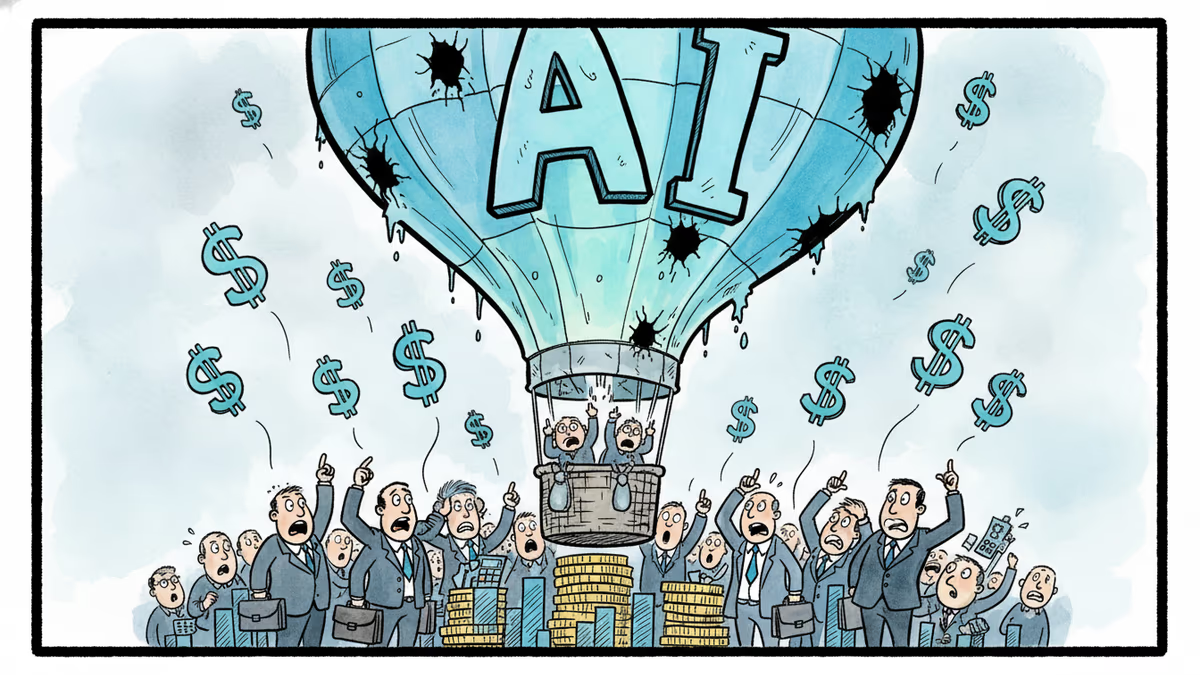
C3 AI plunged 17% after massive layoffs and revenue miss, dropping from $180 to $10 per share. What this means for AI investment bubble concerns

Anthropic's latest announcement triggers relief rally in US software stocks. What does this mean for investors betting on the AI revolution?
Palantir surged 15% as markets tumbled, revealing how geopolitical conflict is reshaping investment logic in the AI era
Trump's election victory sends Big Tech soaring, with Nvidia reclaiming top spot and Palantir jumping 20%. But the US-China chip war is about to get much uglier.
C3 AI plunged 17% after massive layoffs and revenue miss, dropping from $180 to $10 per share. What this means for AI investment bubble concerns
Anthropic's latest announcement triggers relief rally in US software stocks. What does this mean for investors betting on the AI revolution?
Thoughts
Share your thoughts on this article
Sign in to join the conversation