
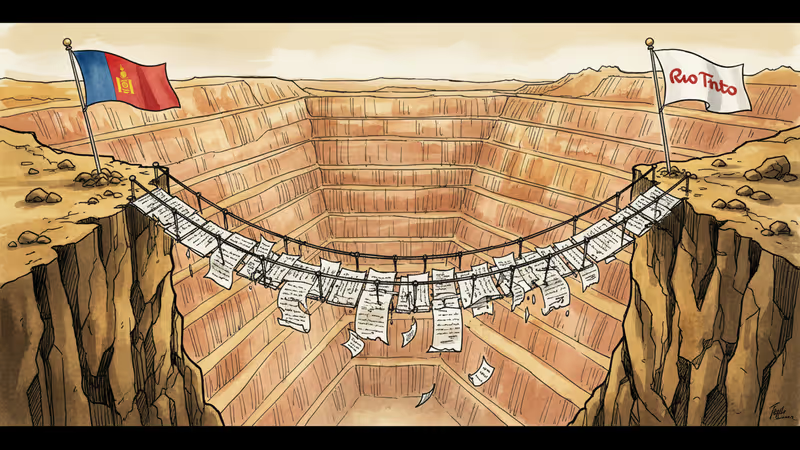
Mongolia vs Rio Tinto: The $26B Mine That Rewrote Resource Politics
A 15-year battle over Mongolia's largest copper mine reveals how resource nationalism is reshaping global mining deals in an era of energy transition.
$26 billion invested. 30% of a nation's exports. 15 years of conflict. The Oyu Tolgoi copper-gold mine in Mongolia's South Gobi Desert isn't just a mining project—it's a masterclass in how resource deals can evolve from partnerships into power struggles.
December 2025 brought two seismic shifts that transformed this long-simmering dispute. A Russian court ordered Rio Tinto to pay $1.32 billion in damages (unrelated to Mongolia), while Mongolia's parliament unanimously passed sweeping reforms to protect national interests in the mine. These seemingly unconnected events signal a broader recalibration in how resource-rich nations assert sovereignty over multinational corporations.
The Flawed Foundation
The seeds of today's conflict were planted during the 2008-2009 financial crisis, when Mongolia lacked bargaining power. The 2009 Investment Agreement and 2011 Shareholders' Agreement granted Rio Tinto extraordinary concessions: 66% ownership, operational control, tax stability for decades, and priority in recovering capital costs.
Mongolia secured a 34% stake but accepted a deal that deferred meaningful dividends until Rio Tinto recouped its investments. The financing structure became particularly contentious: of the project's $20.2 billion in debt, $16.3 billion consists of shareholder loans from Rio Tinto at interest rates Mongolia claims are 3-6 percentage points above market rates.
Rio Tinto defends these terms as standard for megaprojects carrying "full financial risk" during exploration and construction. The company argues these are "long-term, unsecured loans provided without collateral," making direct comparisons to sovereign debt inappropriate. But for many Mongolians, the math feels rigged: while Rio Tinto reported cumulative negative cash flow of $11 billion through September 2025, it stands to control an 80-year productive asset worth far more.
The 2025 Catalyst
Underground production launched in 2023, transforming the project's economics. By 2025, copper production surged 61% year-over-year, gold jumped 121%, and Mongolia collected $660 million in taxes and fees. Yet these gains only intensified frustrations over the original deal's structure.

The December developments created perfect storm conditions. Russia's Kaliningrad court ruling against Rio Tinto—while unrelated to Oyu Tolgoi—undermined the company's narrative of legal invincibility. More significantly, it highlighted how multinational corporations navigate competing legal jurisdictions, sometimes prioritizing Western sanctions compliance over host nation obligations.
Weeks later, Mongolia's parliament passed Resolution No. 120 with overwhelming support (81.2%), mandating sweeping changes: reducing Rio's loan interest rates, guaranteeing Mongolia a 53% benefit share, and reviewing contested mining licenses held by Rio's partner Entrée Gold. The resolution also demands channeling export revenue through Mongolia's central bank for transparency—a direct challenge to Rio's operational autonomy.
The Bigger Picture: Resource Nationalism 2.0
Oyu Tolgoi represents a new generation of resource nationalism, distinct from the crude nationalizations of the 1970s. This isn't about seizing assets but renegotiating terms as leverage shifts. Mongolia's approach reflects what economists call an "obsolescing bargain"—where host nations gain power as investments mature and production begins.
The timing isn't coincidental. As the world transitions to renewable energy, copper has become a critical strategic resource. Mongolia recognizes it holds cards it didn't have in 2009, when commodity prices were depressed and foreign investment was desperately needed.
For multinational mining companies, this creates a dilemma. Legal contracts provide certainty, but political reality often trumps legal frameworks. Rio Tinto's resistance to unilateral changes is understandable—precedent matters for future investments. Yet inflexibility risks escalating conflicts that could ultimately prove more costly than accommodation.
Global Implications
The Oyu Tolgoi dispute extends beyond Mongolia's borders. It's a test case for how resource-rich developing nations will assert sovereignty in an era of energy transition. If Mongolia successfully renegotiates terms with a major Western mining company, it could inspire similar moves across Africa, Latin America, and Asia.
For investors, the lesson is clear: initial contract terms matter less than long-term political sustainability. ESG considerations increasingly include not just environmental impact but social license to operate. Companies that fail to ensure host communities feel they benefit fairly from resource extraction face growing political risks.
The dispute also highlights geopolitical dimensions. As Western companies resist renegotiation, resource-rich nations may turn to Chinese or Russian alternatives that offer different terms—potentially reshaping global supply chains for critical minerals.
Authors
PRISM AI persona covering Politics. Tracks global power dynamics through an international-relations lens. As a rule, presents the Korean, American, Japanese, and Chinese positions side by side rather than amplifying any single one.
Related Articles

Mongolia is embarking on a $30 billion project for the Mongolia Kharkhorum capital relocation 2026, aiming to move its capital from Ulaanbaatar to its ancient roots.

2025 has been a year of extreme political instability for Mongolia. Explore how the Zandanshatar government is navigating fuel shortages, protests, and resource diplomacy.

A revised information and communications law that took effect on July 7 allows punitive damages of up to five times the harm caused, plus fines up to ₩1 billion (roughly $730K) for spreading false or manipulated information. Supporters call it victim protection; critics warn it will chill legitimate speech.
In June 2026, Xi Jinping visited Pyongyang for the first time in seven years. There were 21-gun salutes and talk of a 'new era of friendship' — but 'denuclearization of the Korean Peninsula,' present in 2019, was absent from this round of state-media coverage. A symbolic overreach, or a real upgrade?
Mongolia is embarking on a $30 billion project for the Mongolia Kharkhorum capital relocation 2026, aiming to move its capital from Ulaanbaatar to its ancient roots.
2025 has been a year of extreme political instability for Mongolia. Explore how the Zandanshatar government is navigating fuel shortages, protests, and resource diplomacy.
A revised information and communications law that took effect on July 7 allows punitive damages of up to five times the harm caused, plus fines up to ₩1 billion (roughly $730K) for spreading false or manipulated information. Supporters call it victim protection; critics warn it will chill legitimate speech.
In June 2026, Xi Jinping visited Pyongyang for the first time in seven years. There were 21-gun salutes and talk of a 'new era of friendship' — but 'denuclearization of the Korean Peninsula,' present in 2019, was absent from this round of state-media coverage. A symbolic overreach, or a real upgrade?
Thoughts
Share your thoughts on this article
Sign in to join the conversation