
Ancient Syphilis Discovery Rewrites 500 Years of Medical History
A 5,500-year-old syphilis genome found in Colombia challenges everything we thought we knew about venereal disease origins and the infamous 1495 Naples outbreak.
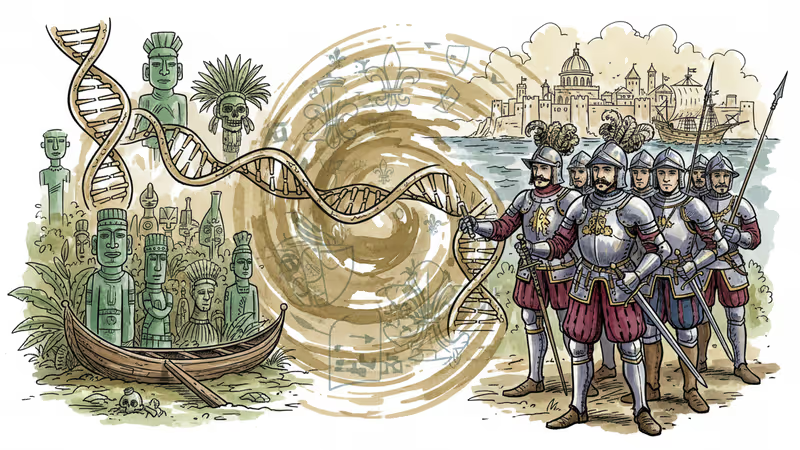
When 20,000 French mercenaries swept into Naples in 1495, they didn't just conquer a city—they became ground zero for Europe's first massive syphilis pandemic. The "Great Pox" would go on to kill up to 5 million people, and for centuries, that siege marked what historians considered syphilis's dramatic entrance into European civilization.
But a 5,500-year-old genome discovered in a Colombian rock shelter is about to rewrite that entire narrative.
The Ancient Pathogen That Changes Everything
Elizabeth Nelson, an anthropologist at Southern Methodist University, and her team have uncovered something extraordinary: a complete Treponema pallidum genome from an individual who died millennia before Columbus ever set sail. This isn't just about pushing back dates—it's about fundamentally rethinking how we understand the evolution and spread of one of history's most stigmatized diseases.
The discovery suggests that treponemal diseases like syphilis, bejel, and yaws have been with humanity for thousands of years longer than we imagined. What we thought was a "new world" disease introduced to Europe might actually be an ancient pathogen that found perfect conditions to explode in 15th-century Naples.
The Perfect Storm of 1495
While Charles VIII's army didn't introduce syphilis to the world, it created the ideal conditions for what became a legendary outbreak. The French king assembled a massive melting pot of brigands and mercenaries from across Europe—French, Swiss, Polish, and Spanish fighters all mixing in close quarters.

Charles himself wasn't exactly a moral exemplar. Court chronicler Johannes Burckard noted the king's "fondness of copulation" and reported that once he'd been with a woman, he "cared no more about her" and immediately sought another partner. His soldiers eagerly mirrored this behavior, creating the perfect conditions for rapid disease transmission.
This wasn't just about sexual behavior—it was about unprecedented mixing of populations from across Europe, combined with the stress, poor nutrition, and crowded conditions of military campaigns.
Rewriting Medical History
This discovery represents more than just archaeological curiosity. It's reshaping how we understand pathogen evolution and the relationship between human migration and disease spread. If syphilis-causing bacteria were already circulating in the Americas thousands of years before European contact, it changes fundamental assumptions about the Columbian Exchange and its role in global health history.
The implications extend to modern epidemiology. Understanding the true evolutionary timeline of pathogens like Treponema pallidum could inform current treatment strategies and help predict how similar bacteria might evolve in response to antibiotics.
The Blame Game Revisited
For centuries, syphilis carried geographic stigma—the French called it the "Neapolitan disease," while Italians dubbed it the "French disease." Each nation blamed others for its spread. But if the pathogen predates European exploration by millennia, these nationalist narratives collapse entirely.
This pattern of blame and stigmatization around sexually transmitted infections continues today, affecting everything from public health policy to individual treatment-seeking behavior. The ancient Colombian genome suggests we've been getting the story wrong from the very beginning.
Authors
Related Articles
1.77-million-year-old Homo erectus skulls from China push back Asian colonization by 130,000 years, revealing humanity's surprisingly rapid spread across continents.

Scientists have recreated the 4,000-year-old fragrances used in Egyptian mummification and are now incorporating them into museum exhibits, transforming how we experience ancient history through smell.

Archaeologists found traces of plant poison on 60,000-year-old arrowheads, proving prehistoric humans used complex chemical hunting strategies.

Researchers find traces of a 3,700-year-old red rice wine in a Bronze Age Chinese cemetery. The discovery reveals sophisticated fermentation tech using a starter similar to modern sake.
1.77-million-year-old Homo erectus skulls from China push back Asian colonization by 130,000 years, revealing humanity's surprisingly rapid spread across continents.
Scientists have recreated the 4,000-year-old fragrances used in Egyptian mummification and are now incorporating them into museum exhibits, transforming how we experience ancient history through smell.
Archaeologists found traces of plant poison on 60,000-year-old arrowheads, proving prehistoric humans used complex chemical hunting strategies.
Researchers find traces of a 3,700-year-old red rice wine in a Bronze Age Chinese cemetery. The discovery reveals sophisticated fermentation tech using a starter similar to modern sake.
Thoughts
Share your thoughts on this article
Sign in to join the conversation