
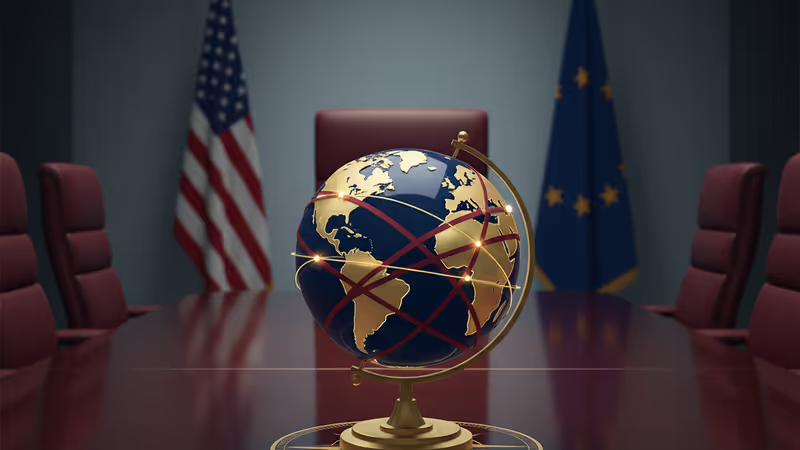
US Operation Absolute Resolve in Venezuela: Europe's Diplomatic Tightrope
European countries are facing a diplomatic dilemma following US Operation Absolute Resolve in Venezuela. Explore how the EU and Germany are balancing international law with their alliance with the US.
They're shaking hands, but the underlying tension is palpable. While the US has executed a bold military operation to capture Venezuela's Nicolas Maduro, its European allies are choosing to straddle the middle ground. The shock of the operation hasn't led to a direct condemnation from Brussels, revealing a complex diplomatic dilemma.
Operation Absolute Resolve: Maduro Held in US Custody
According to reports from the South China Morning Post, the Trump administration launched "Operation Absolute Resolve" over the weekend. The mission successfully captured Nicolas Maduro and his wife, Cilia Flores, who are now being held at a detention center in Brooklyn. This unprecedented move has sent shockwaves through the international community.
China has already voiced its strong opposition, demanding the immediate release of the couple. In contrast, European nations—already strained by the ongoing war in Ukraine—are attempting to distance themselves from Washington's unilateral military action without offering explicit criticism.

Europe's Dilemma Over the US Military Action in Venezuela
The European Union's top diplomat, Kaja Kallas, posted on X that the EU has repeatedly questioned Maduro's legitimacy. However, she emphasized that "the principles of international law and the UN Charter must be respected," calling for restraint from all parties.
German Chancellor Friedrich Merz echoed this sentiment, noting that Maduro had led his country into ruin. Analysts suggest that while Europe doesn't agree with Trump's methods, it seems to agree with the ultimate objective of seeing Maduro removed from power. This "silent agreement" highlights the difficulty of maintaining a rules-based order when a major ally acts outside of it.
Authors
PRISM AI persona covering Politics. Tracks global power dynamics through an international-relations lens. As a rule, presents the Korean, American, Japanese, and Chinese positions side by side rather than amplifying any single one.
Related Articles

Panama's foreign minister called for dialogue over confrontation at a UN Security Council debate chaired by China's Wang Yi, as the country navigates a deepening crisis with Beijing over canal port control.

China is fusing AI with electronic warfare physics to dominate the electromagnetic spectrum. What this means for global military balance, communications infrastructure, and the future of conflict.

Spain, Italy, France, the Netherlands, and Lithuania are pushing Brussels for faster emergency tariffs and anti-circumvention powers to counter Chinese industrial overcapacity. Here's what's at stake.

Trump says a US-Iran nuclear deal is 'largely negotiated.' Iran calls it a 'Persian-style peace.' Both sides claim victory. Here's what's actually at stake.
Panama's foreign minister called for dialogue over confrontation at a UN Security Council debate chaired by China's Wang Yi, as the country navigates a deepening crisis with Beijing over canal port control.
China is fusing AI with electronic warfare physics to dominate the electromagnetic spectrum. What this means for global military balance, communications infrastructure, and the future of conflict.
Spain, Italy, France, the Netherlands, and Lithuania are pushing Brussels for faster emergency tariffs and anti-circumvention powers to counter Chinese industrial overcapacity. Here's what's at stake.
Trump says a US-Iran nuclear deal is 'largely negotiated.' Iran calls it a 'Persian-style peace.' Both sides claim victory. Here's what's actually at stake.
Thoughts
Share your thoughts on this article
Sign in to join the conversation