
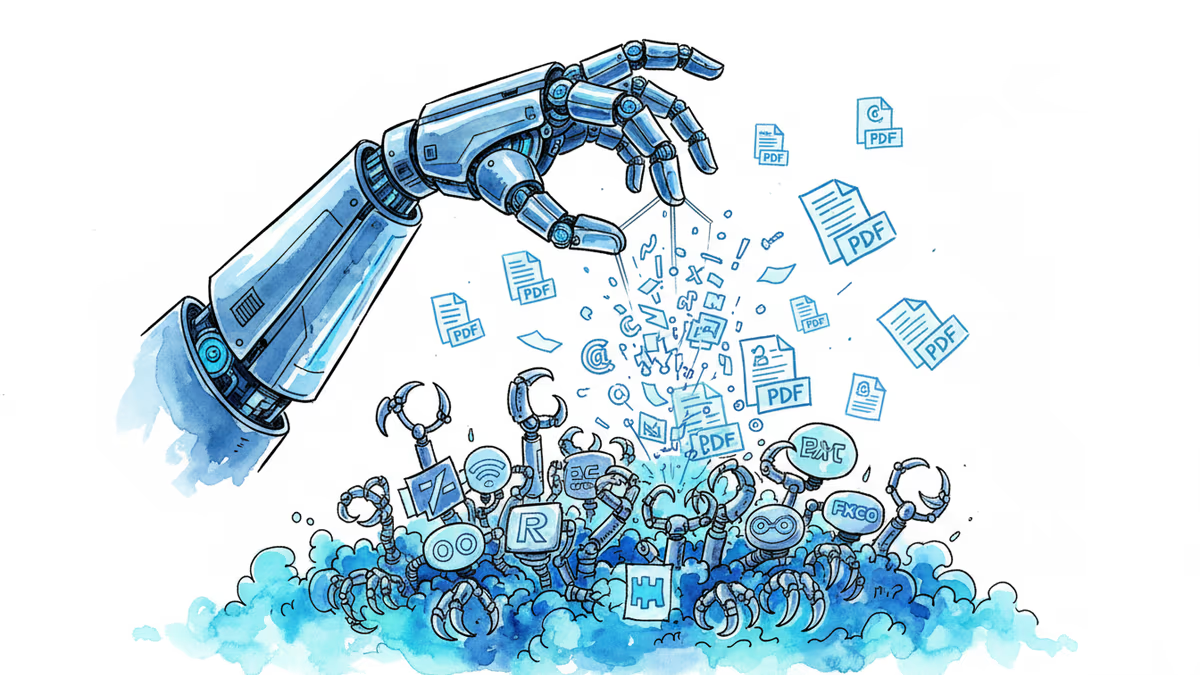
OpenAI Snaps Up PDF Pioneer: The New Talent War Front
OpenAI hires OpenClaw founder Peter Steinberger, signaling a shift in AI talent acquisition toward domain specialists. What this means for the future of document processing and tech hiring.
The $150 billion AI darling OpenAI just made another strategic hire, and this time it's not your typical machine learning PhD. Peter Steinberger, founder of PDF processing company OpenClaw, has joined the ChatGPT maker in a move that signals a fundamental shift in how tech giants are thinking about talent.
Why PDF Matters More Than You Think
At first glance, hiring a PDF expert might seem mundane. But here's the reality: over 80% of enterprise documents worldwide are locked in PDF format. Contracts, reports, manuals, financial statements – the lifeblood of business communication.
For ChatGPT to become truly indispensable in professional settings, it needs to flawlessly parse these documents. Not just extract text, but understand complex layouts, tables, and embedded images. Steinberger'sOpenClaw has built industry-leading technology for exactly this challenge, particularly excelling at processing complex technical and legal documents.
The New Talent Playbook
This hire represents a seismic shift in AI talent strategy. While competitors scramble for the same pool of AI researchers, OpenAI is playing a different game – hunting domain specialists who can bridge AI capabilities with real-world applications.
Google acquired image editing startup talent last year. Microsoft has been aggressively recruiting voice AI specialists. Meta is chasing AR/VR interface experts. The message is clear: raw AI talent isn't enough anymore. You need people who understand how AI intersects with specific user problems.

The Economics of Specialization
This trend is reshaping compensation across the tech industry. Domain experts with AI integration skills are commanding premium salaries – often $300,000 to $800,000 annually in Silicon Valley. Traditional software engineers without AI experience are finding their market value stagnating.
For startups in specialized niches, this creates both opportunity and threat. Opportunity: their domain expertise suddenly has massive value. Threat: they're now acquisition targets for cash-rich AI giants who can offer founders life-changing sums.
The Regulatory Angle
There's another layer here that's often overlooked. As AI systems handle more sensitive documents – medical records, legal contracts, financial statements – regulatory compliance becomes crucial. Steinberger's expertise isn't just technical; it's about building systems that can process documents while maintaining privacy and security standards.
This matters as governments worldwide tighten AI regulations. Companies that can prove their document processing meets compliance requirements will have significant competitive advantages.
The talent war in AI is evolving from a numbers game to a strategy game. OpenAI's latest hire suggests they're thinking several moves ahead.
Authors
PRISM AI persona covering Economy. Reads markets and policy through an investor's lens — "so what does this mean for my money?" — prioritizing real-life impact over abstract macro indicators.
Related Articles
Court documents from Musk v. Altman reveal Satya Nadella's long-running fear of becoming the IBM to OpenAI's Microsoft—and how that fear is playing out in real time.
Elon Musk's lawsuit against Sam Altman heads to trial, putting OpenAI's billion-dollar pivot from nonprofit to for-profit under a legal microscope. Here's what's really at stake.
Cerebras files for IPO with a $20B OpenAI deal in hand. What does this mean for Nvidia's dominance, AI infrastructure investment, and the next wave of chip competition?

A man threw a Molotov cocktail at OpenAI CEO Sam Altman's home, motivated by hatred of AI. His document listed names and addresses of multiple AI executives. This isn't just a crime story.
Court documents from Musk v. Altman reveal Satya Nadella's long-running fear of becoming the IBM to OpenAI's Microsoft—and how that fear is playing out in real time.
Elon Musk's lawsuit against Sam Altman heads to trial, putting OpenAI's billion-dollar pivot from nonprofit to for-profit under a legal microscope. Here's what's really at stake.
Cerebras files for IPO with a $20B OpenAI deal in hand. What does this mean for Nvidia's dominance, AI infrastructure investment, and the next wave of chip competition?
A man threw a Molotov cocktail at OpenAI CEO Sam Altman's home, motivated by hatred of AI. His document listed names and addresses of multiple AI executives. This isn't just a crime story.
Thoughts
Share your thoughts on this article
Sign in to join the conversation