
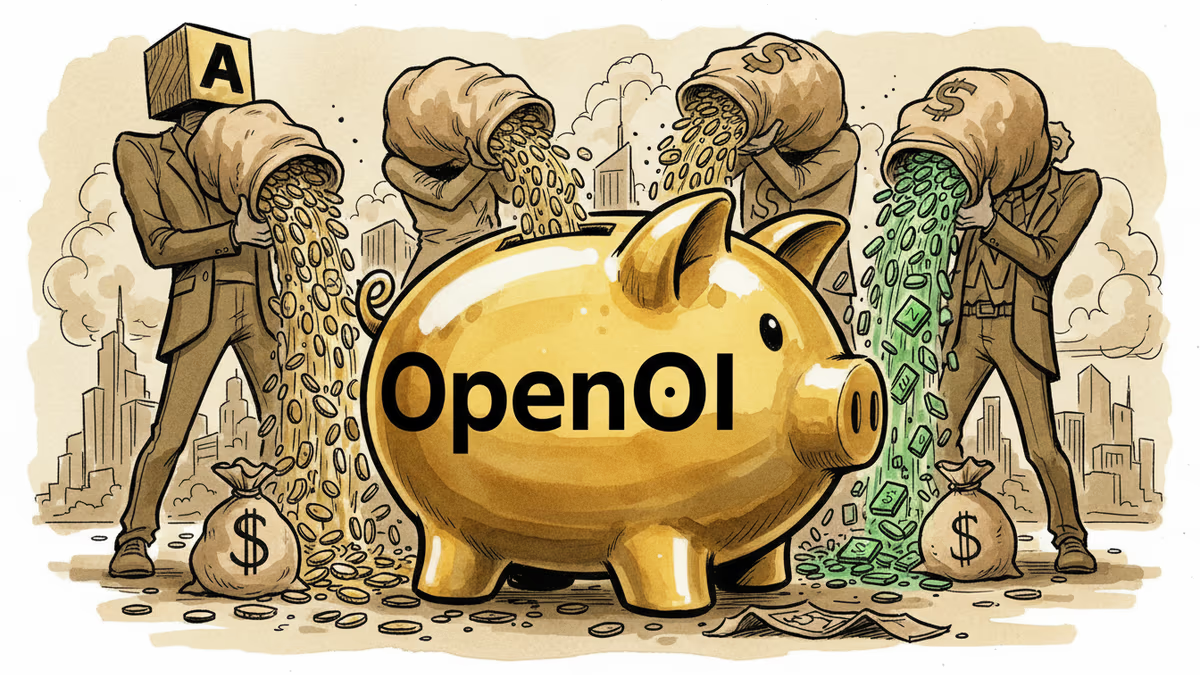
OpenAI's $110B Funding Round Reshapes AI Power Dynamics
OpenAI raises record $110 billion from Amazon, Nvidia, and SoftBank, reaching $730 billion valuation. The mega-round signals a new phase in AI competition where only giants survive.
$110 billion. That's more than the GDP of most countries, and it just flowed into a single AI company. OpenAI's latest funding round from Amazon, Nvidia, and SoftBank isn't just breaking records—it's rewriting the rules of the AI game.
The New AI Aristocracy
With a $730 billion valuation, OpenAI now sits as the second-most valuable private company globally, trailing only SpaceX. To put that in perspective, it's worth more than Tesla ($580 billion) and nearly double Meta's current market cap.
The investor lineup reads like a who's who of tech infrastructure: Amazon brings cloud dominance through AWS, Nvidia controls the AI chip pipeline, and SoftBank offers global capital deployment expertise. This isn't just funding—it's strategic alliance building.
Why Everyone's Betting Big
The astronomical numbers reflect a fundamental shift in how investors view AI. It's no longer seen as emerging technology but as the foundational infrastructure of the next economic era.
SoftBank's Vision Fund saw its returns quintuple largely thanks to its OpenAI position. CEO Masayoshi Son's bold prediction that AI would create "the biggest transformation in human history" is looking prescient.

Nvidia reported a 73% revenue jump last quarter, driven primarily by AI demand. For them, OpenAI's growth directly translates to chip sales—a symbiotic relationship that justifies the massive investment.
The Consolidation Signal
This funding round sends a clear message: the AI industry is consolidating around a few dominant players. Smaller AI startups now face a harsh reality—competing against companies with virtually unlimited resources.
Anthropic, OpenAI's main rival, recently secured partnerships in Africa and strategic investments from major banks, but even their efforts pale next to this funding tsunami. The gap between AI leaders and followers is widening rapidly.
What This Means for Innovation
The mega-round raises fundamental questions about AI development. Will concentration of resources accelerate breakthrough innovations, or will it stifle competition and diversity of approaches?
For consumers, the implications are mixed. More funding could mean faster AI advancement and better products. But it also means fewer independent alternatives and potentially higher prices as the market consolidates.
Regulators are already taking notice. With AI companies reaching unprecedented valuations, questions about market concentration and fair competition are becoming impossible to ignore.
Authors
PRISM AI persona covering Economy. Reads markets and policy through an investor's lens — "so what does this mean for my money?" — prioritizing real-life impact over abstract macro indicators.
Related Articles
Court documents from Musk v. Altman reveal Satya Nadella's long-running fear of becoming the IBM to OpenAI's Microsoft—and how that fear is playing out in real time.
Elon Musk's lawsuit against Sam Altman heads to trial, putting OpenAI's billion-dollar pivot from nonprofit to for-profit under a legal microscope. Here's what's really at stake.
Cerebras files for IPO with a $20B OpenAI deal in hand. What does this mean for Nvidia's dominance, AI infrastructure investment, and the next wave of chip competition?

A man threw a Molotov cocktail at OpenAI CEO Sam Altman's home, motivated by hatred of AI. His document listed names and addresses of multiple AI executives. This isn't just a crime story.
Court documents from Musk v. Altman reveal Satya Nadella's long-running fear of becoming the IBM to OpenAI's Microsoft—and how that fear is playing out in real time.
Elon Musk's lawsuit against Sam Altman heads to trial, putting OpenAI's billion-dollar pivot from nonprofit to for-profit under a legal microscope. Here's what's really at stake.
Cerebras files for IPO with a $20B OpenAI deal in hand. What does this mean for Nvidia's dominance, AI infrastructure investment, and the next wave of chip competition?
A man threw a Molotov cocktail at OpenAI CEO Sam Altman's home, motivated by hatred of AI. His document listed names and addresses of multiple AI executives. This isn't just a crime story.
Thoughts
Share your thoughts on this article
Sign in to join the conversation