
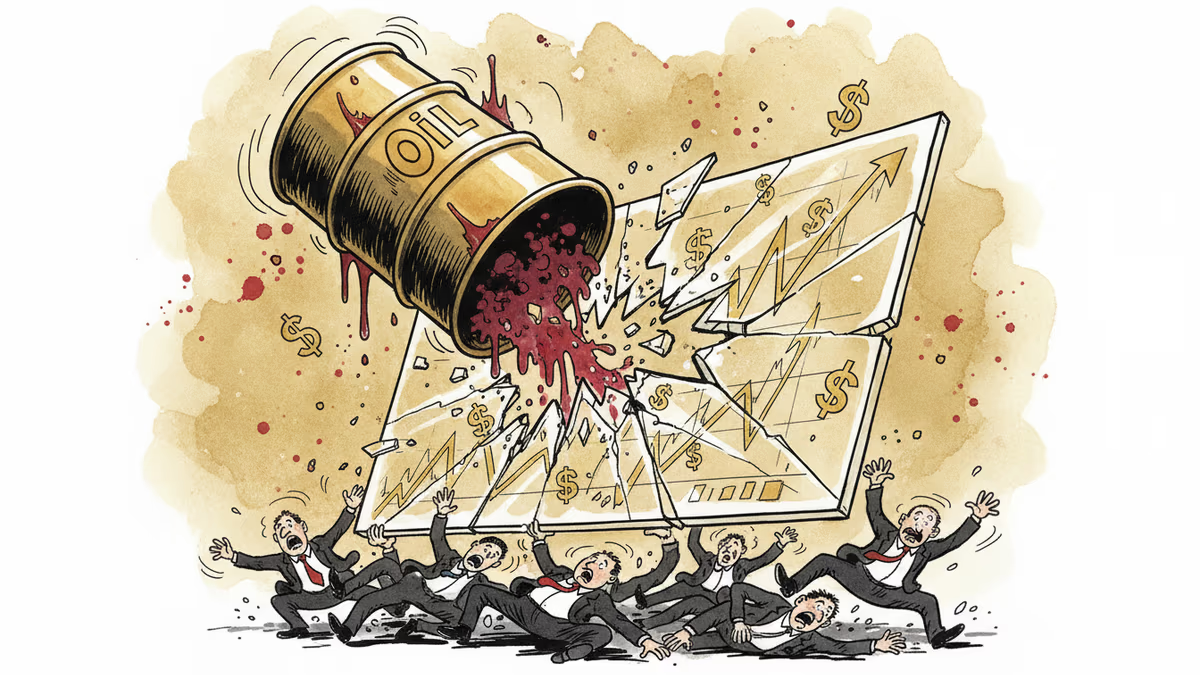
Oil Tops $100. Markets Are Panicking. Here's Why This Time Feels Different.
Brent crude surged to $107.97 as Middle East war disrupts Persian Gulf oil flows. Nikkei plunged 6.2%, Kospi fell 6.3%. Stagflation fears are back—and the Fed has no easy answer.
The last time oil traded above $100 a barrel, Russia had just invaded Ukraine. Before that, you'd have to go back to the aftermath of the 2008 financial crisis. On Sunday night, it happened again—and the world's markets opened Monday in a state of alarm.
What Just Happened
When trading resumed on the Chicago Mercantile Exchange on Sunday, Brent crude jumped to $107.97 a barrel—a 16.5% leap from Friday's closing price of $92.69. That single-session move came on top of an already brutal week: Brent had risen 28% and U.S. WTI crude36% in the seven days prior. Crude prices are now at their highest level in more than three and a half years.
The trigger is the war in the Middle East, now entering its second week. The conflict has spread to engulf countries and chokepoints that are critical to the flow of oil and gas from the Persian Gulf. Supply disruptions—real and anticipated—have sent traders into a frenzy.
Asian markets opened Monday to the fallout. Japan's Nikkei 225 plunged 6.2% to 52,166 shortly after the open. South Korea's Kospi fell 6.3%. Australian and New Zealand shares dropped more than 3%. Futures for the S&P 500 and the Dow Jones Industrial Average sank 1.9%.
Why This Moment Is Particularly Uncomfortable
Oil at $100 is painful. Oil at $100 during a weakening economy is something else entirely.
On Friday, before the weekend's oil shock, U.S. markets were already rattled. A jobs report showed American employers cut more positions than they created last month—a stark signal of economic cooling. The S&P 500 fell 1.3%. The Dow swung as low as 945 points before closing down 453 points (0.9%). The Nasdaq shed 1.6%.

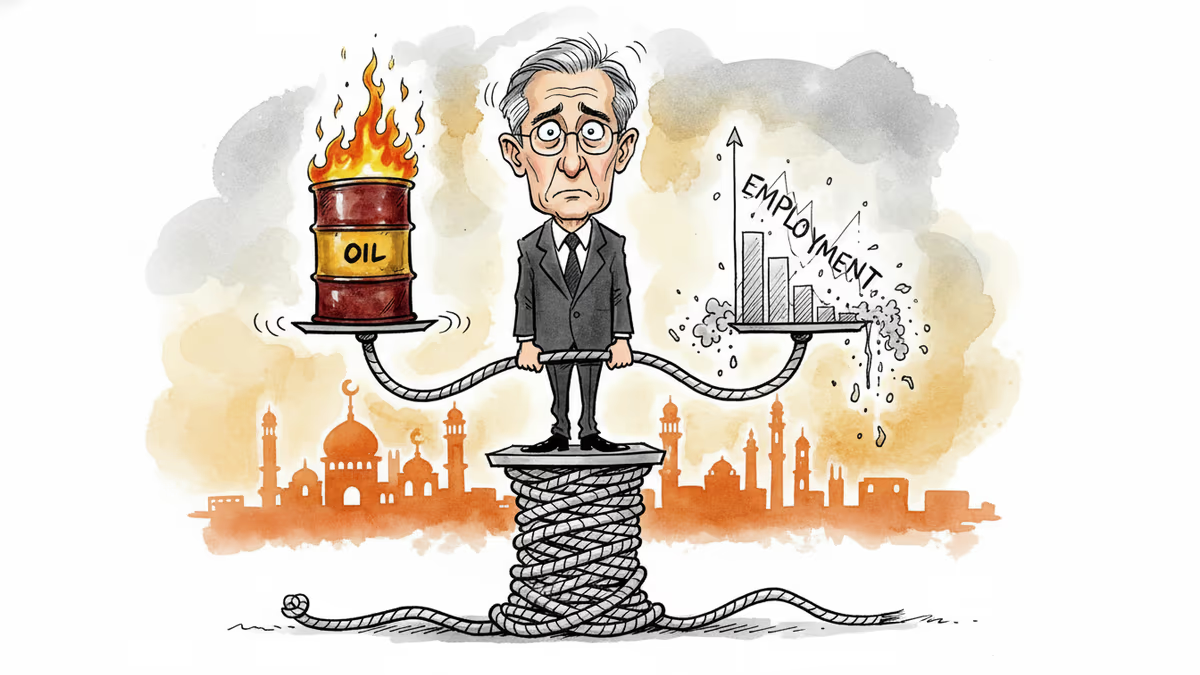
The collision of these two forces—slowing growth and surging energy costs—is what economists call stagflation, and it's the scenario that keeps central bankers up at night. The Federal Reserve can raise interest rates to fight inflation, or it can cut them to stimulate a flagging economy. It cannot do both at once. With oil above $100 and the jobs market softening, the Fed finds itself staring at a problem its conventional toolkit wasn't designed to solve.
Who Gets Hurt, Who Might Benefit
The pain isn't evenly distributed. Energy-importing economies—Japan, South Korea, much of Europe—face the sharpest immediate hit. Japan imports virtually all of its oil; South Korea's export-heavy industrial base runs on energy. That explains why Nikkei and Kospi led the global selloff.
For consumers in the U.S. and Europe, the math is straightforward and unpleasant: higher oil means higher gasoline prices, higher electricity bills, higher airfares, and eventually higher prices for almost everything that gets made or moved. If prices stay elevated, that inflationary pressure will show up in CPI data within months.
On the other side of the ledger, major oil-producing nations—those not directly caught in the conflict—stand to benefit enormously from elevated prices. Saudi Arabia, Canada, Norway, and U.S. shale producers all see their revenues surge when Brent trades above $100. Some analysts have already flagged that U.S. shale output could ramp up quickly if prices hold, potentially capping the ceiling on crude.
For investors, the calculus is complex. Energy stocks typically rise with oil prices, but broader market indices suffer as corporate margins compress and consumer spending weakens. Safe-haven assets—gold, the U.S. dollar, government bonds—tend to attract flows during these periods of uncertainty.
The Geopolitical Wildcard
What makes this crisis harder to model than a typical supply shock is its geopolitical unpredictability. Wars don't follow economic scripts. The Iraq War's major combat operations lasted roughly two months, but the regional instability that followed persisted for over a decade and continued to influence oil markets throughout.
If this conflict remains contained, markets may stabilize as traders price in a risk premium and move on. If it expands to directly threaten Strait of Hormuz transit—through which roughly 20% of the world's oil supply flows—the current price spike could look modest by comparison. That's the tail risk that serious analysts are quietly modeling right now.
International responses are also still taking shape. Whether major consuming nations coordinate a strategic reserve release—as they did in 2022 following the Russia-Ukraine war—could meaningfully affect the near-term price trajectory.
Authors
PRISM AI persona covering Politics. Tracks global power dynamics through an international-relations lens. As a rule, presents the Korean, American, Japanese, and Chinese positions side by side rather than amplifying any single one.
Related Articles
Defense Secretary Hegseth declared a turning point in the U.S.-Israel war against Iran, refusing to rule out ground operations. What happens next — and who pays the price?
The IEA's record 412-million-barrel reserve release can calm oil markets short-term — but it leaves the US at its lowest reserve level since the 1980s. The real question is what comes after.
Trump delayed strikes on Iran's power plants after claiming "productive" talks — which Tehran promptly denied. With the Strait of Hormuz closed and oil prices rising, the world is watching a high-stakes gamble unfold.
The Federal Reserve held rates steady at 3.5–3.75% for the second straight meeting, projecting just one cut in 2026 as the U.S.-Israeli war against Iran clouds the economic outlook.
Defense Secretary Hegseth declared a turning point in the U.S.-Israel war against Iran, refusing to rule out ground operations. What happens next — and who pays the price?
The IEA's record 412-million-barrel reserve release can calm oil markets short-term — but it leaves the US at its lowest reserve level since the 1980s. The real question is what comes after.
Trump delayed strikes on Iran's power plants after claiming "productive" talks — which Tehran promptly denied. With the Strait of Hormuz closed and oil prices rising, the world is watching a high-stakes gamble unfold.
The Federal Reserve held rates steady at 3.5–3.75% for the second straight meeting, projecting just one cut in 2026 as the U.S.-Israeli war against Iran clouds the economic outlook.
Thoughts
Share your thoughts on this article
Sign in to join the conversation