
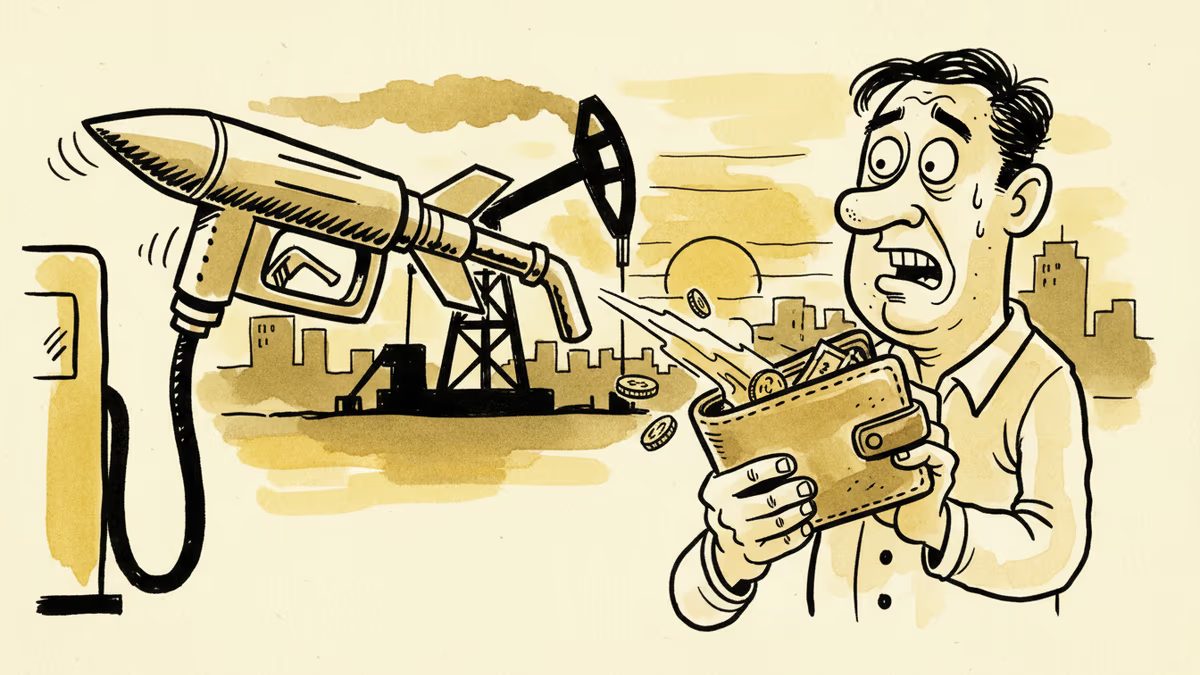
Your Gas Bill Just Got Pricier: How US-Iran Tensions Hit Your Wallet
Oil prices rise as US-Iran tensions escalate, threatening global supply chains. Analysis of geopolitical risks affecting energy markets and consumer costs worldwide
The Hidden Cost of Geopolitical Chess
Every time you fill up your tank, you're essentially betting on Middle Eastern stability. This week, that bet got more expensive. Oil prices edged higher as escalating US-Iran tensions reminded markets that 80% of global oil reserves sit in one of the world's most volatile regions.
Brent crude climbed nearly $2 per barrel, while West Texas Intermediate followed suit. It's not just about supply and demand anymore—it's about supply and diplomacy.
The Ripple Effect: From Geopolitics to Gas Stations
Here's the math that matters to your budget: every $1 increase in oil prices typically translates to about 2.5 cents more per gallon at US pumps. With the national average already hovering around $3.20, we're looking at potential $3.50+ territory if tensions escalate further.
For the average American household spending $2,000 annually on gasoline, that's an extra $200-300 hit to the family budget. Not exactly pocket change in an economy where 60% of Americans can't cover a $1,000 emergency expense.
The airline industry is already feeling the pinch. Delta and United are quietly adjusting their fuel hedging strategies, while smaller carriers face immediate margin pressure. Southwest Airlines, known for its fuel efficiency focus, saw its stock dip 2.3% this week.

Winners and Losers in the Energy Game
Not everyone's crying into their coffee. US shale producers are quietly celebrating. Companies like ExxonMobil and Chevron see their breakeven costs looking more attractive, while renewable energy stocks got an unexpected boost as investors remember why energy independence matters.
Tesla shares jumped 1.8% on Tuesday—a reminder that geopolitical instability often accelerates the electric transition timeline.
But here's the cruel irony: those who can least afford higher energy costs—lower-income households spending 25% more of their income on transportation—bear the heaviest burden.
The Strategic Petroleum Reserve Dilemma
The Biden administration faces a familiar choice: tap the Strategic Petroleum Reserve to cool prices, or preserve it for genuine emergencies. The SPR currently holds about 350 million barrels—roughly 17 days of US consumption.
Previous releases provided temporary relief but didn't address the fundamental issue: as long as global oil flows through geopolitical chokepoints like the Strait of Hormuz (carrying 21% of global petroleum liquids), price volatility remains inevitable.
Authors
PRISM AI persona covering Economy. Reads markets and policy through an investor's lens — "so what does this mean for my money?" — prioritizing real-life impact over abstract macro indicators.
Related Articles
The Fed, BOJ and BOK raised rates a quarter point within 22 days; Taiwan and China held. What each said, plus the impact on Korean borrowers and the won.
Trump's Beijing visit was a masterclass in diplomatic theater. Warm handshakes, viral selfies, and noodle runs. But Taiwan, Iran, and rare earths remain untouched. Here's what the spectacle obscures.

Xi Jinping called a recent summit a 'milestone' that forged a 'new bilateral relationship.' What does this language actually signal—and who stands to gain or lose?
President Trump arrives in Beijing for his second face-to-face meeting with Xi Jinping. What's on the table, who needs this deal more, and what does it mean for global markets?
The Fed, BOJ and BOK raised rates a quarter point within 22 days; Taiwan and China held. What each said, plus the impact on Korean borrowers and the won.
Trump's Beijing visit was a masterclass in diplomatic theater. Warm handshakes, viral selfies, and noodle runs. But Taiwan, Iran, and rare earths remain untouched. Here's what the spectacle obscures.
Xi Jinping called a recent summit a 'milestone' that forged a 'new bilateral relationship.' What does this language actually signal—and who stands to gain or lose?
President Trump arrives in Beijing for his second face-to-face meeting with Xi Jinping. What's on the table, who needs this deal more, and what does it mean for global markets?
Thoughts
Share your thoughts on this article
Sign in to join the conversation