
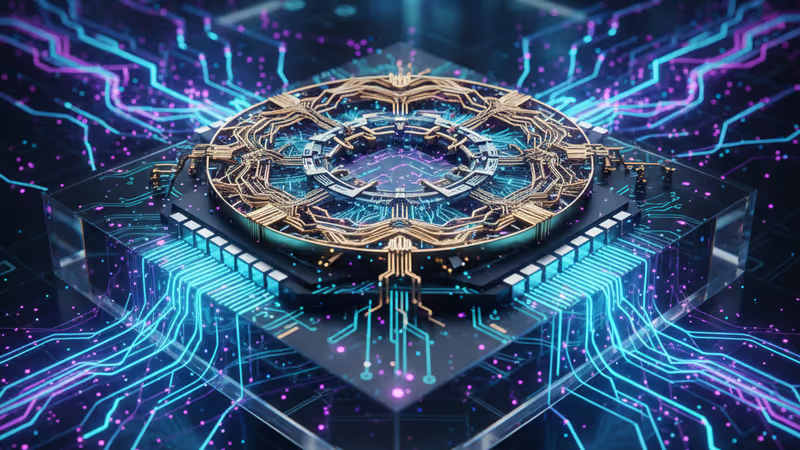
Nvidia Rubin AI Chips Unveiled at CES 2026: Roadmap and Strategy
Nvidia CEO Jensen Huang announced the next-gen Rubin AI chips at CES 2026. Discover the roadmap for the Rubin architecture and Nvidia's vision for 'Physical AI'.
AI bubble fears? Nvidia has an answer. Nvidia just silenced skeptics by revealing concrete details of its next-gen Rubin AI architecture, the highly anticipated successor to the Blackwell lineup.
Nvidia Rubin AI Chips Production Confirmed for 2026
During his keynote at CES 2026 on January 5, CEO Jensen Huang announced that the Rubin AI chips are already in full production. According to Nikkei, these chips'll be available in the second half of 2026, maintaining the company's aggressive annual release cycle.

Huang emphasized that the industry's entered a 'ChatGPT moment' for physical AI. While previous generations focused on digital intelligence, Rubin is designed to power the next wave of robotics and autonomous systems that interact directly with the physical world.
Market Dynamics and Global Competition
Despite Nvidia's dominance, the global stage remains volatile. Chinese chipmaker Biren saw its stock soar during its trading debut, and Huawei has reportedly boosted its domestic part ratio to 60% in its latest smartphones. However, the US decision to delay new China chip tariffs until 2027 provides some breathing room for global supply chains.
Authors
Related Articles

At Milken 2026, five AI insiders—from the CEO of ASML to a quantum physicist challenging LLMs—laid out the physical, energy, and geopolitical limits the AI boom is running into.

At Nvidia's GTC 2026, a rambling Olaf robot had its mic cut mid-demo. The real story isn't the glitch — it's the questions the industry keeps avoiding.

At GTC 2026, Nvidia is expected to unveil an inference chip and the NemoClaw AI agent platform. What happens when the company that owns 80% of AI training comes for the rest of the stack?
Ricursive Intelligence raised $300M at a $4B valuation just two months after launch, using AI to autonomously design and improve AI chips. The semiconductor industry may never be the same.
At Milken 2026, five AI insiders—from the CEO of ASML to a quantum physicist challenging LLMs—laid out the physical, energy, and geopolitical limits the AI boom is running into.
At Nvidia's GTC 2026, a rambling Olaf robot had its mic cut mid-demo. The real story isn't the glitch — it's the questions the industry keeps avoiding.
At GTC 2026, Nvidia is expected to unveil an inference chip and the NemoClaw AI agent platform. What happens when the company that owns 80% of AI training comes for the rest of the stack?
Ricursive Intelligence raised $300M at a $4B valuation just two months after launch, using AI to autonomously design and improve AI chips. The semiconductor industry may never be the same.
Thoughts
Share your thoughts on this article
Sign in to join the conversation