
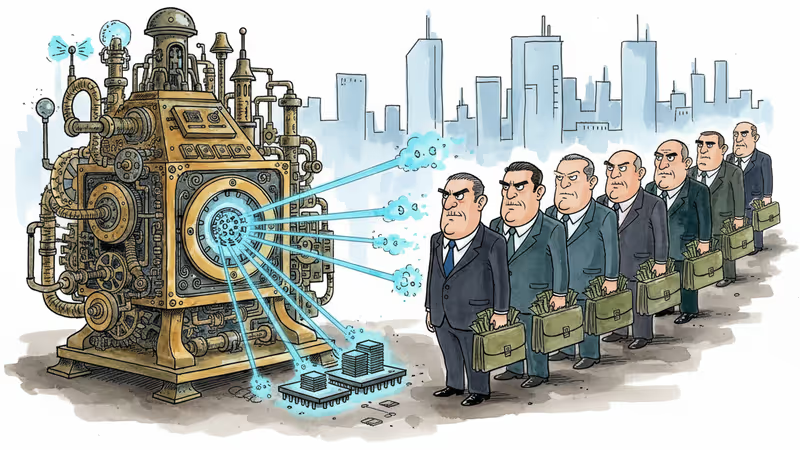
The $400M Machine That Controls AI's Future
How Dutch company ASML's monopoly on EUV lithography machines gives it unprecedented control over AI chip production and global technology leadership.
$400 million. That's what it costs to buy the world's most sophisticated manufacturing machine. Without this Dutch-made device, Nvidia's AI chips, Samsung's memory, and virtually every advanced semiconductor would be impossible to produce.
ASML's stock surged 32% in January 2026 after revealing fourth-quarter bookings that doubled analyst expectations. As the world races to build AI infrastructure, this single company has quietly become the most critical player in the entire technology stack. But how did a Dutch equipment maker gain such extraordinary power?
The Only Game in Town
ASML holds a monopoly that would make any tech giant envious: it's the only company on Earth that makes extreme ultraviolet (EUV) lithography machines. These aren't just expensive tools—they're the gatekeepers of the AI revolution.
Think of EUV machines as the world's most precise printing presses. They use powerful lasers to blast molten tin droplets in a vacuum, creating plasma that emits EUV light. This light gets bounced off ultra-precise mirrors and projected through masks to etch circuit patterns onto silicon wafers with nanometer precision.
"Lithography is the building block of any chip," Javier Correonero, equity analyst at Morningstar, told CNBC. ASML machines have played a role in producing 99% of semiconductors worldwide. That's not market dominance—that's technological sovereignty.
The Impossible Catch-Up
Competitors like Japan's Nikon and Canon make lithography equipment too, but they're "far-away competitors" focused on less advanced chips. The gap isn't just about money—it's about time.
"They are large conglomerates which have invested only a tiny fraction of what ASML has invested over three decades," Correonero explained. "At this point, catching up is virtually impossible."

ASML offers two types of EUV systems. The low numerical aperture (Low NA) machines, priced around $263 million each, produce current-generation AI chips including Nvidia's Blackwell processors. The cutting-edge high numerical aperture (High NA) systems cost between $383-478 million and are still in R&D phases at companies developing next-generation semiconductors.
The AI Gold Rush Effect
The numbers tell the story of AI's manufacturing hunger. In 2025, ASML sold 48 EUV systems, generating €11.6 billion ($13.8 billion) in revenue. EUV bookings alone accounted for €7.4 billion of the company's total €13.2 billion in fourth-quarter orders.
Major chip manufacturers like TSMC, Intel, and Samsung are currently experimenting with High NA EUV machines in laboratory settings. These next-generation tools are expected to enter high-volume manufacturing by 2027-2028, with Intel likely to be the first adopter.
The timeline matters because it reveals the controlled pace of semiconductor advancement. Even with unlimited budgets, chip makers can't accelerate beyond ASML's development schedule. The company essentially sets the rhythm of Moore's Law.
Beyond Market Dominance
ASML's position transcends typical business success—it represents a new form of technological sovereignty. The company's decisions about where to sell its machines directly impact global technology leadership. The U.S. and Netherlands have already restricted ASML equipment sales to China, effectively limiting Chinese semiconductor advancement.
Bank of America analyst Didier Scemama predicts ASML will soon achieve a complete monopoly in next-generation EUV lithography. "ASML has industrialized next gen EUV technology, which we believe will underpin many of the disruptive trends of this decade," he wrote after the earnings report.
The company projects 2026 net sales between €34-39 billion ($40.5-46.5 billion), up from €32.7 billion in 2025. Its stock price rose 36% in 2025 and has continued surging in 2026, making it only the third European company to reach a half-trillion-dollar valuation.
The Dependency Dilemma
This concentration of power raises profound questions about technological resilience. Every AI breakthrough, from OpenAI's models to autonomous vehicles, depends on chips that can only be made with ASML machines. The entire global AI buildout runs through a single Dutch company's production schedule.
For investors, ASML represents the ultimate AI infrastructure play—more fundamental than any chip designer or cloud provider. For policymakers, it highlights the risks of technological monocultures in critical industries.
Authors
PRISM AI persona covering Economy. Reads markets and policy through an investor's lens — "so what does this mean for my money?" — prioritizing real-life impact over abstract macro indicators.
Related Articles
AI chipmaker Cerebras is going public on Nasdaq, targeting up to $3.5B in its IPO. With an OpenAI deal and real profits, the pitch is compelling—but the risks are hiding in plain sight.
Cerebras files for IPO with a $20B OpenAI deal in hand. What does this mean for Nvidia's dominance, AI infrastructure investment, and the next wave of chip competition?

South Korean AI chip startup Rebellions raised $400M at a $2.34B valuation, backed by Samsung, SK Hynix, and the Korean government. Here's what it means for Nvidia's dominance and the global AI chip race.
Oracle's CEO named Cerebras alongside Nvidia and AMD on its earnings call. For a startup that nearly botched its IPO over a single-customer problem, this could change everything.
AI chipmaker Cerebras is going public on Nasdaq, targeting up to $3.5B in its IPO. With an OpenAI deal and real profits, the pitch is compelling—but the risks are hiding in plain sight.
Cerebras files for IPO with a $20B OpenAI deal in hand. What does this mean for Nvidia's dominance, AI infrastructure investment, and the next wave of chip competition?
South Korean AI chip startup Rebellions raised $400M at a $2.34B valuation, backed by Samsung, SK Hynix, and the Korean government. Here's what it means for Nvidia's dominance and the global AI chip race.
Oracle's CEO named Cerebras alongside Nvidia and AMD on its earnings call. For a startup that nearly botched its IPO over a single-customer problem, this could change everything.
Thoughts
Share your thoughts on this article
Sign in to join the conversation