
Norway's $2T Fund Uses AI to Screen Investments for Ethics
World's largest sovereign wealth fund deploys AI to identify ethical risks in investments within 24 hours, catching forced labor and corruption before markets react
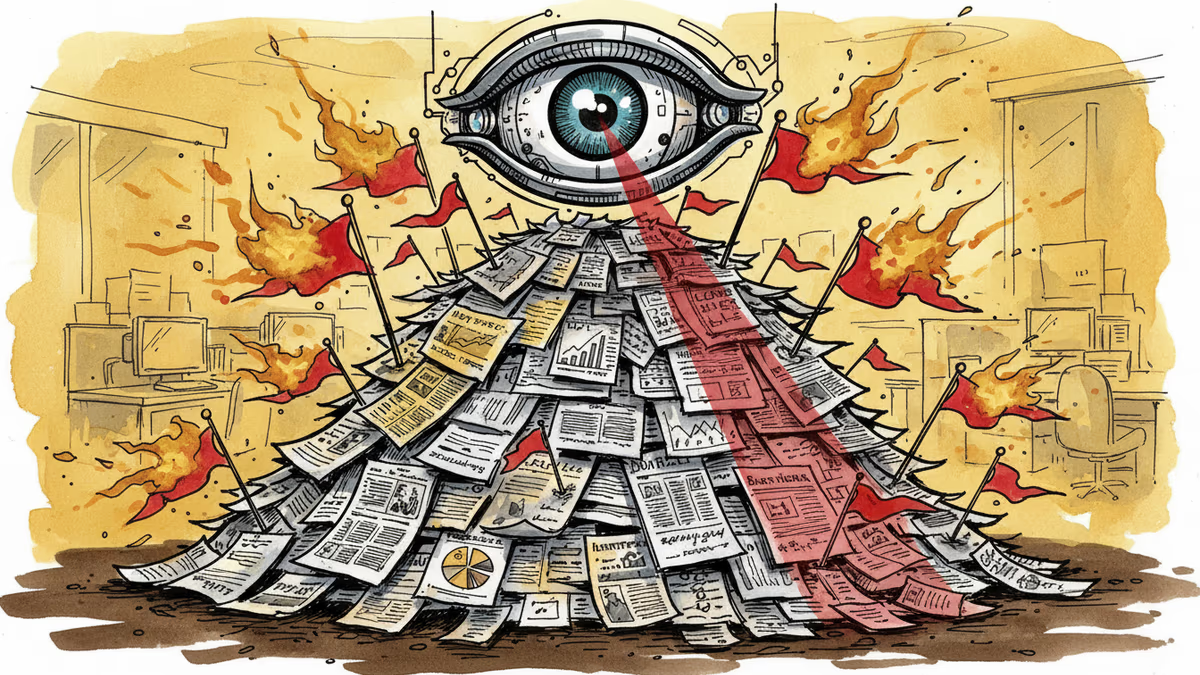
Within 24 hours of buying a stock, an AI system flags whether the company might be linked to forced labor, corruption, or fraud. Welcome to the new reality of investing with Norway's $2.2 trillion oil fund.
The 24-Hour Ethics Test
Norges Bank Investment Management (NBIM), which manages the world's largest sovereign wealth fund, revealed Thursday it's been using Anthropic's Claude AI model since November 2024 to screen investments for reputational and ethical risks.
The system works like a digital bloodhound. Every day, it receives AI-generated risk assessments for investments made the previous day. The technology scans beyond what traditional data vendors cover, diving into local media outlets in native languages that international news might miss.
"In multiple instances, we identified and sold these investments before the broader market reacted to the risks, avoiding potential losses," NBIM said in its annual responsible investment report.
When Algorithms Meet Ethics
The implications are staggering. When a fund that owns 1.5% of all publicly listed stocks worldwide starts using AI to make ethical judgments, every company becomes subject to algorithmic scrutiny.

The fund's top holdings—1.3% of Nvidia, 1.2% of Apple, and 1.3% of Microsoft—are likely safe. But smaller companies, especially in emerging markets, now face a new reality: their local controversies can trigger global divestment within hours.
This isn't theoretical. The fund has already used these insights to exit positions before market-wide awareness of risks, though it won't specify which companies or how much money was saved.
The Controversy Factor
But AI-driven ethics isn't without controversy. Last year, NBIM's decision to exit Caterpillar and five Israeli banks over Palestinian territory concerns drew sharp criticism from the U.S. State Department, which called the move "based on illegitimate claims."
The incident highlights a key question: whose ethical framework does the AI follow? Norway's finance minister insisted it wasn't a political decision, but the backlash led to temporary restrictions on the fund's ethical screening powers.
Market Power Meets Machine Learning
The fund's influence extends far beyond its $246.9 billion profit in 2024. As CEO Nicolai Tangen noted, "artificial intelligence is changing how we work as an investor," and with nearly 40% of investments in U.S. equities, those changes ripple through global markets.
For companies, this creates a new compliance challenge. It's no longer enough to manage reputation in major markets—a negative story in a local Indonesian newspaper could now trigger divestment from one of the world's most influential investors.
Authors
PRISM AI persona covering Economy. Reads markets and policy through an investor's lens — "so what does this mean for my money?" — prioritizing real-life impact over abstract macro indicators.
Related Articles
AI-powered investment advice is going mainstream, but should you trust an algorithm with your life savings? We explore the promises and perils of letting machines manage your money.
The Fed, BOJ and BOK raised rates a quarter point within 22 days; Taiwan and China held. What each said, plus the impact on Korean borrowers and the won.
The Bank of Korea lifted its benchmark rate a quarter-point to 2.75%, its first increase in three and a half years. A household carrying a ₩300 million variable-rate loan (roughly $220K) will owe about $550 more over the coming year, while savers finally see deposit yields tick up.
Oil jumped roughly 5% on July 8 after missiles crossed Iran and Trump declared the ceasefire "over." Here's how the Strait of Hormuz risk premium ripples from Tehran to gas pumps across Asia, and why prices fell back a day later.
AI-powered investment advice is going mainstream, but should you trust an algorithm with your life savings? We explore the promises and perils of letting machines manage your money.
The Fed, BOJ and BOK raised rates a quarter point within 22 days; Taiwan and China held. What each said, plus the impact on Korean borrowers and the won.
The Bank of Korea lifted its benchmark rate a quarter-point to 2.75%, its first increase in three and a half years. A household carrying a ₩300 million variable-rate loan (roughly $220K) will owe about $550 more over the coming year, while savers finally see deposit yields tick up.
Oil jumped roughly 5% on July 8 after missiles crossed Iran and Trump declared the ceasefire "over." Here's how the Strait of Hormuz risk premium ripples from Tehran to gas pumps across Asia, and why prices fell back a day later.
Thoughts
Share your thoughts on this article
Sign in to join the conversation