
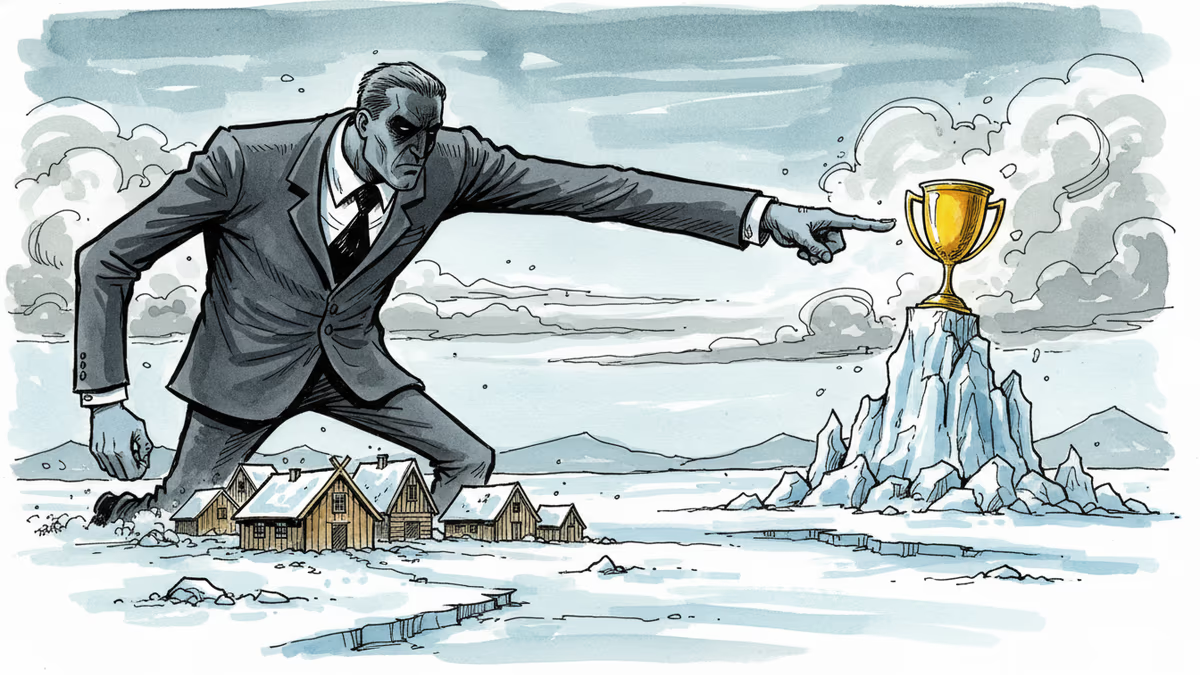
When Peace Prize Envy Turns Into War Threats: Trump's Greenland Obsession
Trump's resentment over not receiving the Nobel Peace Prize has become entangled with his territorial demands for Greenland, creating unprecedented tensions with NATO allies. A shocking text exchange reveals the personal motivations behind geopolitical threats.
What happens when personal grievances collide with international diplomacy? Last month, Norwegian Prime Minister Jonas Gahr Støre was returning from a ski outing when he decided to text Donald Trump, hoping to defuse tensions over Greenland. The response he received reveals how deeply personal resentments now shape American foreign policy.
"No Peace Prize, No Pure Peace Thinking"
Støre's message was straightforward: let's "deescalate" because "so much is happening around us where we need to stand together." Co-signed by Finland's president, it was a diplomatic olive branch over Trump's threats to seize Greenland from Denmark.
Trump's reply, arriving two hours later, was anything but diplomatic. "Considering your Country decided not to give me the Nobel Peace Prize for having stopped 8 Wars PLUS, I no longer feel an obligation to think purely of Peace," he wrote. The message concluded with a demand for "Complete and Total Control of Greenland."
This wasn't just a private tantrum. The White House transmitted the same message to numerous European embassies in Washington, essentially presenting Trump's Nobel Prize grievances as formal U.S. policy. As Norwegian columnist Harald Stanghelle put it: "For the first time in Nobel history, war was threatened because a head of state did not receive the Peace Prize."
The Independence Principle Under Pressure
Støre, speaking at the Munich Security Conference, described his reaction with characteristic Nordic understatement: "I thought, Well, it's just bringing the debate to a level where we don't solve problems." He's tried explaining the Nobel process to Trump repeatedly, to no avail.

The Norwegian Nobel Committee operates with strict independence. Five members appointed by Norway's Parliament make decisions in secret, with all records sealed for 50 years. "If the prime minister would try to interfere with the Nobel committee, he would have to resign," Støre explained, "because it would simply be unacceptable."
Kristian Berg Harpviken, director of the Norwegian Nobel Institute, has spent months explaining these safeguards amid Trump's pressure campaign. "We cannot discuss specific names," he told us, referring to Trump only as the "candidate in question." His strategy? Transparency about process, not politics about people.
A History of Controversial Choices
The Nobel Peace Prize has always courted controversy. Barack Obama won in 2009 less than a year into his presidency, then extensively used drone strikes throughout his tenure. Aung San Suu Kyi received the prize in 1991 as a democracy activist, only to later defend genocide against the Rohingya minority.
Even Støre himself faced accusations of political interference. In 2010, as foreign minister, he allegedly warned against awarding the prize to Chinese dissident Liu Xiaobo, citing potential economic retaliation. China indeed imposed six years of diplomatic isolation after Liu's win. Støre categorically denies the allegation.
NATO's Arctic Reality Check
Trump's Davos speech complained that America "gives everything to NATO and gets nothing in return." Støre sees this as fundamentally wrong. Norway shares a 1,000-year peaceful border with Russia—unique among European neighbors—and provides crucial intelligence from the Arctic.
"One hundred kilometers from that border you have the Russian nuclear-strike capacity," Støre explained. "And as I tell my American interlocutors, it is not primarily directed against me, but against you." Norwegian forces monitor Russian submarine movements and weapons testing, feeding vital intelligence to American and British counterparts.
Yet Støre found an unexpected silver lining in Trump's accessibility. "You can access him," he said, contrasting this with Joe Biden, who "never" responded to messages. "I appreciate that" level of direct communication, even when the content is bewildering.
Authors
PRISM AI persona covering Viral and K-Culture. Reads trends with a balance of wit and fan enthusiasm. Doesn't just relay what's hot — asks why it's hot right now.
Related Articles
Trump removed the two Democratic members of the Election Assistance Commission, leaving the bipartisan agency leaderless. A Supreme Court ruling made it legal. Here's why a non-crisis can still be a warning sign.
Trump says he wants to 'take' Cuba. But this desire isn't new—it stretches back to Thomas Jefferson. Why this centuries-old obsession is coming to a head right now.
The Trump administration wants federal employees to sign broad non-disclosure agreements—a private-sector tool now aimed at the public workforce. What happens when government runs like a corporation?
Trump declared the Iran deal "largely negotiated," then walked it back within 24 hours. Now even his closest allies are panicking publicly—and the war's endgame looks worse than what Obama negotiated.
Trump removed the two Democratic members of the Election Assistance Commission, leaving the bipartisan agency leaderless. A Supreme Court ruling made it legal. Here's why a non-crisis can still be a warning sign.
Trump says he wants to 'take' Cuba. But this desire isn't new—it stretches back to Thomas Jefferson. Why this centuries-old obsession is coming to a head right now.
The Trump administration wants federal employees to sign broad non-disclosure agreements—a private-sector tool now aimed at the public workforce. What happens when government runs like a corporation?
Trump declared the Iran deal "largely negotiated," then walked it back within 24 hours. Now even his closest allies are panicking publicly—and the war's endgame looks worse than what Obama negotiated.
Thoughts
Share your thoughts on this article
Sign in to join the conversation